









WQHD vs QHD: What’s the Difference and Which One is Better?
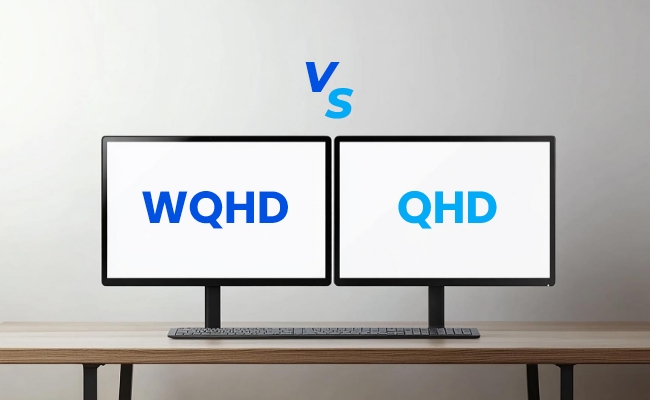
When hunting for a new monitor or TV, you might encounter technical terms such as “WQHD” and “QHD” to describe the display resolution. But what do these abbreviations actually mean and how do QHD vs WQHD displays differ, anyway?
In this article, we will explore the difference between WQHD vs QHD that can help you understand the difference better — and find out which display technology is right for you!
What is WQHD?
WQHD is an acronym for Wide Quad High Definition. This is a term that refers to 2560 x 1440 pixel resolution displays. It is also often referred to as 1440p in the market.
WQHD screens have a 16:9 aspect ratio which is wider than that of Full HD 1080p displays. The increased number of pixels displayed across the screen gives WQHD monitors and TVs the ability to reproduce fine detail as well as sharpness that is visible in resolution potential almost twice that of the 1080p Full HD format.
What is QHD?
QHD stands for Quad High Definition as its full name. QHD displays use 2560 x 1440 pixels as their resolution point comparable to WQHD devices.
So WQHD and QHD monitors both share identical 2560 x 1440 resolutions. Some manufacturers use QHD as a marketing term to describe this resolution specification. Now, moving forward let’s take a look at what is WQHD vs QHD difference.
WQHD vs QHD: What’s the Difference?
WQHD and QHD describe the same pixel resolution of 2560 x 1440. Then, what exactly is the difference between QHD and WQHD?
A screen with QHD resolution shows content at a resolution level that consists of four times the amount in standard HD (720p). WQHD, on the other hand, stands for Wide Quad High Definition.
The pixel count and screen clarity within QHD and WQHD displays remain identical when you observe them. The term WQHD serves as the primary specification reference for displays yet QHD tends to be favored by smartphone along with tablet manufacturers.
QHD vs. WQHD: Comparison Table
The table demonstrates that WQHD vs QHD displays identical resolution specifications and display characteristics. Here is a quick overview of the difference between WQHD and QHD:
WQHD vs. QHD: Where to Use?
Given that WQHD and QHD ultimately offer the very same resolution and display experience, they are equally well-suited for various use cases like gaming, content creation, and general usage:
QHD vs. WQHD monitor
QHD and WQHD monitors serve as optimal choices for display purposes because they provide better screen size and sharper image quality than 1080p while requiring less graphics processing power than 4K. QHD and WQHD monitor deliver equivalent visual quality when they have identical resolution and pixel density.
The decision between QHD and WQHD monitors should be made based on additional specifications such as refresh rates, response times, and panel types rather than resolution terminology.
QHD vs. WQHD for gaming
When gaming, WQHD, and QHD monitors allow boosting up details beyond 1080p while still achieving smooth frame rates that 4K may struggle with on mid-range graphics cards.
So both resolutions provide an ideal middle ground, letting you turn up eye candy and retain high FPS counts in games. The gaming experience will be similar since QHD vs WQHD offers the same number of pixels.
WQHD vs. QHD for content creation
Video editing programs along with 3D modeling software require WQHD and QHD displays because their enhanced pixel counts provide clear visualization of timelines assets and tools.
The addition of QHD or WQHD resolution provides better precision to users who work on photo retouching and compositing alongside animation and other content creation tasks beyond 1080p resolution.
Is WQHD Better than QHD?
Since WQHD and QHD share the exact same 2560 x 1440 resolution spec, one is not inherently "better" than the other in terms of pure image quality. However, let's compare some general pros and cons when evaluating WQHD vs QHD:
WQHD: Pros and Cons
Pros:
- Sharper clarity versus 1080p
- Wider 16:9 aspect ratio better for movies
- More desktop space for multitasking
- Better gaming visuals than 1080p
Cons:
- Requires more GPU power than 1080p
- Not as sharp as 4K (3840 x 2160)
QHD: Pros and Cons
Pros:
- Sharper clarity versus 1080p
- Matches WQHD visual quality
- Ideal middle ground between 1080p and 4K
- Enhanced gaming graphics over 1080p
Cons:
- Demanding on GPUs than 1080p
- Not as sharp as a 4K (3840 x 2160) resolution
How to Choose Between WQHD and QHD?
Avoid becoming confused by attempts to compare WQHD and QHD resolution and quality when assessing a new monitor or TV that lists these specifications in its model name and specs sheet. Throughout this guide, we saw that QHD and WQHD deliver the same 2560 x 1440 resolution resulting in equivalent display sharpness.
Instead, base your buying decision on other display characteristics:
- Refresh rates: The gaming and video experience improves with increased refresh rates. Seek displays with refresh rates exceeding 144Hz.
- Response times: Seek response times below 1 ms to achieve superior motion clarity.
- Panel types: Examine TN versus VA versus IPS panel differences in color reproduction, contrast ratios, and viewing angles.
- Adaptive sync: The presence of G-Sync or FreeSync technology helps to achieve smoother frame delivery while reducing screen tearing during gaming sessions.
- HDR capabilities: Brighter panels achieve enhanced high dynamic range performance.
- Connectivity: Examine contemporary input choices such as DisplayPort and HDMI 2. 1 for higher bandwidth to leverage higher resolutions and frame rates.
FAQs
Is WQHD better than QHD?
WQHD and QHD provide identical visual quality because they both use a resolution of 2560 x 1440. WQHD maintains the same level of sharpness and clarity as QHD.
Is WQHD equal to 4K?
WQHD (2560 x 1440) does not match the resolution of 4K because 4K displays use 3840 x 2160 total pixels. 4K monitors deliver superior detail quality than both WQHD and QHD display options. 4K requires hardware components that are more advanced than WQHD for attaining fluent framerates when using video and gaming applications.
Is WQHD good for gaming?
The gaming performance of WQHD displays reaches exceptional levels. The 2560 x 1440 resolution permits users to elevate their graphical output and image precision beyond the Full HD 1080p benchmarks. WQHD resolution maintains sharp textures and visual details while delivering smooth frame rates and playability which 4K demands make difficult. Equivalent QHD displays follow the same principles.
Conclusion
Both WQHD and QHD use the same resolution of 2560 x 1440 which provides better image clarity and display area than Full HD 1080p.
Focus on other specifications instead of comparing WQHD with QHD during your evaluation process. Only examine refresh rates and response times along with connectivity features since these determine your display performance requirements. Which display do you currently use? Share with everyone in the comments section below.
Search
Subscribe for the Latest Updates
Security insights & offers right into your inbox