
Turret Security Cameras — Meaning, Comparison, Recommendations & Installation
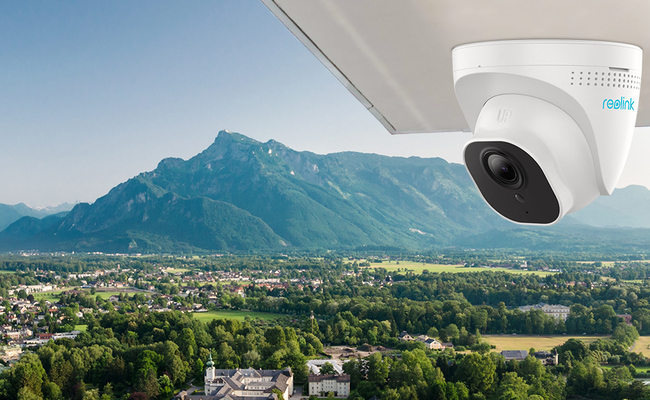
Turret security cameras, often called "eyeball" or flat-faced dome cameras, have rapidly become the standard recommendation for modern outdoor and indoor security monitoring. By eliminating the outer glass housing of a dome while preserving a low-profile, vandal-resistant ball-and-socket design, turret cameras deliver unparalleled physical flexibility and exceptional image reliability right where it matters most.
Whether you are looking for the best turret security camera, configuring a comprehensive home security NVR, or simply trying to eliminate recurring false notifications on your phone, this guide breaks down exactly how turret technology works, what quality standards to look for, and how to select the right configuration for your specific scenario.
- What Is a Turret Security Camera?
- Why Choose a Turret Camera for Home & Business Surveillance?
- 5 Key Features to Look for in the Best Turret Camera
- 3 Best Turret Security Cameras for Different Scenarios
- Turret Security Cameras vs. Other Shapes
- How to Install Turret IP Security Cameras?
- Buyer's Decision Table for Turret Cameras
- Real-World User Insight: Why Homeowners Choose Turret Cameras
- FAQs
- Conclusion
What Is a Turret Security Camera?
A turret security camera (also called an eyeball or flat-faced dome camera) uses a ball-and-socket design that allows the lens to swivel freely within its mount. It provides the easy angle adjustment of a bullet camera combined with the discrete, vandal-resistant benefits of a dome camera, but without the glare or reflection issues.
Because of their compact, rounded structure, it is physically difficult to add external Wi-Fi antennas to their chassis without compromising their weatherproofing. As a result, the vast majority of indoor and outdoor turret cameras utilize Power over Ethernet (PoE), which uses a single network cable to deliver both high-speed data and stable power
Why Choose a Turret Camera for Home & Business Surveillance?
When designing a security system for a home or business, choosing the right physical form factor is just as important as selecting the right resolution. Turret cameras have rapidly become the industry favorite for outdoor installations like doorways, driveways, soffits, and eaves.
They provide the perfect balance of easy angle adjustment and low-profile durability.
1. No Lens Glare or Infrared Ring Reflection
One of the biggest flaws with traditional dome security cameras is the glass dome housing that covers the lens. Over time, dust, fingerprints, or rainwater on the plastic dome can cause the camera's infrared (IR) light to reflect directly back into the lens at night, resulting in a foggy, unreadable image.
Because turret cameras feature a flat, exposed lens face without a outer glass shell, they are completely free from infrared glare and light reflections, ensuring perfectly clear night footage.
2. Fewer False Alerts and Reduced Maintenance
Bullet-style cameras are notorious for attracting pests. Their long, protruding housings provide the perfect sheltered frame for spiders to spin webs directly across the camera lens. At night, these webs catch the camera's IR light, causing a blinding glare and triggering constant, frustrating false motion alerts on your phone.
The rounded, sleek, and flat-faced design of a turret camera leaves nowhere for spiders to anchor their webs, significantly reducing maintenance and false alarms.
3. Highly Adaptable Ball-and-Socket Design
Turret cameras feature a unique "eyeball" design where the camera sphere sits inside a mounting socket. Once the base is securely screwed to a wall, ceiling, or eave, you can freely swivel, tilt, and rotate the inner camera ball by hand to point exactly where you need it. This makes installation and post-mounting adjustments incredibly easy compared to complex dome cameras.
4. Low-Profile and Non-Intrusive Aesthetics
While bullet cameras stick out aggressively—acting as a highly visible deterrent—they can often look too industrial or hostile on a residential home or a cozy retail storefront. Turret cameras offer a tight, low-profile aesthetic that blends seamlessly into the architecture of a building. They look clean and professional without making guests or customers feel like they are being aggressively watched.
5. Superior Night Vision
Many premium turret cameras utilize advanced EXIR (Extended Infrared) technology rather than traditional circular IR LEDs. Standard infrared can create a "hotspot" effect, where the center of the video is overexposed and bright white, while the corners remain pitch black. EXIR rectangular lenses spread the infrared light evenly across the entire widescreen frame, maximizing illumination efficiency and extending the camera's effective viewing range in complete darkness.
5 Key Features to Look for in the Best Turret Camera
1. Resolution
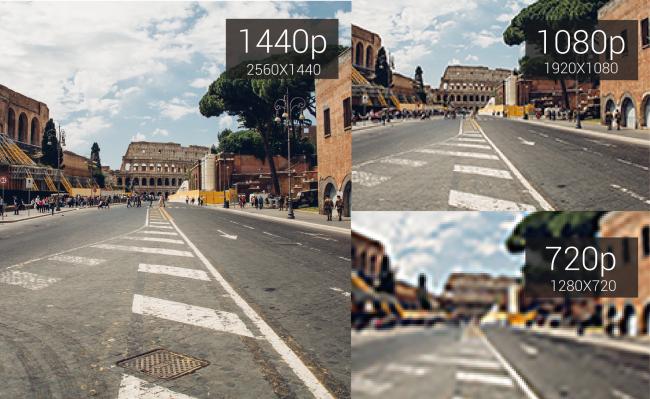
Higher video resolution dictates how much detail you can capture. For expansive outdoor driveways or business store entrances, UHD resolution like 4K is necessary to identify details
A raw specification number like 4K means the camera captures roughly 8 million pixels per frame. In a real-world scenario, this allows you to digitally zoom into a recorded video clip of an incident at your front door at 2 AM without the image breaking apart into blurry, pixelated squares.
While 1080p works well enough for general indoor rooms or tight, enclosed spaces , an outdoor turret should feature a minimum of 5MP or native 4K to capture clear details at a distance.
2. High-Aperture Color Night Vision
The physical construction of the camera lens determines its ability to monitor your property after dark without producing grainy, unreadable video frames.
In real low-light testing, lenses with a wider physical aperture—such as f/1.0 or f/1.6—consistently outperform standard f/2.0 or f/2.4 lenses in dimly lit garages, yards, and stairwells.
Premium turret cameras pair a large aperture lens with an advanced ambient light sensor to deliver full-color night footage in near-total darkness, typically down to an ultra-sensitive 0.001 lux.
Standard infrared (IR) cameras remain highly affordable and work in total blackness, but they only yield black-and-white video shapes.
3. AI Alerts and Smart Detection
Basic, legacy motion sensors rely on simple pixel changes or heat tracking, which frequently trigger dozens of annoying false alerts on your phone every day.
Basic motion detection triggers on almost everything—including falling leaves, passing animals, wind-blown tree shadows, or heavy rain.
Look for turret cameras that feature built-in, edge-based AI. This processing power allows the camera to accurately recognize specific physical profiles, meaning it will only notify your smartphone when an actual person, vehicle, or package crosses into its frame.
4. Subscription-Free Local Storage Integration
Standard cloud-dependent security systems frequently lock your recorded video history behind expensive monthly subscription fees.
Storing your data in the cloud requires an active internet upload stream, which can fail if your Wi-Fi suffers a dropped signal or dead zone.
Opt for turret cameras built around a local storage design framework, using an on-board microSD card slot, an external network attached storage (NAS) drive, or a dedicated Network Video Recorder (NVR). Local storage offers complete data privacy, preserves full video quality, and ensures continuous 24/7 recording with absolutely no monthly platform fees.
5. Weatherproofing Enclosures (IP65 Rating or Higher)
Because turret cameras are frequently installed outdoors along roof eaves, soffits, and exposed walls, they must feature a robust physical weather sealing certification.
An IP65-rated housing can safely handle normal rainfall and light garden hose splashes. However, an IP66-certified turret camera is built to survive heavy, direct water downpours and high-pressure storms without moisture penetrating the housing or causing lens condensation over time.
Always verify that an outdoor turret carries a verified IP65 or higher rating to withstand freezing winter drops and extreme summer heat. Indoor-only turret variants lack these durable physical seals and should never be deployed outside.
3 Best Turret Security Cameras for Different Scenarios
1. Reolink RLC-843A — Best for Heavy-Duty Vandal Protection & Zoom (Indoor/Outdoor)
The Reolink RLC-843A is an armored, ultra-high-definition PoE turret-style dome camera engineered to withstand physical impacts and harsh weather while delivering crystal-clear 4K surveillance.
Your Problem: High-traffic entryways, low roof overhangs, and commercial storefronts leave security cameras highly vulnerable to vandalism. If an outdoor camera sits within arm's reach, standard plastic housings can be easily smashed, blinded, or physically twisted out of alignment by an intruder, leaving your property completely blind when you need it most.
Built with a heavy-duty metal casing and a reinforced clear dome, the RLC-843A carries a certified IK10 vandal-proof rating.
Protected beneath its armored shell is a premium 4K 8MP Ultra HD image sensor matched with a 5X motorized optical varifocal lens. Unlike standard cameras that rely on digital zoom (which crops into an image and degrades the video into blurry pixels), the RLC-843A's optical zoom adjusts the physical lenses inside the dome. This allows you to completely narrow your field of view via the app to lock onto crisp, legally actionable facial details or distant license plates at a distance without any pixel distortion.
The camera also features an IP67 waterproof rating, continuous PoE plug-and-play installation, on-device AI person/vehicle/pet detection to cut out false alerts, and a built-in siren to actively deter unwelcome visitors.
If you need a zero-compromise security solution for an exposed alleyway, vulnerable front door entrance, storefront, or low-hanging porch ceiling, the Reolink RLC-843A provides unparalleled physical durability and adjustable long-range clarity.
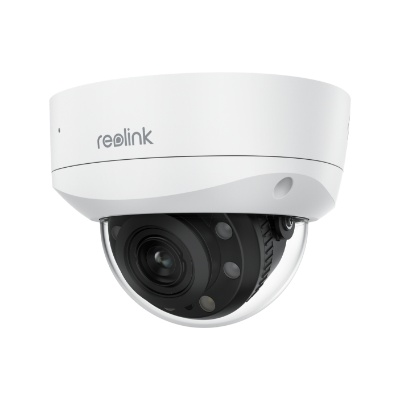
Smart 4K PoE IK10 Camera with 5X Optical Zoom
IK10 Vandal-Proof, 4K 8MP Ultra HD, 5X Optical Zoom, Color Night Vision
2. Reolink RLC-833A — Best Outdoor Turret with Optical Zoom
The RLC-833A is designed for high-traffic perimeters or driveways where you need to zoom in on distant details—like license plates—without losing image quality.
Your Problem: When an incident happens at the edge of your property, standard fixed-lens cameras only allow for "digital zoom," which simply stretches the video frame and results in a blurry, pixelated mess.
This heavy-duty 4K Ultra HD camera is built with a motorized varifocal lens that supports 3X true optical zoom. It physically adjusts the glass elements to bring distant objects closer while preserving perfect 8MP clarity. It also comes equipped with smart AI filtering (people, vehicles, and pets), two-way audio, and a proactive siren-and-spotlight defense system.
For complex exterior layouts where distance clarity is non-negotiable, the Reolink RLC-833A provides the premium optical flexibility required to track key entry points with absolute precision.
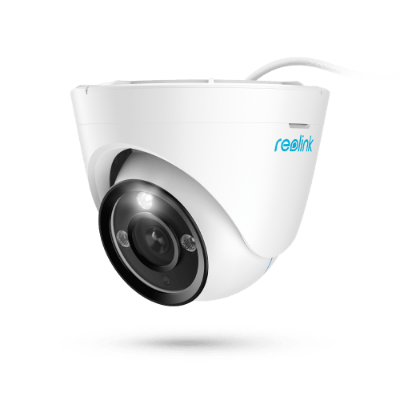
4K UHD PoE Turret IP Camera
4K 8MP Ultra HD, 3X Optical Zoom, Person/Vehicle/Pet Detection, Spotlight Night Vision.
3. Reolink RLC-520A — Best Budget-Friendly Turret Camera
The RLC-520A offers a highly reliable, no-nonsense entry point into smart home security, delivering clear 5MP Super HD resolution and AI detection at a fraction of the cost of premium models.
Your Problem: Outfitting an entire property with security cameras can quickly become expensive, but settling for cheap budget cameras often means dealing with constant false alarms caused by rain, wind, or shadows.
Despite its accessible price tag, this camera features exceptional 5MP (2560 x 1920) resolution and advanced on-board AI processing. It accurately identifies actual people and vehicles, sending you real-time notifications only when an actual threat is detected. It includes a built-in microphone for ambient audio recording and 18 powerful infrared LEDs that pierce through 100 feet of absolute darkness.
You can watch the below video about RLC-520 turret camera installation and day and night image quality. The video is shared by a Reolink user.
If you are a DIY enthusiast looking to set up a comprehensive local storage system on a budget, the Reolink RLC-520A provides top-tier essential features without forcing you to pay a monthly subscription fee.
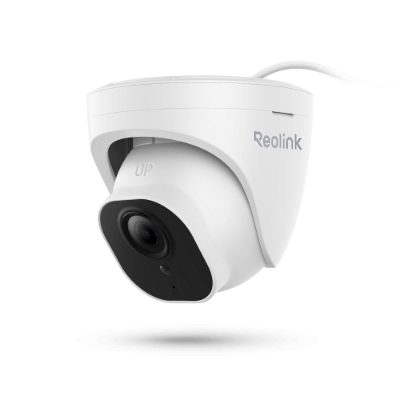
PoE IP Camera with Person/Vehicle Detection
5MP Super HD; Smart Motion Detection, Outdoor/Indoor Protection; 100ft Night Vision; Audio Recording; Time Lapse, Remote Access & Control.
Turret Security Cameras vs. Other Shapes
How to Install Turret IP Security Cameras?
Installing a turret camera is a straightforward process because its unique ball-and-socket design allows it to be mounted in almost any orientation—including flat ceilings, vertical walls, or slanted eaves. Because it uses a single cable for both power and data, you do not need a professional electrician to complete the setup.
Step 1: Map Out Your Mounting Location
-
Mount high for protection: Always install your outdoor turret camera at least 9 to 10 feet above the ground. This keeps it out of arm's reach from vandals or intruders while maximizing its downward viewing angle.
-
Prioritize sheltered spots: While high-quality turret cameras are weather-resistant, placing them under a soffit, eave, or porch overhang shields the lens from direct rainfall and preserves pristine image clarity over time.
-
Test the Wi-Fi or line run: Before drilling any holes, temporarily position the camera at the intended spot to ensure your Ethernet cable can reach or your Wi-Fi signal is strong enough to avoid recording gaps.
Step 2: Route the Single Ethernet Cable
-
Choose compatible PoE models: PoE turret cameras require only a single Cat5e or Cat6 Ethernet cable to connect the camera directly to your home Network Video Recorder (NVR), a PoE switch, or a PoE-enabled router. This single wire handles both data transmission and electricity simultaneously.
-
Handle long-distance drops: If your turret camera is located at a remote perimeter far from your central router or NVR, you can easily add an Ethernet extender or a PoE switch to safely extend the connection distance beyond the standard 300-foot limit without sacrificing video quality.
Step 3: Secure the Base and Position the "Eyeball"
-
Mount the base bracket: Use the manufacturer's mounting template to drill pilot holes into your wall or ceiling. Secure the heavy-duty mounting base using the included screws.
-
Adjust the camera angle by hand: Unlike rigid dome cameras that require complex internal unscrewing, a turret camera allows you to freely swivel, tilt, and rotate the inner camera sphere within its socket base. Point the lens directly toward your primary target zone.
-
Lock the collar ring: Once the camera is aimed perfectly, hand-tighten the outer locking collar ring to secure the ball socket firmly in place so wind or vibration cannot shift the lens out of alignment.
Buyer's Decision Table for Turret Cameras
Real-World User Insight: Why Homeowners Choose Turret Cameras
In a Reddit discussion comparing bullet, dome, and turret cameras, users said turret cameras are a practical choice for driveways, garages, and outdoor walls because they are easier to angle, less likely to suffer from dome glare, and can offer better durability when built with a metal housing.
One homeowner was trying to cover recessed garage areas and a driveway, where blind spots and night footage quality were the main concerns. Users emphasized that a fixed turret camera can be more reliable than a PTZ camera for these areas because it always watches the same key spot instead of possibly facing the wrong direction.
Key Takeaway: Turret cameras work well for homes and businesses that need stable 24/7 coverage, flexible mounting, reduced glare, and reliable outdoor monitoring around entrances, driveways, storefronts, and building corners.
FAQs
Are turret cameras good?
Yes. Turret cameras are a good choice for both home and business security because they are easy to adjust, suitable for outdoor use, and less likely to suffer from glare than dome cameras. They work especially well for driveways, entrances, garages, storefronts, and building corners where you need a fixed camera angle and clear day-and-night monitoring.
Which is better turret or dome cameras?
It depends on where you install the camera. Turret cameras are often better for outdoor walls, driveways, and low-light areas because they are easier to angle and usually have fewer reflection or glare issues. Dome cameras are better for indoor ceilings, offices, stores, and places where you want a more discreet, tamper-resistant design.
Do turret cameras have audio recording?
Some turret cameras have audio recording, but not all models do. If audio is important, check whether the camera has a built-in microphone and whether local laws allow audio recording in your area. For privacy and compliance, many users place audio-enabled cameras at entrances, yards, or business areas where recording is clearly disclosed.
Conclusion
Securing a perimeter effectively requires choosing a non-intrusive camera layout that actively minimizes physical maintenance while preserving forensic night clarity. Turret cameras solve the primary vulnerabilities of traditional housings, making them the most dependable physical form factor for continuous, year-round property protection.
If you have any questions about planning your specific turret network layout, routing your PoE lines, or maximizing your camera's night vision range, please feel free to leave a comment and share your thoughts below!
Search
Subscribe for the Latest Updates
Security insights & offers right into your inbox