
Best Infrared Security Cameras: Complete Buying Guide

Infrared security cameras use infrared (IR) light to capture clear video in low-light conditions or complete darkness. When visible light is insufficient, built-in IR LEDs illuminate the monitored area with infrared light, allowing the camera to record black-and-white footage without relying on normal lighting.
This guide explains how infrared security cameras work, how they compare with other night vision cameras, and what to consider when choosing the right IR camera for your home or property.
Key Takeaways:
- Infrared cameras use IR LEDs to capture black-and-white video in complete darkness.
- 850nm IR offers stronger illumination, while 940nm reduces visible red glow.
- Choose the IR range based on the monitoring distance and area.
- Choose colour night vision instead if capturing colour details at night is more important.
What Are Infrared Security Cameras?
Infrared security cameras, also called IR CCTV cameras, are surveillance cameras that use infrared light to capture clear video in low-light conditions or complete darkness.
IR security cameras typically have built-in infrared LEDs around or near the camera lens. When the surrounding light becomes too low, these LEDs illuminate the monitored area with infrared light, allowing the camera to see objects that would otherwise be difficult or impossible to capture in the dark. Some IR LEDs may produce a faint red glow at night.
Infrared cameras are often grouped under the broader category of night vision security cameras. Unlike cameras that rely mainly on available visible light, IR cameras can continue monitoring even when there is little or no ambient light.
Infrared is not the only type of night vision available. Security cameras may also use colour night vision or low-light technologies. Learn more in our guide to night vision security cameras.

What to Look for in Infrared Security Cameras
When choosing an infrared security camera, focus on how well it can capture useful details at night rather than simply whether it has IR LEDs. Consider the following factors:
IR Night Vision Range
Check the camera's rated infrared range and match it to the monitoring area. Around 10–15 m (33–50 ft) may be enough for porches, entrances, and small indoor spaces, while driveways, large gardens, and commercial areas may benefit from 30 m (100 ft) or longer IR coverage.
Keep in mind that the usable range can also be affected by nearby walls, reflective surfaces, weather, and the camera's installation angle.
Infrared Wavelength
Most infrared security cameras use either 850nm or 940nm IR LEDs.
- 850nm: Generally provides stronger illumination and a longer effective range, but the LEDs may show a faint red glow at night.
- 940nm: Produces little or no visible red glow, but typically provides a shorter illumination range than 850nm.
For most outdoor security applications, 850nm IR is the more common choice.
Resolution
Choose a resolution that provides enough detail for the monitoring distance. 2K/4MP cameras can be sufficient for general home monitoring, while 4K/8MP or higher can provide more detail for driveways, entrances, vehicles, and larger outdoor areas.
However, resolution alone does not determine infrared image quality. Sensor size, lens aperture, IR illumination, and exposure settings also affect how much detail is visible at night.
Field of View
Field of view determines how much of the area the camera can cover. A camera with around 90°–110° horizontal FOV works well for focused areas such as entrances and driveways, while cameras with 140° or wider views can cover larger spaces with fewer blind spots.
For very wide areas, dual-lens cameras can provide views approaching 180°, while PTZ cameras can monitor different directions through pan and tilt movement.
Smart Detection
Look for cameras that can distinguish people, vehicles, and animals from general motion. This helps reduce unnecessary alerts caused by branches, insects, shadows, or other movement.
For entrances and driveways, person and vehicle detection are particularly useful, while animal detection is more relevant for gardens, farms, or properties where pets and wildlife are common.
Weather Resistance
For outdoor use, check the camera's IP rating. IP66 cameras are generally protected against dust and strong water jets, while IP67 models provide additional protection against temporary water immersion.
Also check the operating temperature range if the camera will be installed in areas with very hot summers or freezing winters.
Infrared Security Cameras vs. Colour Night Vision Cameras
Infrared security cameras and colour night vision cameras use different methods to capture footage after dark. Infrared cameras use IR LEDs and typically produce black-and-white images in darkness, while colour night vision cameras either use visible spotlights or a larger image sensor and wider aperture to capture colour in low-light conditions.
Colour night vision can generally be divided into spotlight colour night vision and full-colour low-light night vision.
Infrared night vision is suitable for locations that may become completely dark and where visible illumination is not desired. Spotlight colour night vision is useful when colour details, such as clothing or vehicle colour, need to be captured even in very dark conditions. Full-colour night vision is better suited to locations with some ambient light, using a larger sensor and wider aperture to capture more light and retain colour.
Best Infrared Security Cameras Recommendation
Best for Comprehensive Coverage – Reolink OMVI 3i
Reolink OMVI 3i combines a fixed wide-angle lens with a PT lens to monitor the overall scene while following moving targets for closer details. Its infrared night vision also allows it to continue monitoring areas with little or no visible light.
Best for: Driveways, front yards, entrances, parking areas, and other locations where both wide-area coverage and target tracking are needed.
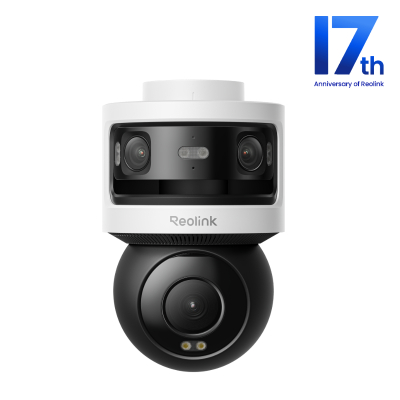
All-in-one Triple-Lens 180° Panoramic Pan-Tilt Security Camera
10MP Dual-Lens 180° View, 4K 360° Full Coverage, SyncTrack with auto framing & auto tracking, Local Storage (No Monthly Fees), Local AI Video Search.
Best for 180° Coverage – Reolink Duo 3 WiFi
Reolink Duo 3 WiFi combines two lenses to provide a 180° panoramic view, making it suitable for monitoring wide areas with fewer blind spots. It supports infrared night vision for monitoring in darkness, along with spotlight colour night vision when colour details are needed.
Best for: Wide driveways, backyards, building entrances, and other broad outdoor areas.
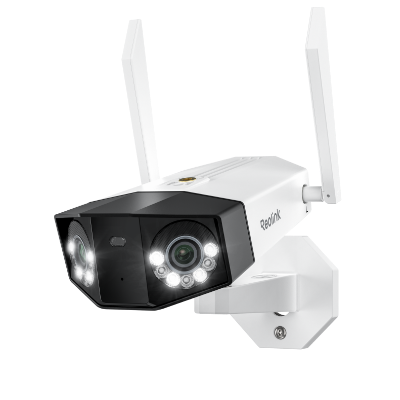
Groundbreaking 16MP Dual-Lens WiFi Camera
16MP UHD, Dual-Lens, Motion Track, 180° Wide Viewing Angle, Plug-In WiFi, Color Night Vision.
FAQs
Can You Place IR Security Cameras Behind Glass/Windows?
When an infrared security camera is placed behind glass, the infrared reflection could occur, resulting in inferior pictures.
The best tip for you is to NEVER place the infrared security camera systems behind any glass. And you may choose an outdoor IR surveillance cameras so that it can brave the outside elements.
Also, don’t mount the wireless infrared security cameras too close to a wall, ceiling, or in between two walls, otherwise the camera's IR LEDs will be obstructed and cause infrared reflection.
How Do I Disable or Get Rid of the Red Glow on an Infrared Security Camera?
The faint red glow on many infrared security cameras comes from 850nm IR LEDs used to provide night vision. If your camera supports it, you can turn off the built-in IR LEDs through the camera's app or PC client.
Avoid covering the IR LEDs with tape, as this can reduce or disable the camera's infrared night vision. If you need night vision without the built-in red glow, you can disable the camera's IR LEDs and use a compatible external infrared illuminator instead.
What are the disadvantages of IR cameras?
Infrared security cameras work well in darkness, but they have several limitations:
- Black-and-white night footage: IR night vision usually cannot capture colour details such as clothing or vehicle colour.
- IR reflection: Glass, walls, ceilings, or other reflective surfaces close to the camera can reflect infrared light back into the lens and cause glare or overexposure.
- Reduced detail at longer distances: Image clarity generally decreases as objects move beyond the camera's effective IR illumination range.
- Possible red glow: Common 850nm IR LEDs may produce a faint red glow that can be visible at night.
- Affected by weather and objects: Rain, fog, snow, insects, and spider webs near the lens can reflect IR light and reduce nighttime image quality.
Can infrared cameras see at night?
Yes. Infrared cameras can see at night and even in complete darkness by using built-in IR LEDs to illuminate the area with infrared light. The camera sensor captures the reflected infrared light and typically produces a black-and-white image when there is insufficient visible light.
Conclusion
Infrared security cameras provide reliable nighttime monitoring by using IR light to capture footage even in complete darkness. They are especially useful for entrances, backyards, driveways, warehouses, and other areas with little or no ambient lighting.
When choosing an IR security camera, consider its night vision range, resolution, field of view, IR wavelength, smart detection, and installation environment. If capturing colour details at night is more important, a spotlight or full-colour low-light camera may be a better alternative.
Search
Subscribe for the Latest Updates
Security insights & offers right into your inbox