
7 Worst Types of Theft Explained & How to Stay Safe

Not all theft is the same, and the difference matters. From petty larceny and burglary to identity theft and embezzlement, each type of theft carries different penalties, risks, and prevention strategies. Understanding those differences matters because the type of theft affects the charge, the punishment, and what victims should do next.
By the end of this guide, you’ll understand the 7 major types of theft, how serious each offense is, and what practical steps help reduce your risk. You’ll also see why visible security measures remain one of the strongest deterrents against opportunistic stealing.
Note: Every 26 seconds, a break-in case occurs somewhere in the United States, making theft prevention and quick response more important than many people realize.
What is Theft, Legally?
The legal definition of stealing is intentionally taking someone else’s property without permission and with the intent to permanently deprive them of it. In most U.S. states, theft and larceny are used interchangeably under criminal law.
Stealing is a crime in all 50 states, even when the value of the property seems small. Theft charges can range from minor misdemeanors to serious felony offenses depending on the value of the property, whether force was used, and how the crime occurred.
A simple example makes the elements of theft easier to understand. If someone finds a wallet in a coffee shop, notices the owner’s ID inside, and still keeps the cash while throwing the wallet away, prosecutors can argue all core elements exist:
- Taking property
- Property belonging to another person
- Intent to permanently keep it. That intent is what separates theft from an honest mistake.
Note: some states divide theft crimes into multiple categories like larceny, unlawful taking, or criminal conversion, but the underlying principle stays largely the same.
The 7 Worst Types of Theft
Petty Theft / Petty Larceny
Petty theft involves stealing property below a state’s felony threshold, usually between $500 and $1,000 depending on local law. Petty larceny remains one of the most common examples of petty crimes across the United States.
A large percentage of petty theft cases are opportunistic. Porch package theft, shoplifting, and stealing an unlocked bicycle all happen because the target looked easy and low-risk. The property value may seem small, but a conviction can still create a criminal record that affects employment and housing opportunities later.
Many people wrongly assume “petty” means harmless. Retailers and prosecutors often pursue repeat offenders aggressively because smaller theft incidents tend to escalate over time.
Grand Theft / Grand Larceny
Grand theft applies when stolen property exceeds a state’s felony threshold, commonly $950, $1,000, or $1,500 depending on jurisdiction. Grand larceny is the older legal term still used in states like New York.
The core difference between petty theft and grand theft is value. Stealing a $100 phone charger may result in misdemeanor theft charges. Stealing a $35,000 vehicle or expensive jewelry collection pushes the crime into felony territory quickly.
High-value property theft often targets homes with predictable routines or weak exterior visibility. Luxury electronics visible through windows, unsecured garages, and poorly lit driveways create attractive opportunities for organized theft crews.
Burglary
Burglary occurs when someone unlawfully enters a structure intending to commit a crime inside. The crime inside does not need to be completed for burglary charges to apply.
That distinction surprises many victims. A person forcing open a back door at 2 a.m. while carrying burglary tools may still face burglary charges even if nothing was ultimately stolen.
Residential burglary carries heavier penalties because homes involve personal safety risks. Federal crime data also treats burglary separately from larceny-theft because unlawful entry dramatically increases the danger level.
Pro Tip: The Reolink TrackMix works well as a burglary deterrent because its dual-lens zoom tracking, spotlight system, and audible siren force intruders into visibility immediately. Criminals tend to abandon easy-entry opportunities once they realize movement is actively being tracked and recorded.
Most burglars look for low-friction entry points:
- Unlocked garages
- Dark side entrances
- Hidden back doors
- Sliding doors without reinforcement
Reducing concealment matters almost as much as locking the door itself.
Robbery
Robbery involves taking property directly from another person through force, intimidation, or threats. Unlike other theft crimes, robbery always involves confrontation with the victim present.
That is why robbery qualifies as a violent felony rather than a simple property offense. Armed robbery charges become significantly more severe because the presence of a weapon increases the risk of bodily harm or death.
Carjacking falls under robbery because the victim remains present during the theft of the vehicle. Bank robbery statutes also carry some of the harshest theft-related penalties in federal criminal law.
Street robberies often happen fast and close-range. Parking lots, ATM areas, poorly lit transit stops, and isolated sidewalks remain common targets because criminals rely heavily on surprise and intimidation.
Motor Vehicle Theft
Motor vehicle theft involves taking someone else’s vehicle without permission and with intent to deprive them of ownership permanently. Most states prosecute vehicle theft as a felony due to the property value involved.
Modern vehicle theft increasingly relies on technology instead of forced entry. Relay attacks on keyless entry systems allow thieves to amplify signals from key fobs inside homes and unlock vehicles without touching the owner’s keys physically.
Driveway surveillance has become much more important because insurance claims supported by footage tend to move faster and face fewer disputes. Clear timestamps, vehicle direction, and suspect descriptions help investigators immediately.
Note: joyriding may be charged differently from theft in some states if prosecutors cannot prove intent to permanently keep the vehicle.
Identity Theft
Identity theft involves using another person’s private information without permission for financial gain or fraud. Social Security numbers, banking credentials, and login details remain the most commonly targeted data points.
Identity theft rarely begins with dramatic hacking scenes. Mail theft, stolen documents, phishing links, and compromised online accounts are far more common starting points.
Victims lose an average of over $1,100 per incident and often spend months repairing damaged credit records or disputing fraudulent activity. Synthetic identity fraud, which combines real and fake information together, has also become one of the fastest-growing financial crime categories in the United States.
Mail theft deserves special attention because physical stolen mail frequently leads directly to identity theft. Bank statements, tax forms, replacement credit cards, and medical paperwork all contain valuable personal information.
Embezzlement
Embezzlement happens when someone legally trusted with money or property abuses that access for personal gain. Employees, financial managers, trustees, and nonprofit administrators are common defendants in embezzlement cases.
The key distinction is lawful access. A cashier secretly diverting company deposits into a personal account commits embezzlement because the employee initially had authorized access to the funds.
Most embezzlement cases are not discovered through dramatic arrests. They are uncovered quietly during audits, accounting inconsistencies, or vendor payment reviews.
Small businesses and HOAs face elevated risk because financial responsibilities are often concentrated among a small number of people. Limited oversight creates opportunities for fraud to continue undetected for months or years.
What To Do If You're a Victim of Theft
The first few hours after theft matter more than most people realize. Fast documentation improves both police investigations and insurance claims significantly.
1: Document Everything Immediately
Photograph damaged entry points, missing property areas, vehicle locations, and anything disturbed during the incident. Save timestamps, receipts, serial numbers, account notifications, and surveillance footage immediately before files get overwritten.
2: File a Police Report
Police reports create an official record that insurance companies frequently require before processing claims. Even petty theft incidents should be reported because repeat offenses often establish broader crime patterns investigators track locally.
3: Notify Relevant Parties
Identity theft victims should contact banks and credit bureaus immediately. Vehicle theft victims should notify insurers quickly because delayed reporting sometimes complicates coverage investigations.
4: Preserve Surveillance Footage
Home security footage often becomes the most valuable evidence in theft investigations. Save original video files instead of relying only on app playback clips, especially if timestamps or suspect vehicles appear clearly.
5: Consult a Local Attorney if Necessary
Repeat victimization, organized theft, or major financial losses may justify legal consultation. Attorneys can explain victim compensation options, restitution processes, and state-specific rights.
How to Protect Yourself From Theft
Most theft is opportunistic. Criminals usually target properties that appear easy, dark, distracted, or poorly monitored.
Exterior Lighting
Well-lit homes consistently attract less criminal activity than dark properties with concealed entry points. Motion-triggered floodlights also create psychological pressure because sudden visibility removes anonymity.
Visible Security Cameras
Visible surveillance cameras reduce opportunistic theft because criminals prefer low-risk environments. Cameras also provide evidence when deterrence fails, especially for package theft, driveway incidents, and burglary attempts.
Secure Entry Points
Reinforced strike plates, quality deadbolts, and smart garage security reduce forced-entry opportunities significantly. Sliding doors and side entrances deserve particular attention because they are frequently overlooked.
Mail Security
Mail theft remains one of the easiest gateways into identity theft. Locking mailboxes, daily collection routines, and digital billing reduce exposure considerably.
Neighborhood Awareness
Shared footage between neighbors helps identify repeat offenders faster. Community groups with active communication often detect suspicious patterns long before formal police alerts appear.
Reolink Elite Pro Floodlight PoE – Best for Burglary, Motor Vehicle Theft, Grand Theft, and Petty Larceny Prevention
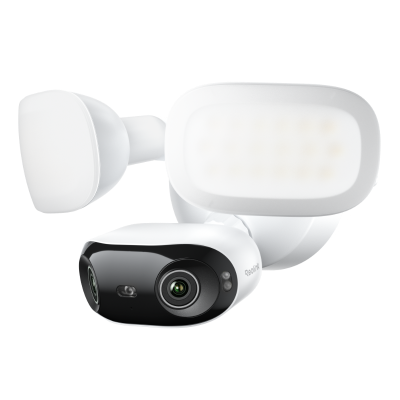
Smart 16MP PoE Dual-lens Floodlight Camera with 180° Panorama
16MP Ultra HD View, 180-Degree Ultra-Wide Panorama, 2800-Lumen Adjustable Floodlights, Adjustable Color Temperature (3000K–6500K).
The Reolink Elite Pro Floodlight PoE is now on sale! Don’t miss the Reolink Spring Sale 2026 for great deals on Reolink cameras!
The Reolink Elite Pro Floodlight PoE is a popular security camera among homeowners who are looking to stop trespassers and deter burglars before they ever reach the house. Its 16MP resolution and 180° panoramic field of view enables wide and sharp footages. Paired with dual adaptive floodlights rated at 2,800 lumens each and a powerful built-in 105dB sire, all trespassers will be sure to stay away from the property.
With PoE connectivity, the camera provides reliable, always-on recording for large outdoor areas such as front yards, wide driveways, and poorly lit side passages where theft often starts. Unlike conventional passive cameras, this active deterrence system uses intelligent perimeter detection to activate bright lights and audible warnings the instant an intrusion is detected.
Its greatest strength in theft prevention lies in its psychological deterrence and complete coverage. The combination of ultra-high-resolution panoramic video and intense illumination removes dark hiding spots, clearly documents property boundaries, and compels any intruders to retreat before they can approach the home.
Reolink Video Doorbell PoE– Best for Petty Theft and Identity Theft

Smart 5MP Video Doorbell with Chime
5MP Super HD, Person Detection, Power over Ethernet, 180° Diagonal Viewing Angle, Two-Way Audio, High-Quality Night Vision.
The Reolink Video Doorbell PoE is well suited for homeowners who want stronger protection against package theft and mail related crimes. It records sharp 2K+ (5MP) video with a wide, head to toe view, making it easier to see faces, packages, and activity right at your door. Built in person and package detection, along with responsive two way audio, adds another layer of awareness and control.
Because it uses power over ethernet (PoE), the doorbell supports stable, continuous recording. This makes it more ideal than battery-powered models that might miss unpredictable theft events happening at the front doors, porches, and mailbox areas due to battery power drain.
What truly sets it apart for porch security is the combination of customizable detection zones and consistently clear footage. Always on, high resolution video helps capture critical details such as facial features, delivery labels, and exact movement timelines. These are critical evidence details that slower, motion only doorbells often fail to record when it matters most.
Reolink RLK8-1200D4-A – Best for Grand/Petty Theft, Burglary, and Motor Vehicle Theft Prevention
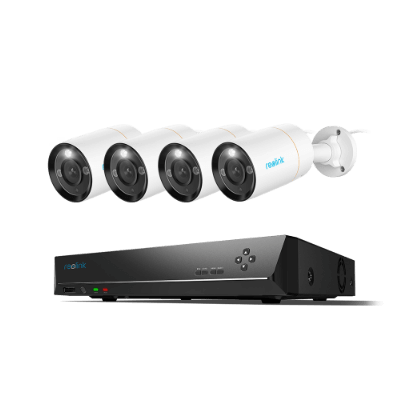
12MP 8-Channel PoE Surveillance Kit with Spotlights
4 pcs 12MP Ultra HD Security Cameras; 2TB HDD 8-Channel NVR for 24/7 Recording; Person/Vehicle Detection; Color Night Vision.
The RLK8-1200D4-A is a strong fit for homeowners who want broad theft prevention coverage without monthly subscription fees. The system includes four 12MP PoE dome cameras, an 8-channel NVR with a 2TB HDD, AI person/vehicle/pet detection, and color night vision.
PoE installation gives the RLK8-1200D4-A stable continuous recording for driveways, front entrances, garages, and side paths where theft activity commonly occurs. Unlike battery-only systems, the cameras maintain full-time coverage without recharge interruptions.
The biggest advantage for theft investigations is evidence quality. Clear 12MP footage combined with always-on recording helps capture license plates, suspect clothing, and movement timelines that lower-resolution systems often miss.
Reolink FE-P – Best for Physical Embezzlement and Internal Retail Theft
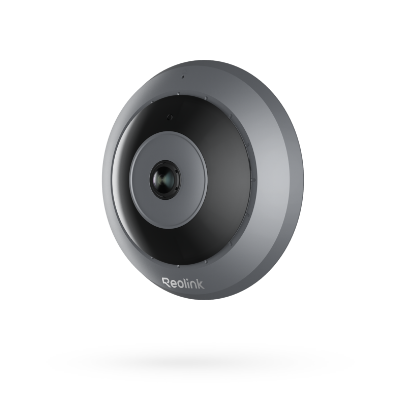
6MP PoE 360° Panoramic Indoor Fisheye Camera
6MP Super HD, 360° Panoramic View, Power over Ethernet, Multiple Display Modes, Smart Person Detection, Two-Way Audio, Clear Night Vision.
For business owners looking to monitor indoor spaces without ongoing subscription costs, the Reolink FE P offers a practical all in one solution. Its fisheye lens captures a full 360° view from a single ceiling-mounted position, and dewarping modes let you switch between different viewing layouts depending on your space. It also includes smart person detection and a built-in siren to help actively deter suspicious activity accurately.
As a PoE camera, the FE-P also delivers stable continuous recording, which is an essential function for high-risk areas like shop floors, checkout counters, stock rooms, and offices. Instead of relying on multiple cameras with narrow fields of view, this single unit can keep the entire room in sight at all times with its ultra-wide fisheye angle, removing blind spots that can be exploited.
The camera’s ability to deliver uninterrupted 6MP footage means you are always getting sharp details. This matters when there is a need to investigate how cash is handled, how inventory moves, and how employees interact. These are important details tighter-angle cameras with lower resolution often fail to piece together.
Reolink Trackmix PoE – Best for Robbery & Nighttime Identification
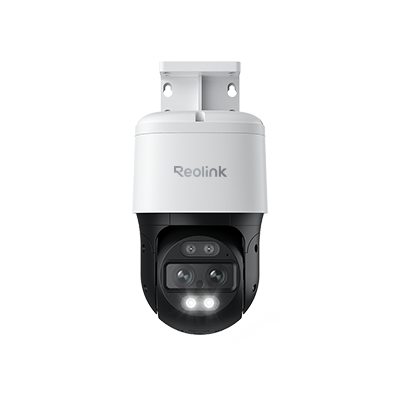
4K Dual-Lens PTZ Camera with Dual Tracking
4K 8MP Ultra HD, Wide & Telephoto Lenses, Pan & Tilt, Auto-Tracking, Person/Vehicle Detection, Power over Ethernet, Two-Way Audio.
The Reolink TrackMix PoE is designed for anyone who needs a smarter way to monitor fast-moving activity around their property, without being tied to subscription fees. Its dual-lens 4K (8MP) system combines a wide overview with automatic zoom tracking, while the 355° pan and 90° tilt give it the range to follow movement across large areas. Built-in spotlights also enable full-color night footage, adding both visibility and deterrence after dark.
As it is powered by ethernet cables, this model delivers stable monitoring performance. It is especially effective for vulnerable zones like driveways, entry points, garages, and backyard access routes. Instead of relying on a fixed frame that can lose sight of motion, this motorized setup actively follows subjects in real time, helping ensure that important activity stays in view from start to finish.
What most people admire about the Trackmix PoE is the system. It can capture both the wider scene and zoomed-in details at the same time. This means you can clearly identify how someone approached, track their movements, and still extract close-up visual details.
FAQs
Does liability insurance cover theft?
Liability insurance usually does not cover stolen personal property directly. Homeowners or renters insurance typically handles theft-related property claims instead. Coverage depends heavily on policy terms, deductibles, and the type of stolen property involved.
Do burglars avoid cameras?
Yes, visible security cameras deter many opportunistic burglars because cameras increase identification risk significantly. Criminals generally prefer properties with poor lighting, hidden access points, and no visible surveillance systems.
Can security cameras be tampered with?
Security cameras can be tampered with physically or digitally if installed poorly. Common methods include cutting power, damaging lenses, disabling Wi-Fi signals, or spray-painting visible cameras during a break-in attempt.
How can you prevent your CCTV cameras from being tampered with or disabled?
Mount CCTV cameras higher than easy arm reach and use vandal-resistant housings where possible. PoE systems reduce exposed wiring, while cloud backups or NVR recording help preserve footage even if a camera becomes damaged.
Is theft a felony or misdemeanor?
Theft can be either a misdemeanor or felony depending on property value, force used, criminal history, and state law. Petty theft usually stays misdemeanor-level, while grand theft, robbery, and vehicle theft commonly qualify as felonies.
Conclusion
Theft ranges from small misdemeanor offenses to major federal felonies carrying decades of prison time. Understanding the different types of theft helps victims respond faster, document evidence properly, and understand how serious a crime may become legally.
Knowledge also changes prevention. Most theft succeeds because criminals find easy opportunities, weak visibility, or distracted targets. Small security improvements often eliminate that opportunity entirely.
The strongest defense against theft is making your home, vehicle, and personal information harder to exploit in the first place.
Search
Subscribe for the Latest Updates
Security insights & offers right into your inbox