
Outdoor Floodlights with Motion Sensor: Ultimate Guide
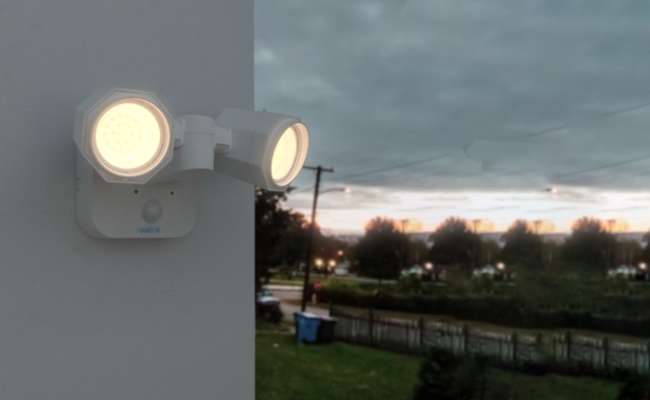
An outdoor floodlight with a motion sensor turns on automatically when a person, vehicle, or animal moves into range, then switches off once the area clears. There are many models in the market but the right choice depends on just three considerations. You'll need to ensure whether you have wiring near the mount point, how much area you need lit, and whether a plain light is enough or you also want a record of what triggered it.
For a porch or side door, a compact wired or plug-in fixture with 400 to 800 lumens is usually enough. For a driveways, garages, or backyards, plan for 1,000 lumens or more, a wider sensing angle, and possibly two light heads instead of one as the area is far more spacious.
There can be more to consider beyond just literal floodlights with motion sensors. This is why we’ve put together a guide to help you make an informed decision. We’ll walk you through the different types available, explain which specifications actually matter, highlight the common mistakes buyers make, and show you how to solve one of the most frequent frustrations with these lights.
- Types of Outdoor Floodlights
- How to Choose the Right Motion Sensor Floodlight
- Why Does My Motion Sensor Floodlight Keep Going Off?
- Common Mistakes to Avoid
- How to Install and Aim a Motion Sensor Floodlight
- Motion Sensor Floodlights Worth Knowing
- Floodlight vs. Floodlight Camera: Which Do You Need?
- Best Reolink Floodlight Cameras Worth Knowing
- Buyer Decision Table
- FAQs
- Conclusion
Types of Outdoor Floodlights
Wired (Hardwired) Floodlights
Wired floodlights connect to your home's electrical system, so they never lose power or need charging, but they do need a nearby junction box or some electrical work to install.
Because they draw continuous power, wired fixtures are the most reliable option for a light you want on standby 24/7, and they're usually the brightest option per dollar since they're not limited by battery size.
However, installation might require more thought. If there's no existing junction box near where you want the light, you're looking at running new wiring or hiring an electrician.
Battery-Powered Floodlights
Battery-powered floodlights run on removable, rechargeable batteries with no wiring at all. This makes them easy to mount almost anywhere, including sheds, fences, and rentals where you can't modify the wiring.
But, because they are powered by batteries instead of cables, it'll need recharging or swapping on a schedule that depends on how often the light triggers and how cold it gets. Lithium batteries hold up better in the cold than older battery chemistries, but performance still drops once temperatures fall well below freezing, so a battery light rated for "months per charge" in mild weather may need more frequent attention through a hard winter.
Solar-Powered Floodlights
Solar floodlights use an attached or cable-connected panel to recharge an internal battery, so they need a mounting spot that gets real daily sun.
Performance is tied directly to how much light the panel actually receives, not just whether it's technically outdoors.
Important Note: Some floodlights now come built into a security camera, adding video recording and two-way audio to the same fixture instead of just a light. That's a different buying decision than a plain floodlight, and we walk through when it's worth the upgrade in Floodlight vs. Floodlight Camera: Which Do You Need? further down.
How to Choose the Right Motion Sensor Floodlight
Brightness
For doorways and porches, 400 to 800 lumens is enough since you're lighting a small, close-in area. For driveways and backyards, look for 1,000 to 3,000 lumens. If you want the brightest option for a wide, open driveway, stay toward the top of that range.
Motion Sensing Range and Angle
Range tells you how far away the sensor picks up movement. Angle tells you how wide a field it covers. A 120-degree sensor covers roughly a third of a full circle in front of the fixture while a 180-degree sensor covers a full half-circle, which matters more for a driveway or side yard than a narrow porch approach. A high-range, narrow-angle sensor mounted on a pole covers distance well but can miss movement off to the side.
Weatherproof Rating
IP65 handles normal rain and garden-hose-strength splashing. IP66 is built for direct high-pressure jets, which matters if the fixture sits somewhere it could get hit by a hose or sits fully exposed to storm-driven rain. For most home installs, IP65 is enough. But, it's well-recommended to go for IP66 if the floodlight will be placed in an exposed coastal or storm-prone spot.
Pro Tip: To learn deeper about IP ratings, check out our IP ratings guide for more information.
Power Source
As defined by the types of floodlight cameras, go for wired if you need always-on reliability, battery for flexible placement, solar for zero ongoing cost with a sunny mount point.
Color Temperature and Design
There are mainly three common ranges of color temperature. Warm white (2700K-3000K) reads as cozy porch lighting. Cool white (4000K-5000K) and daylight white (5000K-6500K) reads as brighter security lighting. Most fixtures also now come in a few finish options (white, black, bronze) if you want the light to match your exterior hardware rather than stand out.
Lighting Modes
Most motion-activated floodlights offer motion-only, dusk-to-dawn (low ambient light plus full brightness on motion), and always-on. Check which modes a fixture supports before buying if you specifically want the dusk-to-dawn combination, since not every motion-activated model includes it.
Why Does My Motion Sensor Floodlight Keep Going Off?

Most basic floodlights use a PIR (passive infrared) sensor, which triggers on a combination of heat and movement. That's exactly why the most common false-trigger causes are animals crossing the yard, tree branches or bushes moving in the wind, and passing cars on a street-facing mount, not an actual security event.
The usual fix is narrowing the sensitivity setting and repositioning the fixture away from foliage, so it's aimed at the walkway or entry point instead of open yard or street. That reduces false triggers but doesn't eliminate them, because a PIR sensor genuinely can't tell a raccoon from a person.
Pro tip: Sensitivity and positioning only go so far, because a plain PIR sensor still reacts to any heat and movement it picks up. This could be pets, wind-blown branches, and passing traffic included. Cameras with smart person/vehicle/animal detection fix this at the source by identifying what's actually moving before deciding whether to fire the light or send an alert, so the same triggers that set off a basic PIR sensor simply don't register on an AI-filtered one.
Common Mistakes to Avoid
Buying for lumens alone
A high-lumen fixture with a narrow sensing angle can still miss movement off to the side. Check angle and range together, not lumens in isolation.
Mounting too high or aimed at open sky
A floodlight aimed above head height and out toward the street lights up less of what you actually need covered and picks up more false triggers from passing traffic.
Skipping the weatherproof rating on an exposed mount.
A fixture with no clear IP rating, or one rated for splashing but mounted somewhere it gets directly hosed by driving rain, is a common early failure point.
Assuming "wireless" means zero maintenance
Battery and solar fixtures still need attention such as recharging, repositioning for sun, or swapping batteries more often in cold weather.
Not checking for a dusk-to-dawn mode if you want one.
Not every motion-activated fixture includes a low-level ambient mode; check this before buying if you want the light on at low brightness all night and bright on motion.
How to Install and Aim a Motion Sensor Floodlight
Most motion sensor floodlights have a sensitivity dial, a timer, and a brightness control on the back or underside of the fixture. Sensitivity allows you to set how much movement triggers the light while the timer allows you to adjust how long it stays on after triggering.
Mounting height and aim matter as much as those settings. Manufacturer install guides for this category typically land in the 6 to 8 foot range, angled slightly downward toward the path, driveway, or entry point you actually want covered, not out toward open sky or the street. Walking back and forth in front of the light after mounting is the simplest way to confirm the angle actually covers the area you're aiming for, rather than guessing from the specs alone.
Motion Sensor Floodlights Worth Knowing
If you just need a light that turns on when something moves, plenty of straightforward options exist. A few widely available fixtures, verified against their published specs:
- LUTEC 7635401012-B (wired): 38W, 3,500 lumens, IP65, with a dusk-to-dawn mode that runs at 20% overnight and jumps to full brightness on motion. (Installation instructions, via LUTEC's official site)
- Tuffenough 8330D-210R (solar): 2,500 lumens across three adjustable heads, 270° coverage, PIR range up to 26 feet, remote included. (Manufacturer manual - see caveat below)
- LYWALT Jy2323T4 (solar): 3,000 lumens, four heads, dual PIR sensors covering 180° up to 40 feet, no wiring needed. (Manufacturer's product page)
- INCX 156GYD-2 (solar): 3,000 lumens, 120° sensing angle, stays lit 30 seconds per trigger, up to 1,500 activations per charge. (Spec sheet)
- Philips 7601909053 (wired): 44W, 4,200 lumens, two adjustable heads, PIR range 16 feet at 120°. (Product spec page)
These all do the one job a motion sensor floodlight is built for: light up when something moves, then switch off once it's clear. What none of them do is show you what actually happened, only that a light turned on. For a porch or a spot you just want lit at night, that's genuinely enough, and any of these five is a reasonable pick. It only starts to matter if you'd actually like to see who or what set it off, which is worth knowing before you buy either one.
Floodlight vs. Floodlight Camera: Which Do You Need?
A plain floodlight lights up an area so you can see what's there but a floodlight camera lights the area and records what triggered it. Most models add two-way audio so you can talk to whoever's there without opening the door. If visibility is all you need, any of the fixtures above will do the job. If you also want a clip of the delivery, the visitor, or whatever set it off, that's the layer a floodlight camera adds on top of the same fixture.
Best Reolink Floodlight Cameras Worth Knowing
Reolink makes floodlight cameras across the same wired, battery, and solar categories covered above, each pairing the light with recording and two-way audio. Here's how a few current models compare on the specs that actually matter.
Reolink Solar Floodlight Camera

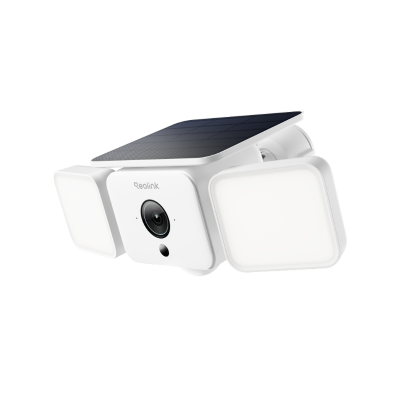
The Reolink Solar Floodlight Cam is built for exactly the no-wiring scenario. It's solar and battery powered, delivers up to 1,000 lumens with adjustable color temperature, and its AI detection is built to tell people, vehicles, and animals apart, reducing false alerts.
Did You Know?: The Reolink Solar Floodlight Camera was awarded the Golden Winner of the A'Design Awards in 2026?
Smart 2K Solar Floodlight Security Camera
150° Ultra-Wide View, 2K 4MP HD Resolution, AI-Based Adaptive Floodlight, Endless Power with Reolink SolarEase™.
Reolink TrackFlex Floodlight WiFi

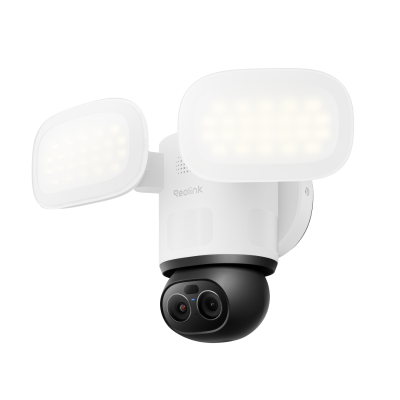
For a driveway or larger property with more than one blind spot, the TrackFlex Floodlight WiFi covers more ground from one mount point. It can pan and tilt across 360 degrees, adds 6x hybrid zoom to cover more distance, and puts out up to 3,000 lumens, which is closer to what a multi-fixture driveway setup would otherwise take two or three separate lights to achieve.
Smart 4K 360° Coverage Wi-Fi Floodlight Security Camera
Local AI Video Search, 4K 8MP Ultra HD, 360° Coverage View, 6X Hybrid Zoom, Dual-Color Floodlight.
Important Note: Reolink's own install guides for the Solar Floodlight Cam and the TrackFlex Floodlight WiFi both recommend mounting 2 to 3 meters (7 to 10 feet) up, a bit higher than the 6 to 8 foot range covered earlier for plain fixtures. That extra height is there to maximize the PIR sensor's detection range on a camera, not just to spread light, so use this number rather than the plain-floodlight one if you're installing either of these instead.
Both store footage locally on a microSD card, so there's no required monthly fee to keep recordings, which matters if avoiding recurring costs is one of the reasons you were considering a plain floodlight in the first place.
Buyer Decision Table
Now that you know what a floodlight camera actually adds, here's how that plays out across seven common situations:
FAQs
How many lumens should an outdoor floodlight be?
For entrances, doorways, and porches, 400 to 800 lumens is enough for a small area. For larger areas like driveways and backyards, look for 1,000 to 3,000 lumens.
Are outdoor motion sensor floodlights worth it?
Yes. They light the area automatically when something moves, which is useful for both everyday convenience and security. If you want a record of what triggered the light rather than just the light itself, a floodlight camera does both from one fixture.
Can you add a motion sensor to a flood light?
If your existing floodlight doesn't have a built-in sensor, you can usually add a standalone motion sensor module that wires between the fixture and the power source, provided the fixture is hardwired and you're comfortable working with the wiring (or have an electrician do it). It's simpler to buy a floodlight with the sensor already built in, which is standard on nearly all current models.
How do motion detector lights work?
A motion detector light uses a PIR (passive infrared) sensor that reacts to heat combined with movement in its field of view. When it detects both, it signals the light to turn on for a set amount of time, then switches off once no further movement is detected. A plain floodlight can't distinguish what caused the motion, a person, a car, or a raccoon all trigger it the same way. Telling those apart requires an image sensor, which only a floodlight camera has; that's a camera feature, not something a standard motion-sensor floodlight can do on its own.
What is a floodlight camera?
A floodlight camera is a security camera with a bright motion-activated light built into the same fixture, so it lights up an area and records video the moment it detects motion.
Conclusion
Most of this comes down to matching light to space, not chasing the highest lumen count you can find. A porch or side entrance rarely needs more than a basic wired or plug-in fixture in the 400 to 800 lumen range, while a driveway or backyard is better served by sizing up past 1,000 lumens and checking the sensing angle too, not just the number on the box. But if you've ever stood at a triggered floodlight wishing you knew who or what actually set it off, that's the one thing no plain fixture can give you, and it's exactly what Reolink floodlight cameras can cover.
Be sure to leave down any questions you have in mind and we'll do our best to help!
Search
Subscribe for the Latest Updates
Security insights & offers right into your inbox