
Wired vs. Wireless Security Cameras: Which One to Choose
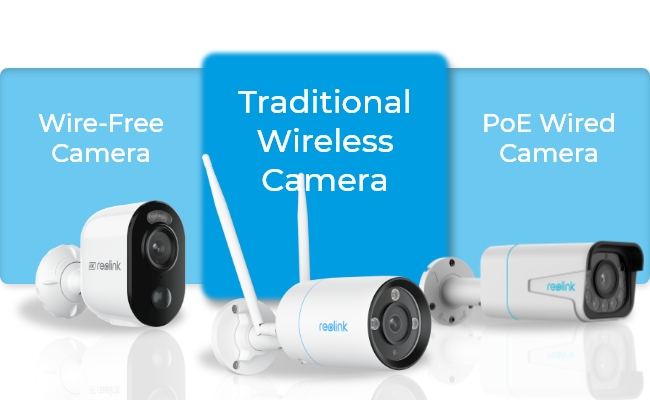
Wired cameras plug into a cable for constant power and data. Wireless cameras connect over WiFi and get power from a battery, solar panel, or a standard outlet. That difference plays a key role in choosing the right system, affecting everything from setup and cost to reliability and storage.
This guide is for anyone, ranging from homeowners to small business owners, looking for valuable information to decide between a wired or wireless security camera.
TLDR: If you want maximum reliability and 24/7 recording and don't mind running cable, wired is the better fit. If you want a fast DIY setup and the flexibility to reposition cameras later, wireless, or a fully cordless wire-free model, is the better fit.
Further down this guide, we break down installation, power, storage, cost, and security so you can further define the right match to your property.
- What Is a Wired Security Camera?
- What Is a Wireless Security Camera?
- Wired vs. Wireless: What's the Difference?
- Which Costs More: Wired or Wireless Security Cameras?
- Wired vs. Wireless Security Cameras: Pros & Cons
- Wired vs. Wireless: Which One Should You Choose?
- Best Wired and Wireless Camera Recommendations
- FAQs
- Conclusion
What Is a Wired Security Camera?

A wired security camera connects to a recorder or router using a physical cable. This is typically a single PoE (Power over Ethernet) cable carrying both power and data. Older DVR‑based analog systems instead use a coaxial cable plus a separate power cable. Because the connection never depends on WiFi, wired cameras deliver the most consistent 24/7 recording of any camera type.
- Two main types: PoE IP cameras using one Cat5 or Cat6 Ethernet cable for both power and data, and older analog cameras using separate power and coaxial video cables
- Runs on continuous power, no batteries to charge or replace
- Typically pairs with a local NVR or DVR for storage
Best suited for: Permanent installations in homes, offices, and multi-camera business setups
What Is a Wireless Security Camera?

A wireless security camera sends video to your phone or a recorder over WiFi instead of a data cable. "Wireless" actually covers two different setups. They are namely plug-in cameras that still need a constant outlet for power, and wire-free (battery or solar) cameras that need no cables or outlet at all. Both skip the drilling and cable runs that wired systems require.
- Plug-in WiFi cameras need an outlet within WiFi range but power on continuously
- Wire-free (battery or solar) cameras are fully cordless, ideal for rentals and hard-to-wire spots, but rely on motion-triggered recording to conserve battery
- Data travels over 2.4GHz or 5GHz WiFi, so signal strength and router placement matter
Best suited for: renters, DIY installs, and locations without easy access to wiring
Wired vs. Wireless: What's the Difference?
Wired cameras: Uses a physical cable for continuous power and data, which makes them the most reliable option for 24/7 recording.
Wireless cameras: Connects over WiFi and are either plugged into an outlet or run on a battery. This makes installation faster but ties reliability to your WiFi signal and, for battery models, your charge level.
Wired vs Wireless Security Camera Connection
Wired cameras: Transmits video over a physical cable, usually a single PoE cable, to a router, NVR, or PoE switch.
Wireless cameras: Transmits video over WiFi to your router or a hub, with no data cable required.
Wired PoE IP cameras use a Cat5 or Cat6 Ethernet cable to carry both video data and power to your router or NVR in one connection.
Older analog wired cameras need two separate cables. One for power and one coaxial cable for video. Wireless cameras, be it plug-in or wire-free, skip the data cable entirely and rely on your home WiFi network, so a strong signal at the camera's mounting point matters more than it does for a wired setup.
Verdict: Wired wins on connection stability since it never depends on WiFi. Wireless wins on placement freedom since there's no cable tying the camera to a fixed route.
Wired vs Wireless Security Camera Power Source
Wired PoE cameras: Draws continuous power through the same cable that carries their data, so they never lose power unless the whole circuit goes down.
Plug-in wireless cameras: Needs a nearby outlet and also run continuously.
Wire-free cameras: Runs on a rechargeable battery, typically lasting 20 days to 6 months per charge, and can pair with a solar panel to stay topped up.
This is the clearest place the plug-in vs. wire-free distinction matters: a plug-in WiFi camera behaves like a wired camera from a power standpoint (constant, no charging), while a wire-free camera behaves completely differently (finite charge, needs monitoring).
Verdict: Wired and plug-in wireless both offer constant, maintenance-free power. Wire-free trades that constant power for zero cables, at the cost of periodic charging.
More than meets the eye: Wireless battery life can perform better or worse due to other factors. To get the best out of them, see Reolink's wireless camera battery life breakdown for what affects runtime in practice, night vision use and cold weather both shorten it noticeably.
Wired vs Wireless Security Camera Installation
Wireless and wire-free cameras are easier to install: No complicated cabling works are involved and these cameras usually require simple mounting works and setup. In Reolink's case, most can be mounted and setup in minutes with the Reolink app and no drilling required.
Wired cameras take longer: Every camera needs a cable run back to the router, PoE switch, or NVR.
Because wired security cameras require cabling works, it is more labor-intensive as this will involve drilling, routing cable through walls or ceilings, and connecting each camera to a central recorder. It's a job many homeowners tend to hire an electrician for.
Installing wireless security cameras is usually a DIY job. Plug-in models need only an outlet within WiFi range, and wire-free models need no wiring or outlet at all, just a wall or surface to mount on in a few steps.
Verdict: Wireless and wire-free win on installation speed. Choose wired only if you're comfortable with (or hiring for) cable runs.
Which Records Continuously, and Which Only Records Motion?
24/7 continuous recording: Wired cameras and plug-in wireless cameras can both record 24/7 because they have constant power.
Motion-triggered recording: Wire-free battery cameras are built to conserve power, so most record only when their motion sensor is triggered rather than continuously.
This distinction matters more than most buyers expect. A wired or plug-in setup gives you an unbroken timeline of footage. A wire-free camera only captures what happens after its PIR sensor fires, which is efficient for battery life but means the seconds right before a trigger, or anything that happens too briefly to trigger detection, won't be recorded.
Verdict: Choose wired or plug-in wireless if you need a complete, unbroken timeline. Wire-free is fine if motion-triggered clips are enough for your situation.
Wired vs Wireless Security Camera Storage
Wired cameras: Typically save footage to a local NVR or DVR hard drive. Some Reolink WiFi 6 NVRs like the RLC-810WA supports up to 8TB of local storage across a multi-camera system.
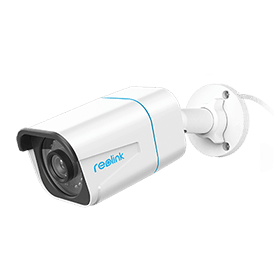
4K PoE IP Camera with Person/Vehicle Detection
Smart Person/Vehicle Alerts; 4K UHD Day; Night; 100ft Night Vision; Time Lapse; IP66 Certified Weatherproof; Audio Recording.
Wireless cameras Usually saves to a microSD card, most current Reolink WiFi and battery models top out at 512GB, or to a cloud plan, which may carry a monthly fee.**
Local storage on a wired NVR means no subscription and no dependence on your internet connection to keep recording. In contrast, wireless cameras give you a choice. You can either store footage in a microSD card which keeps things subscription-free but capped by card size, or save it in a cloud storage. This adds an ongoing cost but protects your footage if the camera itself is stolen or damaged.
Verdict: Wired plus NVR wins for long-term, subscription-free storage at scale. Wireless with a microSD card is the simpler no-subscription option for a handful of cameras.*
Which Is More Secure From Hacking?
Wired cameras: If they aren't connected to the internet, they can't be hacked remotely, which is why some businesses keep a closed-circuit wired system for maximum security.
Wireless cameras: They are exposed to the internet by design, but modern encryption, such as the WPA2 and WPA3 WiFi security built into current Reolink WiFi cameras, makes remote hacking difficult when paired with a strong, unique password.
A fully offline wired system is the hardest target because there's simply no network path in. That said, most households want remote viewing, which means some internet exposure is the trade-off for convenience regardless of camera type. The practical fix isn't avoiding WiFi cameras, it's using WPA2/WPA3 encryption and a unique password instead of the camera's default credentials.
Verdict: A closed wired system is the most hack-resistant by design. A wireless camera with WPA3 and a strong password is secure enough for the vast majority of households.
Wired vs. Plug-in Wireless vs. Wire-Free: Quick Comparison
Which Costs More: Wired or Wireless Security Cameras?
A four-camera wired IP system typically costs $500 to $1,500 installed, and a four-camera wireless IP system costs roughly $400 to $1,000, according to HomeAdvisor's 2026 installation cost data.
Reolink's own installation cost research puts the average security camera system install at $1,511 overall, though a DIY wireless or battery camera install costs $0 in labor since you set it up yourself.
Per camera, HomeAdvisor puts wired IP installation at $100 to $500 and wireless IP at $100 to $250, with the gap coming almost entirely from labor. Professional installers typically charge $100 to $200 per system for straightforward setups, and wired jobs take longer because of the cable runs.
The bigger cost difference shows up after installation. Wired systems paired with a local NVR have no recurring fee. Wireless systems often carry an optional cloud storage subscription if you want offsite backup instead of, or in addition to, a microSD card.
Pro tip: Camera prices and bundle pricing change often. Check the Reolink Flash Sale page before buying to see current system bundle discounts.
Verdict: Wireless costs less upfront and has no mandatory labor cost if you DIY it. Wired can cost less over several years if you use local NVR storage and skip cloud subscriptions entirely.
Wired vs. Wireless Security Cameras: Pros & Cons
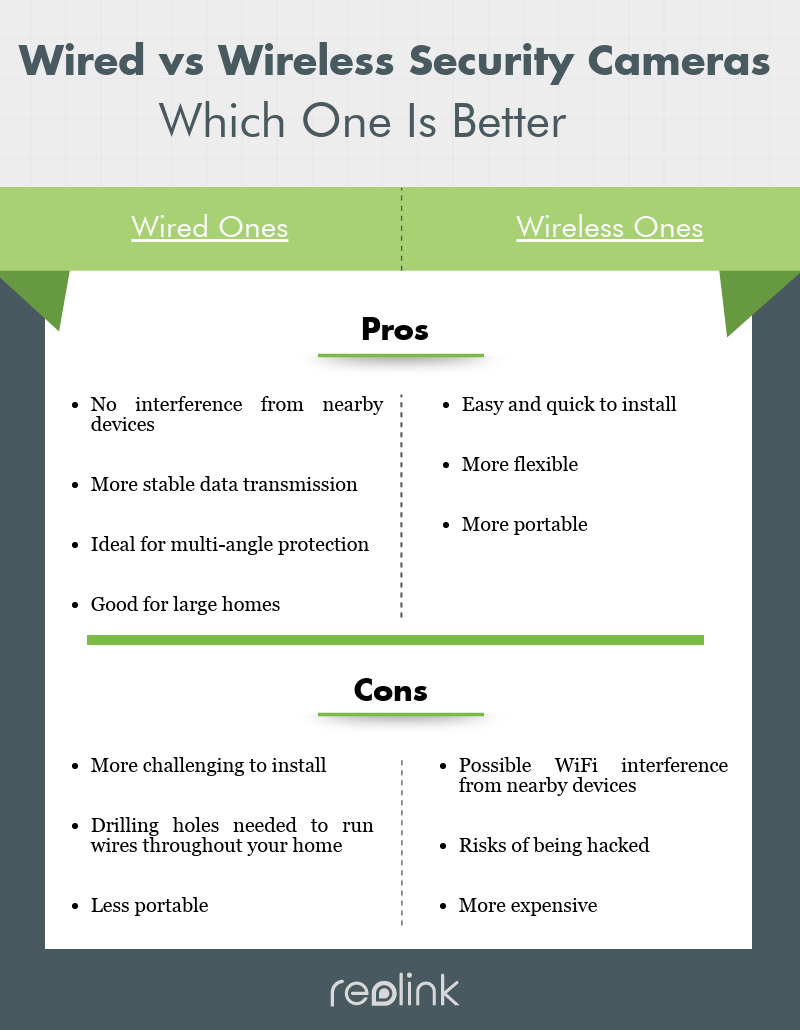
Both wired and wireless security cameras have advantages and downsides, and each fits different scenarios.
Wired security cameras: advantages and downsides
Advantages:
- Reliability: Wired security cameras provide a stable, continuous connection with almost no interference from nearby devices.
- Consistent power: Most wired cameras use Power over Ethernet (PoE) for data and power and can operate continuously, with no batteries to change or recharge.
- Extended range: They can be placed far from the recording device without signal degradation.
- Higher video quality: Wired cameras can transmit higher-resolution video with less compression, so quality is often better in practice.
Downsides: - Complex installation: Installation can be labor-intensive and more expensive due to the need to run cables, especially in existing structures.
- Limited flexibility: Cables restrict camera placement, and repositioning later is difficult.
Wireless security cameras: advantages and downsides
Advantages:
- Easy installation: Wireless cameras are quick to install and well suited to DIY setups.
- Flexibility: They can be placed in various locations without cable constraints, which also suits temporary needs like construction sites or events.
Downsides: - Signal interference: Wireless cameras can experience interference from other devices or obstacles like walls.
- Limited range: Range may be limited; consider a signal booster for larger properties.
- Battery maintenance: Battery-powered wireless (wire-free) cameras require periodic charging or battery changes.
- Potential security risks: Wireless cameras can be vulnerable to hacking if not secured with strong passwords and encryption.
Wired vs. Wireless: Which One Should You Choose?
The right choice depends on your specific setup and needs.
Here's how this plays out for a common scenario: a renter wants to cover a detached garage at the back of the property, with no outlet nearby and a landlord who won't allow drilling. A wired camera is off the table, and even a plug-in wireless camera would need an extension cord run across the yard. A wire-free camera paired with a small solar panel solves it directly: no outlet needed, no permanent modification to the property, and the battery stays charged as long as the panel gets a few hours of sun.
Best Wired and Wireless Camera Recommendations
Check the recommendations below to save time searching for the best wired and wireless outdoor or indoor security cameras. All five models below are current Reolink products, verified against their live spec sheets.
Best Wire-Free Security Camera: Reolink Argus 4 Pro

A 4K dual-lens battery/solar-powered camera with a 180° blind-spot-free field of view and dual-band 2.4/5GHz WiFi 6 for a fast, stable connection. Instead of traditional infrared, it uses Reolink's ColorX night vision, an F/1.0 aperture paired with a larger 1/1.8" sensor, to capture full-color detail in low light without a visible spotlight. It supports up to a 512GB microSD card for local, subscription-free storage, carries an IP66 weatherproof rating, and runs on a 5000mAh rechargeable battery that pairs with the Reolink Solar Panel 2 for continuous power.
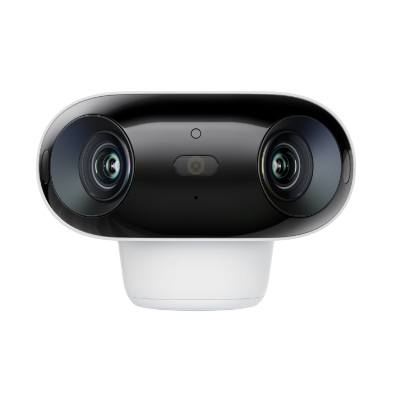
4k 180° Wire-free Color Night Vision Camera
4K UHD 180° Blindspot-free View; Color Vision Day and Night; 30% More Battery Life; Dual-band Wi-Fi 6; Smart detection.
Best Plug-in Wireless Camera: Reolink RLC-810WA

A 4K (8MP) WiFi 6 camera with dual-band 2.4/5GHz support for a stable, interference-resistant connection. It offers color night vision with up to 30 meters of infrared range, an IP67 weatherproof rating, and WPA2/WPA3 encryption. When connected to a compatible Reolink WiFi NVR, it can be part of a system storing up to 8TB locally.
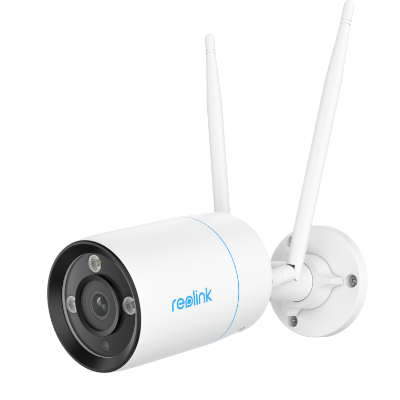
4K WiFi 6 Surveillance Camera
4K 8MP Ultra HD, Dual-Band WiFi 6, Color Night Vision, IP67 Waterproof, Smart Detection, Two-Way Audio, Built-in Siren.
Best Wired High-Resolution PoE Camera: Reolink Duo 3 PoE

A 16MP dual-lens camera delivering a 180° panoramic view with no blind spots, powered and connected through a single PoE cable. Its f/1.6 lens supports strong low-light performance, and it stores footage on a microSD card (up to 512GB) or a compatible Reolink NVR.
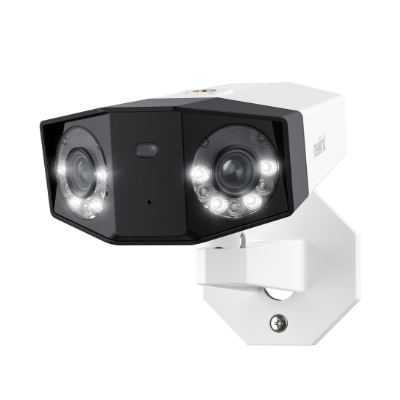
Groundbreaking 16MP Dual-Lens PoE Camera
16MP UHD, Dual-Lens, Motion Track, 180° Wide Viewing Angle, Power over Ethernet, Color Night Vision.
Best Wired Plug-in WiFi Camera: Reolink Duo 3 WiFi

For a camera that needs continuous outlet power but a wireless network connection, the Duo 3 WiFi delivers 16MP resolution and a 180° field of view with dual-band WiFi 6, so you can switch between 2.4GHz and 5GHz based on your network's needs. It also includes smart motion detection and color night vision.
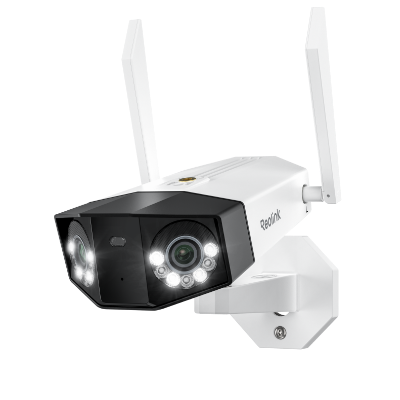
Groundbreaking 16MP Dual-Lens WiFi Camera
16MP UHD, Dual-Lens, Motion Track, 180° Wide Viewing Angle, Plug-In WiFi, Color Night Vision.
Best Wired PoE Zoom Camera: Reolink RLC-811A

A 4K (8MP) PoE camera with 5x optical zoom (2.7mm-13.5mm), which narrows its field of view from a wide 105° down to a focused 31°, useful for reading detail at the far end of a driveway rather than just seeing a car pass. It supports person, vehicle, and animal AI detection and stores footage on a microSD card (up to 512GB) or a compatible Reolink NVR.
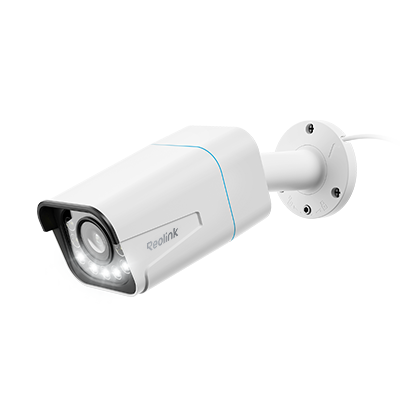
4K Smart PoE Camera with 5 Spotlights
4K 8MP Ultra HD Day & Night, Person/Vehicle Alerts, 5X Optical Zoom, Two-Way Audio, Built-in Siren, Color Night Vision, Live View Anywhere.
FAQs
Is it better to have wired or wireless security cameras?
Neither is universally better, it depends on your setup. Wired cameras win on reliability, video quality, and continuous power, making them the stronger choice for businesses or permanent installations. Wireless cameras win on installation speed and flexibility, making them the stronger choice for renters, DIY setups, or properties without easy cable access. Match the camera type to your priorities rather than assuming one is the default.
Are outdoor wireless security systems reliable?
Outdoor wireless cameras are reliable when installed within strong WiFi range; signal strength, not the outdoor environment itself, is the main factor in reliability. Hardwired cameras remain more consistent for internet reliability since they don't depend on a wireless signal at all. Look for WPA2 or WPA3 encryption on any wireless model to protect it from unauthorized access.
How long do the batteries last in a wireless security camera?
Battery life on a wire-free camera typically ranges from 20 days to 6 months between charges, depending on motion frequency, night vision use, and temperature. Pairing the camera with a solar panel can keep it charged indefinitely in most climates.
Can I install wired security cameras by myself?
Yes, but you'll need to carefully follow the installation guide when drilling holes or routing wires, and take care around any power connections. If you run into issues, Reolink's customer support team can help troubleshoot.
What happens to my recordings if a wired or wireless camera loses power?
A wired camera stops recording locally once its power source cuts out, unless it's on a battery backup or generator. A plug-in wireless camera behaves the same way since it also depends on outlet power. A wire-free battery camera keeps running on its internal battery, but it can't upload new footage to the cloud until your internet connection is restored.
Can I use wired and wireless cameras together in the same system?
Yes. Many households mix both: wired PoE cameras covering fixed, high-priority spots like the front door or driveway, and wire-free cameras covering areas without easy cable access, like a shed, gate, or backyard corner. Most current Reolink NVRs and the Reolink app support managing both camera types from a single interface.
Conclusion
At the end of the day, the core difference comes down to cables. Wired cameras trade installation effort for the most reliable 24/7 recording, while wireless and wire-free cameras trade some of that reliability for a fast, flexible setup. If your property allows cable runs and you want maximum uptime, go wired. If you want to be recording within minutes or need to cover a spot without power, choose wireless or wire-free instead. Plenty of setups use both. Compare your specific situation against the choices above, then check the recommended cameras to find your match. If you have a setup question, leave it in the comments below and we'll help to solve your query!
Search
Subscribe for the Latest Updates
Security insights & offers right into your inbox