
Reolink Argus 4 Pro vs Duo 3 PoE: A Comprehensive Comparison
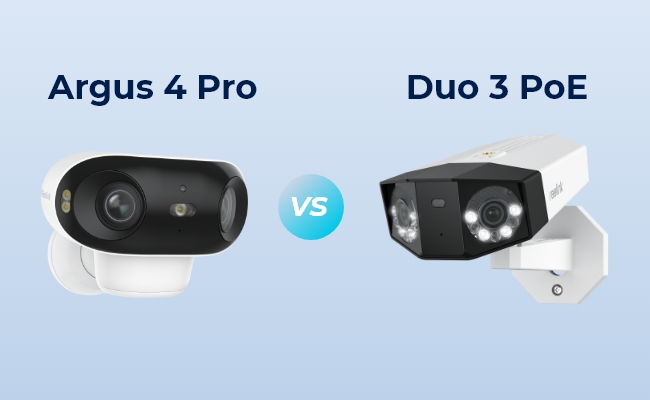
The Argus 4 Pro and Duo 3 PoE are both some of the most popular and innovative flagship cameras ever made to establish home security.
But, each of them were designed in opposite ways. Argus 4 Pro runs on battery and solar power over Wi-Fi 6, while Duo 3 PoE draws data and power from a single Ethernet cable.
If you're deciding between a wire-free camera you can mount almost anywhere and a wired one built for continuous, high-resolution recording, this comparison is for you. We'll be breaking down key attributes in the clearest manner so that you'll be making the most informed choice by the end of this article.
TLDR: Choose Argus 4 Pro for flexible, subscription-free placement anywhere with sun exposure. Choose Duo 3 PoE for 24/7 continuous recording and maximum resolution where running a cable is more realistic.
Argus 4 Pro vs Duo 3 PoE Comparison Table
Reolink lab data: ColorX's larger aperture and sensor cut power draw enough to add roughly 12 extra days of standby time and save about 2 watt-hours per hour compared with a standard IR night-vision camera, based on Reolink's ColorX efficiency data.
Argus 4 Pro Overview
!
The Reolink Argus 4 Pro is a wire-free, dual-lens security camera built for battery or solar power. Combining two 4mm lenses through Reolink's image-stitching technology, it produces a single 180-degree, 4K view with no blind spot down the middle. Its ColorX technology adds full-color night vision without a spotlight, and the whole unit installs anywhere within Wi-Fi 6 range, no outlet or cable required.
Key Features
- 4K UHD (8MP), 180-degree dual-lens field of view, no blind spot
- ColorX color night vision (F/1.0 aperture, 1/1.8" sensor), no spotlight required
- AI person, vehicle, and animal detection with built-in two-way audio
- 5000mAh battery plus 6W solar panel; up to 512GB microSD or Home Hub storage
- Dual-band Wi-Fi 6, Bluetooth 5.0 setup, IP66 weatherproof
For the full hands-on breakdown, including setup notes and real testing observations, see our Argus 4 Pro review.
Did You Know: The Argus 4 Pro picked up a 4.5-star Recommended badge from The Ambient, with reviewers calling out its wide 180-degree field of view and subscription-free local storage.
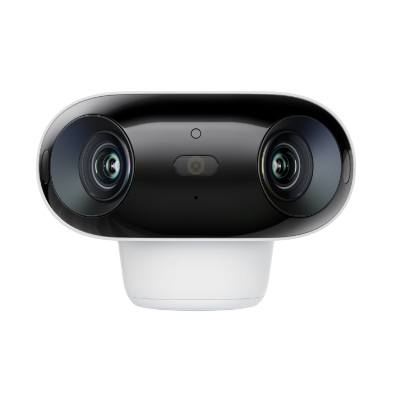
4k 180° Wire-free Color Night Vision Camera
4K UHD 180° Blindspot-free View; Color Vision Day and Night; 30% More Battery Life; Dual-band Wi-Fi 6; Smart detection.
Duo 3 PoE Overview

Reolink Duo 3 PoE is a wired, dual-lens security camera built for continuous, high-resolution recording. Its two 4K sensors combine into a single 16MP, 180-degree image, and one Ethernet cable handles both power and data. It supports motion-triggered, scheduled, or true 24/7 recording, and connects to a Reolink NVR or most ONVIF-compatible systems for centralized storage. That's a meaningful upgrade over its predecessor, the Duo 2 PoE.
Key Features
- 16MP UHD (7680×2160), 180-degree dual-lens field of view, no blind spot
- IR night vision to 30 meters, plus color night vision with spotlight (F1.6 aperture, 1/2.7" sensor)
- AI person, vehicle, and animal detection with built-in two-way audio
- PoE (802.3af, 48V) delivers power and data over one cable; up to 512GB microSD or Reolink NVR
- ONVIF-compatible, IP67 weatherproof, supports 24/7 continuous recording
Fun Fact: The Duo 3 PoE won a 2024 Residential Systems Picks Award at CES 2024, recognized for its seamless dual-lens image stitching and 16MP clarity.
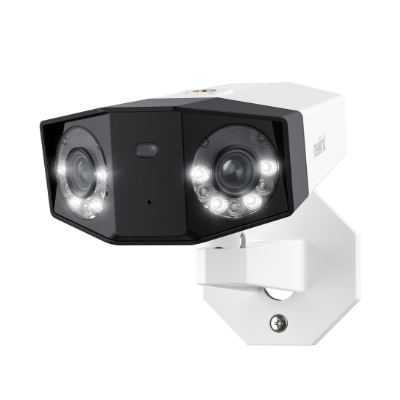
Groundbreaking 16MP Dual-Lens PoE Camera
16MP UHD, Dual-Lens, Motion Track, 180° Wide Viewing Angle, Power over Ethernet, Color Night Vision.
Argus 4 Pro vs Duo 3 PoE: What's the Difference?
Ease of Installation
Argus 4 Pro can be installed anywhere within Wi-Fi range in minutes. Simply mount the bracket, pair over Bluetooth, and you can start recording. This Bluetooth pairing skips the old QR-code-scanning step entirely, so connecting to your home Wi-Fi takes under five minutes once the camera is charged.
Duo 3 PoE takes longer up front, since it needs an Ethernet run to a switch, injector, or NVR. This typically takes 30 to 60 minutes depending on how far the cable has to travel. That same cable pays off after installation, though. Once connected, the camera draws power continuously, removing battery charging and Wi-Fi dropouts from the equation entirely.
Verdict: Argus 4 Pro wins on setup speed but Duo 3 PoE wins on long-term connection stability once it's wired.

Reviewer Take: CGMagazine scored the Argus 4 Pro 7.5/10 in its hands-on installation test, noting that "the wireless nature of the Reolink Argus 4 Pro Security Camera was a huge advantage during installation."
Connectivity
The Argus 4 Pro has no PoE version. It runs on dual-band Wi-Fi 6 and a rechargeable battery, with WPA3 security on the Wi-Fi connection and Bluetooth used only for initial pairing.
The Duo 3 PoE draws both power and data from a single Ethernet cable, which requires an IEEE 802.3af, 48V active PoE source. Confirm your switch or injector supports active mode before ordering, since a passive PoE injector will not power the camera correctly. If you specifically need Reolink's dual-lens design over Ethernet, Duo 3 PoE is the only option between these two.
Verdict: Choose Argus 4 Pro if you can't or don't want to run a cable. Choose Duo 3 PoE if a reliable wired connection is available.
Resolution
Duo 3 PoE records at 16MP (7680×2160), nearly double the pixel count of Argus 4 Pro's 4K UHD (5120×1440, 8MP). In practice, that extra resolution means more usable digital zoom detail across a wide driveway or storefront. That being said, the Argus 4 Pro's 4K resolution is still sharp enough to identify faces and vehicles at typical front-yard distances.
Verdict: The Duo 3 PoE wins on raw resolution and digital zoom headroom, but the Argus 4 Pro's 4K is plenty for most residential distances.

Reviewer Take: SafeWise gave the Duo 3 PoE 4.25/5 stars in its hands-on video quality test, saying "it's easily some of the best [video] quality I've ever seen in a security camera."
Storage
Both cameras support microSD cards up to 512GB. The Duo 3 PoE also pairs with a Reolink NVR for expanded, centralized storage, while Argus 4 Pro pairs with the Reolink Home Hub instead.
Verdict: Storage capacity is a tie at the card level. Duo 3 PoE has the edge for expansion, since a multi-camera NVR setup scales further than the Home Hub.
Third-Party Compatibility
Duo 3 PoE supports the ONVIF protocol natively, so it can join most third-party NVR and VMS systems without extra hardware.
Argus 4 Pro doesn't support ONVIF standalone but you can pair it with a Reolink Home Hub to unlock ONVIF and RTSP access instead.
Important Note: See Reolink's own breakdown of which products support CGI/RTSP/ONVIF and battery camera third-party compatibility for the full picture.
Verdict: For multi-brand NVR integration with no extra hardware, Duo 3 PoE is the compatible choice. Argus 4 Pro can get there too, but only by adding a Home Hub.
Night Vision
Argus 4 Pro's ColorX technology (F/1.0 aperture, 1/1.8-inch sensor) delivers color night vision without needing its onboard spotlight to activate. The Duo 3 PoE instead offers two distinct modes: black-and-white infrared up to 30 meters, or full-color night vision once its built-in spotlight switches on.
Important Note: Read more on how the two technologies compare in ColorX Technology for Reolink Cameras.
Verdict: Argus 4 Pro wins for discreet, spotlight-free color monitoring. Duo 3 PoE wins for longer-range infrared reach.
Cost
Argus 4 Pro carries a lower entry price and needs no PoE hardware, and its bundled solar panel keeps it running long-term at no extra cost. Duo 3 PoE sits a tier higher and may require a PoE switch or injector if your router doesn't already supply PoE, though neither camera carries a monthly subscription fee for local storage.
Important Note: See current pricing directly: Argus 4 Pro and Duo 3 PoE.
Verdict: Argus 4 Pro has the lower entry cost. Factor in a PoE switch for Duo 3 PoE if you don't already have one on hand.
Argus 4 Pro vs Duo 3 PoE: Which Should You Choose?
The right choice depends on your specific setup and needs.
Strengths and Limitations
Both cameras are inherently great for security and deterrence, but each makes deliberate trade-offs to excel at the scenario it was built for.
Strengths
Reolink Argus 4 Pro
- Wire-free installation anywhere with sun exposure, no outlet or cable required
- Spotlight-free ColorX color night vision
- No monthly fees for local storage
- Up to 512GB local storage, or Home Hub
Reolink Duo 3 PoE
- 16MP resolution, nearly double the pixel count of Argus 4 Pro
- True 24/7 continuous recording, not just motion-triggered
- ONVIF-compatible with Reolink NVR and most third-party VMS
- IP67 weatherproofing, a step up from IP66
Limitations
Reolink Argus 4 Pro
- Motion-triggered recording only, no true 24/7 continuous mode
- No ONVIF or third-party NVR support
- Still needs a reasonably sunny mounting spot to stay maintenance-free on solar power alone
Reolink Duo 3 PoE
- Requires an Ethernet run, or a PoE switch/injector, that not every home has ready
- No battery or solar option. Best for places with power outlets.
FAQs
Is there a PoE version of the Argus 4 Pro?
No. Argus 4 Pro is battery and solar-powered only. If you need Reolink's dual-lens design over PoE, Duo 3 PoE is the option to choose.
Can the Argus 4 Pro record 24/7?
No. Battery-powered Reolink cameras, including Argus 4 Pro, use motion-triggered recording to preserve battery life. Duo 3 PoE supports true 24/7 continuous recording since it draws continuous power over Ethernet.
What's the IP rating on Duo 3 PoE?
The Duo 3 PoE is IP67-rated while the Argus 4 Pro is IP66-rated. Both are built for outdoor use, but IP67 tolerates deeper or more sustained water exposure than IP66.
Can I use Duo 3 Wi-Fi instead if I can't run Ethernet?
Yes. The Reolink Duo 3 Wi-Fi shares the same 16MP dual-lens design as Duo 3 PoE but connects over dual-band Wi-Fi 6 instead of Ethernet.
Conclusion
Both cameras erase blind spots with the same 180-degree dual-lens layout, so the real decision comes down to how you'd rather power one. If running a cable to the mounting spot isn't realistic, the Argus 4 Pro's battery-and-solar setup lets you install it almost anywhere the sun reaches. If Ethernet is within reach, the Duo 3 PoE trades that flexibility for continuous 16MP recording and one less thing to recharge. Either way, you're not paying a subscription just to keep your footage local.
Clearer on your pick? Shop for the Argus 4 Pro or Duo 3 PoE now! If you got any questions about either cameras, feel free to drop them down on the comments section down below. We'll be there to help you out!
Search
Subscribe for the Latest Updates
Security insights & offers right into your inbox