
Is Calgary Safe to Live In?

Calgary recorded 15 homicides in 2025, the lowest total in six years, and its Crime Severity Index sits well below the Canadian national average. So is Calgary safe? For most residents, yes. But "safe" isn't uniform across a city of 1.56 million people: property crime, not violent crime, is what new residents actually need to plan around, and a handful of districts carry a disproportionate share of reported incidents.
This guide works from the CPS's 2025 Annual Crime Statistics Report and Statistics Canada's latest inter-city comparison: how Calgary stacks up against Edmonton and Vancouver, which neighbourhoods run lowest on incidents, which carry more nuance than reputation suggests, and whether night walks are worth worrying about. We'll close with what property crime, the risk you're most likely to encounter, means for securing a home through a Calgary winter.
- What Data Actually Says About Safety in Calgary
- Calgary's Safety Profile: Property Crime, Violent Crime, and What They Mean for New Residents
- How Safe Are Calgary's Neighbourhoods?
- Is It Safe to Walk in Calgary at Night?
- Securing Your New Calgary Home
- Best Security Cameras for Calgary's Winters: Reolink Altas Series
- FAQs
- Conclusion
What Data Actually Says About Safety in Calgary

Calgary is not a dangerous city by national standards, and the newest police data confirms it. The 2025 Annual Crime Statistics Report recorded 15 homicides, a rate of 1.0 per 100,000, the lowest figure in the CPS data series and down from 21 in 2024. Violent crime volume rose 4% year over year, but the increase is almost entirely common assaults, the lowest-severity category CPS tracks; homicides, sexual offences, and robberies were all flat or falling.
Resident perception agrees with the statistics report. The 2025 CPC Community Perceptions Report, released June 2025 and the most current edition of this survey, found 80% of Calgarians agree the city is a safe place to live.
Property crime is the messier story. The 2025 Annual Crime Statistics Report shows reported incidents rose 14% versus 2024, but that jump has a clear cause. A new online reporting process roughly doubled shoplifting incidents relative to the five-year average, inflating the overall count. Set that aside and the picture looks different. Vehicle theft, the crime most likely to actually affect a new resident's own driveway, is down 8% from 2024 and 20% below the five-year average, and break-and-enters have fallen 49% since 2016, from 681 to 349 per 100,000.
Calgary's Reputation vs. the Real Risk

Calgary's lingering "dangerous city" reputation traces to something specific. In the 2025 CPC Community Perceptions Report, Calgarians rank homelessness (49%) and drug use (43%) as their top safety concerns over the next five years, well ahead of person crime (37%). Instead of violent crime, visible social disorder downtown is what actually drives the reputation. Substance use and homelessness make some areas feel unsettled without translating into a meaningfully higher risk of being assaulted or robbed. The two are related in perception but categorically different in practice.
For most residents, the more common concerns are vehicle break-ins, package theft, and car theft. That tracks with the City of Calgary's own resident survey, where driving-related concerns rank as a top-three cited community safety issue (17%), well ahead of theft (9%) and behind only homelessness- and addiction-related concerns (29%).
Calgary Crime Rate vs. Other Canadian Cities

Calgary, Edmonton, and Vancouver aren't in the same tier for crime severity, and Calgary comes out safest. Statistics Canada's 2025 CSI data puts Calgary at 61.7 against a national average of 75.0. Edmonton sits at 95.6, roughly 55% higher than Calgary, and Vancouver comes in at 83.5.
Calgary's CSI has now fallen two years running, down 14% in 2024 and another 3% in 2025, confirmed directly in Statistics Canada's city-level tables for both years.
Violent crime severity tells a similar story: Calgary ranks well below Edmonton, which posts one of the country's higher violent-crime-severity scores alongside Saskatoon and Regina.
One caveat: the CSI reflects reported crime weighted by seriousness, and reporting rates vary between cities, so treat comparisons as directional.
Calgary's Safety Profile: Property Crime, Violent Crime, and What They Mean for New Residents

Property crime is Calgary's dominant risk by a wide margin. According to the 2025 Annual Crime Statistics Report, there were 51,999 property crime incidents in 2025. That's a rate of 3,328 per 100,000, against a violent crime rate of 1,086 per 100,000. For a new resident deciding what to actually worry about, that ratio is the headline.
The 14% property crime jump looks worse than it is. Most traces to a new online reporting portal that made it easier for loss prevention officers to file shoplifting reports, which roughly doubled against the five-year average.
Strip that out and the picture calms. Vehicle theft is down 8% from 2024 and 20% from the five-year average, and break-and-enters have fallen 49% since 2016, from 681 to 349 per 100,000.
Violent crime increased 4% year over year and was 16% above the five-year average. However, the rise was largely driven by common assaults. More serious violent offences declined, with homicides falling to 15, robberies down 6%, and sexual offences down 3%.
The practical takeaway: auto theft, vehicle break-ins, and package theft are the realistic risks, not violent crime. Locked vehicles, secured entryways, and visible outdoor cameras address them directly. (CPS counts property crime by incident and violent crime by victim, so the two rates aren't directly comparable.) Disorder calls rose 5% year over year but fell 4% against the five-year average, uncomfortable but rarely escalating into crime.
Pro Tip: The CPS Community Safety Dashboard lets you check any street before signing a lease.
How Safe Are Calgary's Neighbourhoods?

Southwest and Northwest Calgary consistently post the city's lowest incident rates on the CPS Community Safety Dashboard, while three districts, Beltline/Downtown, Forest Lawn, and Saddleridge, account for roughly half of 2025's assaults per the 2025 Annual Crime Statistics Report.
Southwest and Northwest Calgary

User:Thivierr, CC BY-SA 3.0, via Wikimedia Commons
Chaparral, Signal Hill, Aspen Woods, West Springs, Discovery Ridge, and Springbank Hill consistently record some of Calgary's lowest CPS incident counts. Their predominance of detached homes with garage parking likely contributes to fewer vehicle break-ins and lower property crime overall.
Northwest communities like Edgemont, Varsity, and Brentwood rank comparably well. Point McKay, near the Bow River, recorded just 11 crime and disorder incidents in 2024, down 59% from 31 in 2020, per Calgary's open crime data. Both quadrants attract families for their low incident rates and strong schools. Aspen Woods and West Springs are among Calgary's most expensive neighbourhoods, while Edgemont offers a comparable safety profile at a more accessible price.
Northeast Calgary

User:Thivierr, CC BY-SA 3.0, via Wikimedia Commons
Northeast Calgary is safer than its reputation suggests for violent crime, though its property crime numbers deserve real attention. District 5, covering Saddleridge, Taradale, and Falconridge, is one of three districts behind roughly half of 2025's assaults per the 2025 Annual Crime Statistics Report, real data that shouldn't be waved away.
What gets lost is nuance. The district's danger reputation is driven mostly by perceived violent crime, while vehicle break-ins and theft from parked cars are the more statistically relevant risk for a new resident. The NE is also culturally diverse, with a strong South Asian and Filipino community, and offers more affordable housing than the west side.
Southeast Calgary and Forest Lawn

Xz1303, CC BY-SA 3.0, via Wikimedia Commons
Forest Lawn sits in District 4 of Southeast Calgary, one of three districts behind roughly half of 2025's assaults according to the 2025 Annual Crime Statistics Report. At the same time, Forest Lawn's "dangerous" label is widely contested by long-time residents and traces more to demographic assumptions than lived crime data. Forest Lawn is one of Calgary's most multicultural communities, known for its food scene and a neighbourhood identity residents actively defend.
Downtown Calgary and the Beltline

Downtown and the Beltline post Calgary's highest reported incident volume, but incident density and personal danger are two different things. District 1 holds the city's highest concentration of nightlife, late-night foot traffic, and social services, which naturally generates more police contact than a quiet suburb.
By day, Stephen Avenue, East Village, and Eau Claire are active and well-patrolled. After hours, encounters with homelessness or substance use become more frequent, and the Beltline's bar district sees more assault-related incidents tied to nightlife. CPS's Community Engagement Response Team now treats downtown and transit as priority areas. Tourist spots like Stampede Park, 17th Avenue SW, and Kensington stay low-concern at nearly any hour.
Is It Safe to Walk in Calgary at Night?

Most of Calgary is safe to walk through in the evening and at night, by the standards of any major Canadian city. The southwest, northwest, and most inner-city residential communities stay quiet and low-incident after dark.
Downtown and the Beltline are where a bit more vigilance pays off after midnight, not because of violent crime risk to pedestrians, but because encounters with social disorder are more frequent and less predictable. Per CPS's Creating Safe Public Spaces initiative, Community Engagement Response Team (CERT) officers now run targeted operations at specific CTrain hot spots, including the Chinook and Sunalta stations and the south leg of the line, rather than treating disorder as spread evenly across the system.
Pro Tip: Book a ride-hailing app instead of waiting alone at an LRT platform after midnight, since CPS data shows disorder calls concentrated at specific downtown stations. Stick to well-lit, busier streets downtown rather than quiet side streets late at night, and expect residential neighbourhoods outside the core to stay quiet after dark.
Securing Your New Calgary Home

Since property crime is Calgary's dominant risk, visible outdoor cameras address exactly that risk. Vehicle break-ins, package theft, and break-and-enters are the crimes a new resident is statistically likely to encounter, and a camera at the driveway or front door is a direct response.
However, Calgary winters can complicate the hardware question. The city averages around 55 days of snowfall a year, with temperatures regularly below -20°C, so outdoor cameras built for Canadian winters need real cold-weather tolerance, not just a rain-rated housing.
Which camera makes sense often comes down to housing situation. Renters and condo owners usually can't run cables or drill into a building they don't own, so a battery or solar camera with at least IP65 weatherproofing is the practical workaround. Homeowners with a detached house are better served by a wired setup that runs continuously without battery management. Reolink's outdoor camera lineup for Canada covers both cases.
Best Security Cameras for Calgary's Winters: Reolink Altas Series
Reolink Altas PT Ultra: Best for Renters and Condo Owners

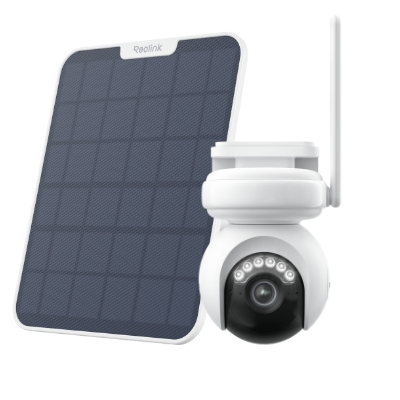
The Altas PT Ultra is the pan-and-tilt model in Reolink's Altas series. Because it's powered by a rechargeable battery and optional solar panel, there's no need for wiring or landlord approval to install it.
Reolink rates it to operate in temperatures from -20°C to 55°C, which is better suited to cold weather than other battery-powered cameras that typically bottom out at -10°C. It also packs a 20,000mAh battery, which is more than three times the capacity of many standard battery cameras. This allows it to run for months between charges.
Unlike a fixed camera that covers only one view, the Altas PT Ultra can pan 355° and tilt 90°, letting it monitor a much larger area. It can also automatically track moving people or vehicles as they cross a balcony, courtyard, driveway, or entryway.
The camera records in 4K resolution, providing enough detail to identify faces, licence plates, and other small details. Its 110° field of view covers a wide area, while Reolink's ColorX night vision captures full-colour footage after dark with the help of a built-in spotlight.
Built for outdoor use, the camera is IP65-rated for weather resistance and supports dual-band Wi‑Fi 6 for a reliable wireless connection. It also works with Google Home and Amazon Alexa.
Footage can be stored locally on a microSD card of up to 512GB, eliminating the need for a subscription. It can run for up to 500 days on a charge in motion-triggered mode, and a compatible solar panel can help keep the battery topped up with minimal maintenance.
Tom's Guide's review confirms the battery life holds up and night footage stays crisp. Still, treat any manufacturer temperature rating as a planning floor, not a guarantee. A severe enough cold snap can push a camera past its rated limit, so it's always best to mount it under an eave and out of direct wind rather than relying on the spec sheet alone.
One honest trade-off is it drops the infrared night-vision mode other Reolink cameras offer, which might not be suitable for anyone who plans to use it to monitor wildlife in absolute darkness. It's also noticeably bulkier than a single-lens camera.
4K Battery-Powered PTZ Camera with Continuous Recording
👍 4K UHD video with continuous recording
👍 ColorX night vision in low light
👍 Pan, tilt, and automatic person tracking
👍 Local storage without monthly fees
Reolink Altas (Two Cameras): Best for Homeowners with Driveways and Multiple Entry Points

The other configuration in Reolink's Altas series, the Altas swaps the pan-tilt motor for a fixed lens. Two units, one aimed at the driveway and one at a second entry point, will cover the same ground as a single dual-lens camera. Like the Altas PT Ultra, it's also a battery and solar-powered camera that can also withstand freezing temperatures of -20°C to 55°C.
The Altas is a bullet-style security camera powered by a 20,000mAh battery, offering up to 540 days of operation per charge in motion-triggered mode. It also comes with a 6W solar panel to help keep the battery topped up.
It records 2K (2560×1440) video using the same f/1.0 lens and ColorX full-colour night vision sensor as the Altas PT Ultra. Unlike its sibling, however, it uses a fixed lens, providing a constant 110° diagonal field of view instead of motorized pan-and-tilt tracking. It's IP66-rated, runs dual-band Wi-Fi 6, stores locally to a 512GB microSD card with no subscription, and works with Google Assistant and Amazon Alexa.
Independent testing calls ColorX night shots under a streetlamp "clean and colourful" without infrared, and rates the field of view wide enough for an average driveway or yard.
Honest trade-off: running two cameras costs more upfront than one PoE camera. Without pan-tilt tracking, a subject walking from one camera's view toward the other isn't followed the way a dual-lens handoff would follow them. Aim each unit at a fixed, high-traffic spot, a driveway entrance or a doorway, rather than open yard space.

2K Pre-recording Bullet Camera with a Long Lasting Battery
2K 10s Pre-recording ; ColorX Night Vision; 20,000mAh Battery; Dual-band Wi-Fi 6.
FAQs
Is Calgary a Nice Place to Live?
Yes. 80% of Calgarians call the city a safe place to live, and a separate City of Calgary survey puts that figure at 75%. It ranked among the world's 10 most liveable cities on the Global Liveability Index as recently as 2024, though it slipped out of the top tier in 2025 on weaker healthcare and stability scores. The main trade-off is property crime, not violent crime, and that's manageable with the same precautions any Canadian city calls for.
Is Calgary Worth Visiting?
Yes. Calgary sits about 130 km, roughly a 1.5-hour drive, from Banff National Park, making it a practical base for exploring the Canadian Rockies. It also hosts the Calgary Stampede each July, billed as the world's largest outdoor rodeo and drawing more than 1.2 million visitors. Violent crime in the city is low and mostly falling, and the areas tourists spend the most time in, downtown and the Beltline, are the same ones covered by CPS's CERT officers at key transit points.
Conclusion
Calgary's safety picture, backed by the CPS's 2025 data, adds up to a genuinely safe city with real geographic texture underneath. Southwest and northwest communities post the lowest incident rates. Downtown, Forest Lawn, and the northeast carry more nuance than their reputations suggest, mostly around property crime rather than violent crime.
Before choosing a neighbourhood, search your specific street on the CPS Community Safety Dashboard. The city-wide average only tells part of the story. Once you've settled on a home, property crime is what to plan for, not violent crime, and outdoor cameras built for Calgary winters are the most direct way to address it. For a start, that might mean one pan & tilt camera like the Altas PT Ultra covering a single vantage point, or two bullet cameras like the Reolink Altas cameras covering a driveway and entry point.
That covers the citywide picture down to hardware for a specific driveway. Got a question about anything covered here? Leave it in the comments and we'll get back to you.
Search
Subscribe for the Latest Updates
Security insights & offers right into your inbox