
Top Picks: 3 Best Security Cameras for Churches

Churches are unlike any other building you'd put a security camera in. They're designed to be open. That openness is the whole point but it's also what makes surveillance for churches quite difficult.
Most churches tend to start reviewing their security after something goes wrong, like a broken window or a missing offering envelope. What many discover next is that choosing the right camera isn’t straightforward. Churches have to balance looks, discretion, and coverage of large open spaces in ways that don’t really apply to homes or retail stores.
Below are three security cameras that are ideal for churches of all sizes. We’ll explain exactly where to install them for maximum coverage and how to make they are easy enough that a volunteer can monitor everything right from their smartphone.
Why Churches Need Dedicated Security Cameras
One of the most prevalent church security problems is donation theft. Cash is often taken at the service and is sometimes left unguarded, which can make them an easy target for theft.
Churches are also more susceptible to break-ins after hours, as the building sits unoccupied for the better part of each day, with no staff presence to deter or respond.
Incidents during services are also rising. According to recent reporting, attacks on houses of worship are intensifying worldwide, a trend that has pushed many congregations to review their security posture for the first time.
Then there's the architectural problem that home cameras aren't built to solve. Church sanctuaries and fellowship halls tend to be spacious with high ceilings. A typical home camera may fit a living room perfectly but could leave 80% of the sanctuary uncovered. Either multiple cameras or a single camera designed to sweep wide open areas is needed and for most churches, the latter is the more practical and cost-effective answer.
Finally, any church security camera must be simple enough for a non-technical volunteer to operate. Remote access via a phone app isn't a bonus feature here. It is what makes the system functional for a congregation that can't afford a dedicated security team.
Our Top 3 Picks for Church Security Cameras
Each camera below is chosen to solve a specific problem churches face. The idea isn't to buy all three on day one; it's to understand which fits your most pressing gap.
Reolink TrackMix PoE - Best for Monitoring Large Indoor Spaces and Entrances
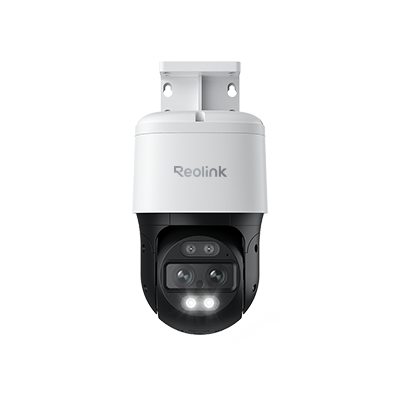
4K Dual-Lens PTZ Camera with Dual Tracking
4K 8MP Ultra HD, Wide & Telephoto Lenses, Pan & Tilt, Auto-Tracking, Person/Vehicle Detection, Power over Ethernet, Two-Way Audio.
A single Reolink TrackMix PoE can sweep an entire sanctuary or fellowship hall. This is coverage that would otherwise require three or four fixed cameras, along with the extra cabling, mounting, and NVR channels that come with them.
Its wide lens covers the full scene. When its AI detects movement, the tele lens closes in and the camera tracks the subject automatically. No operator required. If someone lingers near the offering area after a service ends, the camera follows them. It's the difference between a camera that records what happened and one that actively monitors while it's happening.
The dual-lens design also solves a specific technical problem. Conventional PTZ cameras frequently struggle with focus-hunting. The lens searches back and forth trying to lock on a moving subject, producing blurred footage in exactly the moments you need it most. But, the TrackMix PoE uses digital pan-tilt-zoom layered over a fixed dual-lens setup which avoids that issue entirely. The footage will stay stable and be usable as evidence, when required.
Note: The TrackMix PoE only takes up one channel on a Reolink NVR even though it has two feeds. This is a definite cost-saving benefit for churches that want to use it in their current system and not create a new one.
In a recent thread on Reddit discussing church security cameras, the recurring theme was the need for wide sanctuary coverage and remote access from a phone without driving to the building. The TrackMix PoE addresses both directly.

The ability to pan, tilt and zoom remotely and to check in from a phone to see what caused an alert was mentioned as the biggest benefit over a fixed position.
Reolink RLC-810A - Best for Entrances, Exits, and Donation Areas
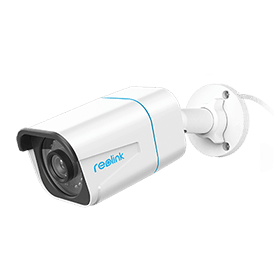
4K PoE IP Camera with Person/Vehicle Detection
Smart Person/Vehicle Alerts; 4K UHD Day; Night; 100ft Night Vision; Time Lapse; IP66 Certified Weatherproof; Audio Recording.
Reolink’s RLC-810A is a reliable, fixed angle fixed angle camera that delivers sharp 4K footage with a capability to capture clear facial details at a doorway from several metres away.
The built-in AI detection is also a real benefit to volunteer church security personnel. Instead of putting up an alert for every bird that passes over or tree branch that moves, the camera can be set to alert for real people and vehicles, whenever required. This helps ensure that alerts are taken more seriously when they are received.
The RLC-820A variant features a dome design suitable for ceiling installation and is far more discreet within a worship space than a bullet style camera. A well designed church camera plan typically places one or two units at each entrance and exit. The donation area is another natural fit for this camera as it can be visible enough to deter wrongdoing, yet sharp enough to document incidents clearly.
Reolink Argus 4 Pro - Best for Outdoor Areas and Locations Without Wiring
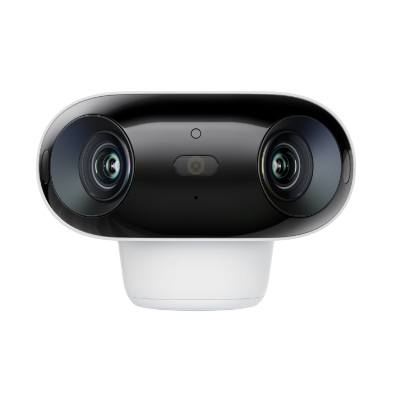
4k 180° Wire-free Color Night Vision Camera
4K UHD 180° Blindspot-free View; Color Vision Day and Night; 30% More Battery Life; Dual-band Wi-Fi 6; Smart detection.
With older church buildings, parking lots or side entrances often aren’t close to a power outlet, and installing conduit through old stone walls can quickly become too expensive. Reolink’s Argus 4 Pro breaks through the barrier. Paired with a solar panel, it runs continuously with no cable installation and no battery swaps. It’s a genuine zero-maintenance setup for a volunteer-managed property.
In poorly lit church car parks, the security camera’s color night vision can be what turns "a dark-coloured vehicle" into a usable description, and this is the kind of detail that can actually assist a police report.
Note: Certain battery powered and solar cameras record short video clips rather than continuous footage. This is usually fine for outdoor perimeter areas, where a clip is triggered when someone enters a parking lot or approaches a side door. However, these cameras aren’t suitable for locations that require uninterrupted, all day recording.
Where to Place Security Cameras in Churches
Fundamentally, placement could matter more than camera functions. A well-positioned mid-range camera tends to monitor better than an expensive one mounted in the wrong spot. Here are a few key spots to look at and how you can place them ideally.
Main entrance and front door - This area typically sees the most foot traffic and is also the most important to cover. Mounting a security camera at eye level (or slightly above) at this spot will help to capture clear, usable facial details of everyone entering. Make sure it’s positioned to frame faces as people approach the door, not after they’ve already passed through.
Sanctuary and main hall - Worship spaces are the hardest areas to cover due to their size and high ceilings. This is when a centrally mounted PTZ camera, such as the TrackMix PoE, can cover the entire floor area more effectively than multiple fixed cameras, which often leave overlapping blind spots. Mounting the camera from a balcony or raised rear area is ideal, as it provides a wide, unobstructed view while keeping the camera discreet and out of reach.
Donation and offering area - This is a high risk space because it often contains unattended cash and valuables. Even a small, visible camera aimed at the offering table acts as a strong deterrent when people can see the camera, it reinforces accountability and is more effective at preventing theft than a hidden one.
Parking lot - Many incidents can occur before and after services, when people are arriving or leaving the parking lot. Surveillance here should focus on identifying vehicles and individuals, not just providing an overview. It’s most ideal to mount weather resistant security cameras lower and angled toward the lot to capture faces and license plates properly. If running cables isn’t practical, solar or wireless cameras are a workable alternative.
Storage rooms, vestry, and cash-counting areas - These tend to be restricted access zones with also a lot of valuables in these spaces. To monitor these spaces properly, place a fixed security camera outside the door to record who enters and when.
Side doors and secondary exits - Many churches tend to overlook these areas, and it’s commonly exploited for break-ins because they're less visible from the street. At minimum, one weatherproof camera per secondary entrance/exit should cover this gap.
Accessories for Your Church Security Cameras
Getting the right camera is the first step. What you pair it with determines how well it actually performs day to day.
MicroSD card
For a church running individual standalone cameras, a microSD card is the most straightforward storage solution available. Aim for enough capacity to hold at least seven days of footage for wherever that camera is placed. A weekly check and clear-out of footage you don't need is usually sufficient to keep storage from filling up.
Solar panel
Relevant specifically to certain cameras like the Argus 4 Pro. With the solar panel, these eligible cameras can draw continuous power from daylight and eliminates the need for battery swaps entirely. For a church that's only staffed a few days a week, removing that maintenance step matters more than it might seem.
Mobile app
With mobile apps, monitoring can be so much more convenient for churches. A trustee or security volunteer can check a live feed, review a motion alert, or confirm a false alarm from their phone without being on-site. For smaller churches with no staff presence outside of services, this is what makes individual cameras genuinely functional rather than just recording devices nobody checks.
Fun fact: All three cameras on this list are accessible remotely through the Reolink app.
NVR (Network Video Recorder)
If your church ever reaches a point where one or two cameras aren't enough coverage, an NVR is the natural next step. It connects multiple wired PoE cameras (e,g. TrackMix PoE and RLC-810A) into a single centralised system, enables 24/7 continuous recording across all of them, and stores everything locally with no subscription fee.
PoE switch
Once you've filled the NVR's built-in ports, a PoE switch lets you keep adding cameras without replacing the recorder. It's a low-cost way to expand coverage as your needs grow, without rethinking your entire setup from scratch.
FAQs
Do you need permission to install security cameras in churches?
Generally, church leadership or the board of trustees can place cameras on church property without outside permission. Educating the congregation about the presence of cameras is a good practice, and cameras should be placed where private areas are not present, like restrooms, changing areas, counselling rooms etc. A simple announcement to the bulletin or on a posted sign is usually enough.
How much do church security cameras cost?
An average good outdoor or indoor camera can cost from $60 to $200 dollars. The complete starter system for the main entrance, sanctuary and one outdoor area consisting of an NVR and three to four cameras costs from $400 to $800. Unlike other all-in-one systems that require monthly subscription fees, Reolink's are subscription-free, which means that once you buy the equipment, there are no monthly fees.
Is it legal to have security cameras in churches?
Yes, in most jurisdictions, security cameras in churches are legal as long as they're in public facing rooms of the property, such as sanctuaries, hallways, entrances, and parking lots. Areas where people have reasonable expectations of privacy are not allowed. While laws differ by country and state, and a cursory check with a local legal adviser is warranted if your situation is unusual, there are no restrictions for most churches as to what type of camera(s) can be used in a common area.
Conclusion
Security cameras in a church aren't a contradiction of its purpose. They're how you protect it. A congregation that feels genuinely safe worships differently than one that doesn't and that sense of safety doesn't happen by accident.
The three cameras covered here address different layers of the same property: the TrackMix PoE for large indoor spaces that fixed cameras can't cover, the RLC-810A for the high-detail fixed-coverage that entrances and donation areas require, and the Argus 4 Pro for outdoor locations where wiring isn't a realistic option. None of them require a full-time operator or a monthly subscription to keep working.
With the shortlist of camera options and the placement guides, it’s time to start with a walkthrough of your church. Cover the locations where something has already gone wrong and where a crime could plausibly happen next first. The most effective church security cameras should be the ones capable of deterring against the specific risks your particular property is facing.
Search
Subscribe for the Latest Updates
Security insights & offers right into your inbox