
Reolink vs Eufy: Which Security Camera Brand Is Better?
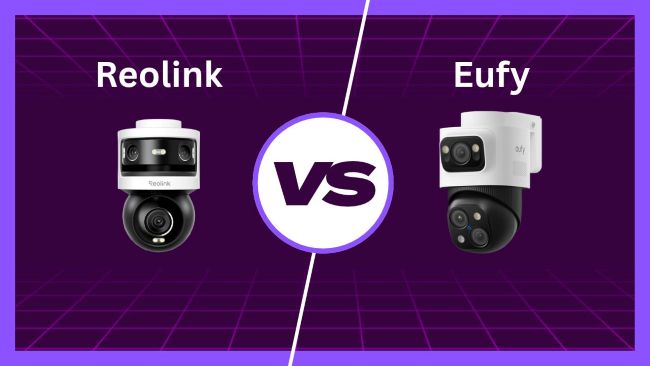
Reolink vs Eufy: Is One Company Better Than the Other?
Most people comparing between the Reolink and Eufy brand wants to know which company produces the better camera.
Reolink and Eufy are well-known names, and each sells wired PoE systems, wireless cameras, 4G cameras and video doorbells. What changes is how each system is built and who it suits.
To be clear, we make Reolink cameras. But, we want to be transparent about how we wrote this comparison article. Every claim comes from information listed on the brands' sites, from a brand's own manual or from a named review. We also match the closest models from each side, so you can compare like for like.
Reolink vs Eufy Security Cameras at a Glance
Most of the real differences show up in how the wired systems work and how open each brand is to other software.
*PoE stands for Power over Ethernet. It means one network cable carries both power and video.
**An NVR is a small recorder box that saves video from wired cameras.
How Reolink and Eufy Make Their Security Cameras
Camera brands split the work in different ways. Some design and build everything themselves. Others design in-house and hire factories to build the products.
Eufy is the smart home brand of Anker. Anker's 2025 annual report (in Chinese) describes its model as in-house design with outsourced production and purchasing. The report doesn't break this down by product line, so we can't say which factories build the Eufy cameras.
Anker also has a large R&D team. The same report counts 3,549 R&D staff at the end of 2025, or 56.3% of its workforce. Those figures cover all of Anker and not only Eufy.
As for Reolink, we handle our own hardware engineering, firmware development, and manufacturing across the board, selling across more than 110 countries.
Where Reolink and Eufy Are Similar
Neither brand needs a subscription to record video. Reolink cameras save to a microSD card, a hub or an NVR, with no subscription needed. Eufy also lists local storage with no monthly fee. Cloud storage is optional on both sides. On Reolink's side, local recording, live view and phone alerts stay free, and the optional cloud plans only cover select devices, so check the supported device list first. Eufy's cloud backup is an optional paid add-on.
4G cameras on either side need a data plan. A microSD card or hard drive may not come in the box, so check each listing.
The top end looks alike too. Each brand sells 4K cameras, and most detect people and vehicles. Many also spot animals. Online orders can be returned within 30 days under Reolink's return policy and Eufy's warranty and return policy.
Winter is another shared limit. Battery cameras on either side only charge between 32°F and 113°F (0°C to 45°C). Reolink's support guide and Eufy's eufyCam S4 battery article both give that range.
Where Reolink and Eufy Differ
In each part below, we start with how the two lineups compare. Then we match the closest models from each brand.
Reolink vs Eufy PoE Systems
Most of Reolink's PoE cameras are standard network cameras. They can work on their own or with a Reolink NVR. The cameras in some of the NVR kits are the exception. The cameras that come with the kit can't work without the NVR.
Eufy's PoE cameras are add-ons that work only with Eufy's own S4 and S4 Max NVRs. They can't run alone, according to Eufy's product pages. Eufy's support page also says its PoE NVR system doesn't work with cameras from other brands. A wired Eufy setup therefore means buying one of those recorders too.
Reolink NVRs work best with its own brand of cameras too. The difference is that Reolink's standalone PoE cameras can also feed other recorders through ONVIF, so you aren't tied to one brand of NVR. If you plan to use a different recorder, check that it supports ONVIF first.
Closest match cameras scenario: Reolink RP-PCB8M vs Eufy PoE Cam E40
Both are 4K PoE bullet cameras. The RP-PCB8M has a 125° view and infrared night vision up to 100 feet (30 meters). It also adds color night vision and an IP67 rating, and it carries a 3-year warranty.
The E40 has a 122° view and starlight color night vision, though Eufy doesn't list a night vision distance. Eufy's support page gives it an IP67 rating. Its warranty is 36 months.
Closest match NVRs scenario: Reolink RLN8-410 vs Eufy PoE NVR S4
On paper they're close, with 8 PoE ports, a 2TB drive and up to 16TB of storage each. Our RLN8-410 records up to 8 wired cameras. The other four of its 12 channels are for battery cameras on one hardware version.
Going past 8 cameras works differently on each side. Eufy's S4 and S4 Max NVRs have 8 ports and reach 16 channels with a PoE switch (not included according to Eufy). Eufy's PTZ cameras also use 2 channels each, so a 16-channel recorder holds up to 8 of them. Reolink's RLN16-410 has 16 PoE ports built in, so a 16-camera setup needs no extra switch. On our side, a PoE switch doesn't add channels to an NVR, so it's worth choosing the size you need up front.
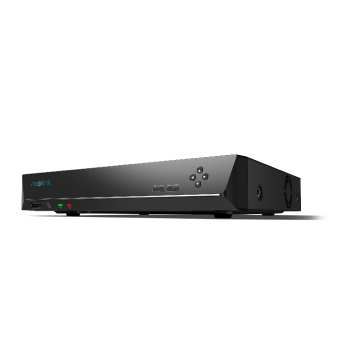
12-Channel PoE NVR
Supporting Up to 16MP, Power over Ethernet, 24/7 Continuous Recording, Expandable Storage Up to 16TB.
Battery and Solar Cameras
Wire-free cameras that run on solar power are available from each brand. The biggest practical difference is Wi-Fi. Most of Reolink's Wi-Fi cameras can join either the 2.4 GHz or the 5 GHz band, according to our Wi-Fi requirements guide. Some models, like the E1 and several Argus cameras, use 2.4 GHz only.
Eufy's support page says its devices support 2.4 GHz only.
The 2.4 GHz band reaches farther, and the 5 GHz band is faster up close. Dual-band cameras let you pick.
Closest match battery cameras scenario: Reolink OMVI 2i Ultra vs Eufy eufyCam S4
Each combines a fixed 4K wide lens with a second lens on a pan-and-tilt head, and solar power keeps them running. The OMVI 2i Ultra adds a 5MP pan-and-tilt lens that turns 355° and tilts 55°. It pairs with a 6W solar panel and a detachable 10,000mAh battery.
It also has infrared night vision up to 33 feet (10 meters), takes a microSD card up to 512GB and joins either the 2.4 GHz or 5 GHz Wi-Fi band.
The eufyCam S4 combines a 4K wide lens with a pan-and-tilt unit that has two 2K lenses. It comes with a 5.5W solar panel and has 32GB of storage built in. It works with or without a HomeBase hub.
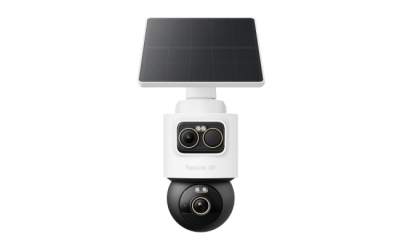
4K + 3K Dual-Lens PT & Bullet Wireless Security Camera
- 4K + 3K Dual-Lens with 360° Full Coverage
- SolarEase Endless Solar Power
- SyncTrack with Auto-Framing & Auto-Tracking
- AI Detection for Person, Vehicle & Animal
- Local Storage Up to 512GB microSD Card
Hubs and Local Storage
A hub is a small device that connects your wireless cameras and stores their video at home. Some cameras from each brand need a hub, and others work without one.
Closest match hub scenario: Reolink Home Hub Pro vs Eufy HomeBase S380
Reolink's Home Hub Pro comes with or without a built-in 2TB drive and takes a drive up to 16TB. Cameras keep recording to that drive during an internet outage.
Eufy's HomeBase S380 has 16GB of built-in storage and grows to 16TB with a drive you add. It also brings BionicMind face recognition and a 100 dB siren.
4G LTE Cameras
For places with no Wi-Fi, like a remote gate or a barn, each brand makes a 4G camera. These cameras need a mobile data plan and Reolink's cellular camera guide has a more in-depth explaination on how that works.
The difference is Wi-Fi. None of Reolink's 4G cameras connect to Wi-Fi. Eufy's 4G LTE Cam S330 can be switched between 4G and 2.4 GHz Wi-Fi. However, Eufy's support page says its older 4G Starlight Camera can't connect to Wi-Fi.
The S330 includes a SIM card with a short trial. Eufy estimates about 700MB of data a month for light use.
Closest match 4G cameras scenario
Reolink Go PT Ultra vs Eufy 4G LTE Cam S330.** These are 4K cameras that each offer a solar option. The Go PT Ultra pans 355° and tilts 140°, and it has infrared night vision up to 33 feet (10 meters). It takes a microSD card up to 128GB and has an IP64 rating.
Eufy's S330 pans 344° and tilts 70°. It comes with a 4.5W solar panel and a 32GB microSD card, and its rating is IP55. Its Wi-Fi fallback helps if your signal is patchy.
Reolink vs Eufy Doorbell Cameras
Doorbell cameras that run on a battery or on your existing doorbell wiring come from each brand, rated IP65 and able to detect packages.
Closest match doorbell cameras scenario
Reolink Battery Video Doorbell (2nd Gen) vs Eufy Video Doorbell E340.** Reolink's Battery Video Doorbell (2nd Gen) records a square 4MP view that shows a visitor's face and any packages on the ground. It lasts up to 300 days on a battery with five minutes of recording a day. It also uses dual-band Wi-Fi and works from 14°F to 131°F (-10°C to 55°C).
The Eufy E340 uses two cameras. A 2K main camera is joined by a second 1080p camera. It stores video on 8GB of built-in memory and lists face detection. For its network performance, it uses 2.4 GHz Wi-Fi only and works from -4°F to 122°F (-20°C to 50°C)
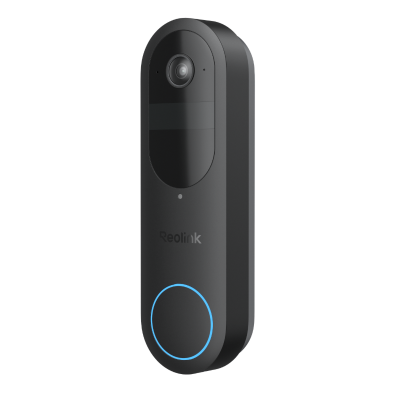
2K Akku-WLAN-Video-Türklingel mit smarter Erkennung
👍 2K 4MP Ansicht von Kopf bis Fuß
👍 Personen-, Fahrzeug-, Tier- und Paketerkennung
👍 bis zu 300-Tage Akkulaufzeit
👍 Lokale Speicherung ohne monatliche Gebühren
AI Detection and Face Recognition
Basic detection looks much the same across the two lineups. Most cameras pick out people and vehicles, some also spot animals, and doorbells add package detection. The clear gap is face recognition, which lets a camera learn the faces of people you know.
Face recognition is available on select Eufy devices, such as the HomeBase S380. It runs BionicMind, which uses faces to sort family from visitors. Reolink cameras do not offer facial recognition as it recognizes the concerns of privacy and data breaches.
Weatherproofing and Cold Weather
An IP rating shows how well a camera resists dust and water and higher numbers mean better protection. Every outdoor camera we checked, from Reolink and Eufy alike, is rated IP55 or higher.
For IP rating between the two companies' cameras, Cold weather splits the lineups. Reolink's standard cameras are rated for 14°F to 131°F (-10°C to 55°C). The Eufy wireless cameras are rated for -4°F to 122°F (-20°C to 50°C). The eufyCam S4 goes up to 131°F (55°C).
However, Reolink's Professional Series PoE cameras go lower, to -22°F (-30°C). Eufy's quick start guide for the PoE Cam E40 lists the same low of -22°F (-30°C) as a recommended range, so the wired pair differ more on heat than on cold.
Closest match wired cameras scenario
Reolink RP-PCB8M vs Eufy PoE Cam E40:** These two share an IP67 rating and a -22°F (-30°C) cold limit. The RP-PCB8M handles more heat, up to 131°F (55°C) against 122°F (50°C) for the E40.
Closest match wireless cameras scenario
Reolink Altas PT Ultra vs Eufy eufyCam S4:** The Altas PT Ultra and the eufyCam S4 share an IP65 rating and the same -4°F (-20°C) cold limit.
Note: Batteries slow down in the cold on both sides. Our solar panel guide says low temperatures slow the battery chemistry. Eufy's cold weather guide says its battery devices may stop working below -4°F until things warm up.
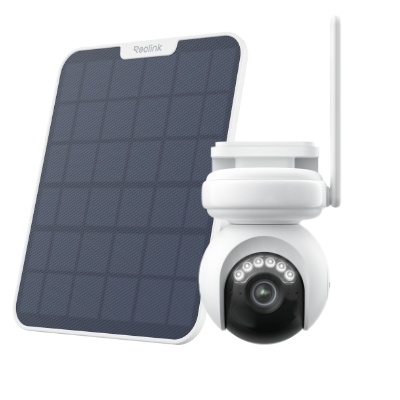
4K Battery-Powered PTZ Camera with Continuous Recording
👍 4K UHD video with continuous recording
👍 ColorX night vision in low light
👍 Pan, tilt, and automatic person tracking
👍 Local storage without monthly fees
Working With Other Software
RTSP and ONVIF are common languages that cameras use to share video with other software and recorders. Home Assistant is a free smart home hub that many people run at home.
Most of Reolink's standalone PoE and plug-in Wi-Fi cameras support ONVIF and RTSP on their own, according to our support guide. The NVR kit cameras, battery cameras and a few older Wi-Fi models need a Reolink Home Hub or NVR for that. The 4G cameras don't support them.
Home Assistant lists an official Reolink integration that works over your local network. Battery cameras generally need a hub or NVR to connect, and 4G cameras aren't supported.
Eufy takes a different route. Eufy's support page says the RTSP feature on its eufyCam line works with network storage that supports RTSP.
Home Assistant's own Eufy page covers only lights and switches from the EufyHome line and doesn't list Eufy's security cameras. Eufy's support page for the Indoor Cam E30 also lists Home Assistant as not supported.
Eufy cameras can still work with Home Assistant. Volunteers have built community add-ons for it. They aren't official, so support depends on whoever maintains them.
Warranty and Returns
Reolink's standard warranty is 2 years, plus 6 months if you register. Professional Series cameras get 3 years. The return policy gives you 30 days from delivery on store orders. You pay return shipping for personal reasons, and we pay it for dead-on-arrival and quality issues.
Eufy's policy covers its security cameras and the HomeBase for 12 months. PoE cameras and the NVR get 36 months. Eufy also offers a 30-day money-back guarantee.
Note: Be sure to check each policy for who pays shipping, since the terms differ by reason.
Which Brand Fits Your Situation
The decision between getting a Eufy or Reolink camera usually comes down to one or two features you can't live without.
This list helps you match a brand to your situation. It doesn't crown an overall winner.
- Want PoE cameras that stand on their own? Reolink's standalone PoE cameras run without an NVR and can feed other recorders, while Eufy's PoE cameras need one of its own NVRs.
- Need one camera that switches between Wi-Fi and 4G? Eufy's S330 does it. Reolink's 4G cameras work on 4G only.
- Is face recognition a must? Eufy offers it. Reolink cameras don't, out of concern for privacy and data breaches.
- Running Home Assistant? Reolink has an official integration. Eufy's cameras connect only through community add-ons.
- Mounting a wired camera somewhere extreme? The RP-PCB8M and the E40 both reach -22°F, but the RP-PCB8M handles up to 131°F against 122°F for the E40.
- Planning to grow one recorder over time? The Eufy NVR S4 starts at 8 channels and reaches 16 with a PoE switch you buy separately. Reolink's RLN8-410 stays at 8 wired cameras, and the RLN16-410 gives you 16 PoE ports from day one.
- Shopping for the longest warranty on wireless cameras? Reolink gives 2 years against Eufy's 12 months. On PoE cameras, Reolink's Professional Series and Eufy both give 3 years.
FAQs
Is Eufy or Reolink better?
Neither brand is better for every setup. Reolink fits if you want standalone PoE cameras, ONVIF and RTSP, or official Home Assistant support. Eufy fits if you want face recognition or a camera that can switch between Wi-Fi and 4G.
Does Eufy make PoE cameras?
Yes. Eufy sells PoE cameras such as the PoE Cam E40, E41 and S4. They work only with Eufy's own S4 and S4 Max NVRs and can't run alone. Eufy's PoE NVR system also doesn't support cameras from other brands.
Do Reolink and Eufy cameras need a subscription?
No. Local recording is free on Reolink and Eufy alike, with no monthly fee. Cloud storage is optional on both. Their 4G cameras need a separate mobile data plan.
Do Reolink and Eufy work with Home Assistant?
Reolink does through an official integration. Most of our battery cameras need a Reolink Home Hub or NVR to connect, and 4G cameras aren't supported. Eufy has no official integration for its cameras, though community-built add-ons can bring them in.
Which handles freezing weather better, Reolink or Eufy?
It depends on the camera. Our RP Professional Series PoE cameras and Eufy's PoE Cam E40 are both rated to -22°F. Among wireless cameras, Eufy's go down to -4°F, colder than our standard cameras at 14°F, and our Altas PT Ultra matches Eufy at -4°F.
Conclusion
Whether you would prefer to get a Reolink or Eufy security camera, it all comes down to your setup. If you want standalone PoE cameras, open standards or Home Assistant, Reolink is a more viable option. If you want face recognition or Wi-Fi and 4G in one camera, Eufy fits. Neither needs a subscription to record locally. When you're ready to match a camera to your space and you're keen to find out more about Reolink security cameras, see our full lineup.
Search
Subscribe for the Latest Updates
Security insights & offers right into your inbox