
Reolink OMVI Series vs Duo Series: Features, Specs & Use Cases
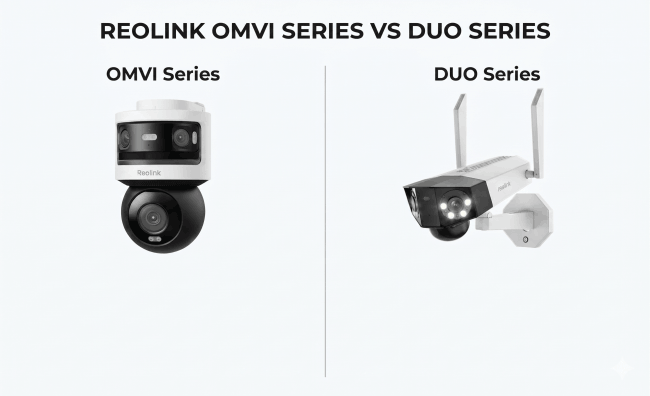
Choosing the right wide-angle security camera usually comes down to a classic compromise: do you want a static, seamless panoramic view, or do you need a camera that can actively spin and track a target?
Reolink tackles this dilemma head-on with two distinct design philosophies.While the established Reolink Duo series uses side-by-side lenses to stitch together a flawless, ultra-wide 180-degree static panorama, the OMVI series ups the ante by combining that same fixed panoramic view with a motorized, independent pan-tilt tracking lens underneath.
If you are trying to figure out which approach makes the most sense for your property, this breakdown compares the feature sets, tracking capabilities, and technical specs of the Reolink OMVI vs. Duo series side by side.
Introduction to the Reolink OMVI and Duo Series
Reolink designs its camera lineups to tackle specific surveillance challenges through distinct hardware configurations. The primary difference between the OMVI series and the Duo series lies in their lens architectures and how they capture expansive environments.
What Is the Reolink OMVI Series?
The Reolink OMVI series represents a hybrid, multi-lens approach to situational awareness. Instead of multiple independent lenses facing random directions, OMVI cameras combine two distinct camera systems into a single housing:
-
The Panoramic Unit: A fixed, dual-lens array at the top that continuously monitors a wide, static field of view.
-
The Pan-Tilt (PT) Unit: A motorized, independent lens positioned underneath that can rotate, tilt, and zoom to track moving targets.
Instead of outputting unrelated video streams, the OMVI series utilizes a dual-view linkage system. The top panoramic lenses provide a constant overhead map of the property, while the bottom PT lens automatically tracks any person or vehicle detected within that broad frame. This eliminates blind spots and ensures you never lose the big picture while tracking a specific event, for example, the flagship, OMVI 3i PoE.
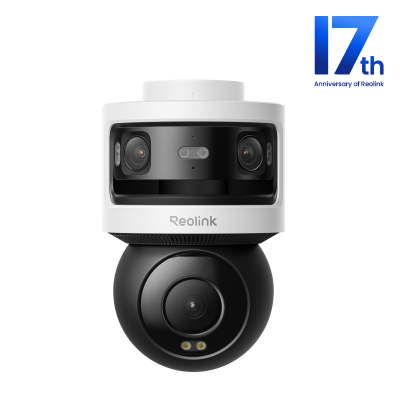
All-in-one Triple-Lens 180° Panoramic Pan-Tilt Security Camera
10MP Dual-Lens 180° View, 4K 360° Full Coverage, SyncTrack with auto framing & auto tracking, Local Storage (No Monthly Fees), Local AI Video Search.
What Is the Reolink Duo Series?
The Reolink Duo series is engineered specifically for seamless, ultra-wide static surveillance. It features two matched lenses mounted precisely side by side within a single fixed chassis.
Rather than displaying two disjointed or overlapping video feeds, the Duo series uses an onboard image-stitching algorithm. This technology blends the edges of both video feeds in real time, correcting for barrel distortion and alignment to output a single, continuous, and fluid 180-degree horizontal field of view.
Designed for set-and-forget coverage of large areas like backyards, parking lots, and storefronts, the Duo series delivers complete edge-to-edge coverage without the warped "fisheye" effect of a single ultra-wide lens. Additionally, many models feature powerful spotlights to maintain full-color night vision and precise AI-driven person, vehicle, and animal detection.
While both series are designed to eliminate blind spots in large areas, they accomplish this through entirely different hardware architectures, tracking capabilities, and resolutions.
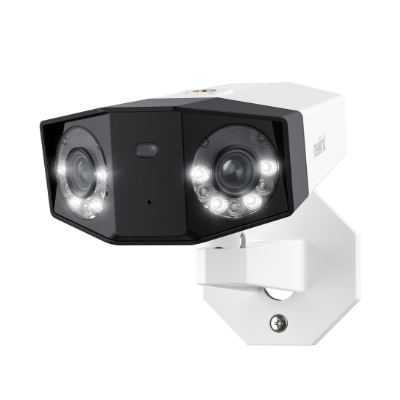
Groundbreaking 16MP Dual-Lens PoE Camera
16MP UHD, Dual-Lens, Motion Track, 180° Wide Viewing Angle, Power over Ethernet, Color Night Vision.
Reolink OMVI vs. Duo Series: Key Differences
1. Hardware Design & Form Factor
-
OMVI Series: Features a larger, distinct dual-body housing. The top section remains locked in place to anchor the panoramic view, while the bottom section is a motorized, rotating turret or dome. Because it contains mechanical motors for panning and tilting, it is heavier and requires a sturdy mounting surface with clear clearance for the moving components.
-
Duo Series: Utilizes a highly recognizable, compact "binocular" or wing-shaped chassis. It is entirely solid-state with no moving parts. Because it is lighter and lower-profile, it mounts quickly to walls, ceilings, or poles, and is much easier to tuck discreetly under eaves.
2. Lens Architecture & Field of View
-
OMVI Series: Uses a triple-lens, dual-unit system. Two lenses are fixed side-by-side at the top to stitch together a permanent 180° panoramic view. The third lens sits on the motorized PT mount below it, acting as an agile scout that moves independently to have a 360° coverage.
-
Duo Series: Uses a dual-lens, single-unit system. It features exactly two matched lenses aligned horizontally. There are no moving parts; the two lenses work exclusively in tandem to deliver one uninterrupted, static 180° overview of the property.
3. Resolution & Image Clarity
-
OMVI Series: Features asymmetrical resolutions between its units. The top panoramic array typically outputs a stitched dual-lens resolution (10MP), while the bottom PT tracking camera independently captures crisp, high-density video (often 4K) optimized for identifying fine details like faces or license plates at a distance.
-
Duo Series: Offers massive, symmetrical widescreen resolutions. While older models utilized dual 4MP sensors to create an 8MP (4608x1728) image, modern iterations feature dual 4K sensors stitched together to output a true 16-Megapixel (7680x2160) UHD** panoramic image, providing incredible clarity across the entire wide frame.
4. Auto-Tracking Capabilities
-
OMVI Series (Mechanical Tracking): This series excels at active tracking. It utilizes a dual-view linkage system: when a human or vehicle is detected anywhere in the top 180° panoramic view, the camera instantly commands the bottom PT lens to physically rotate, tilt, and optically zoom in on the target, tracking them smoothly across the property.
-
Duo Series (Fixed Coverage): This series does not feature mechanical auto-tracking. Because it is a fixed camera, it monitors everything simultaneously. It relies on its massive field of view to keep subjects on screen from edge to edge without needing to move.
5. Smart Features & AI Detection
-
OMVI Series: Its AI processing is split between global awareness and detail capturing. It can trigger smart alerts for people, vehicles, and animals across the panoramic field, while simultaneously applying tailored motion-tracking rules to the PT lens.
-
Duo Series: Applies its AI algorithms evenly across a single, massive 180° canvas. It features highly accurate person, vehicle, and animal detection across the entire stitched frame. Because the frame never moves, setting up precise, localized Motion Detection Zones and digital tripwires (smart fences) is incredibly reliable and straightforward.
Reolink Duo vs. OMVI Series: Comparison Table
The following table shows the main specifications side by side for easy comparison by users.
Where to Use Reolink Duo and OMVI Series? Installation Scenarios
The installation location and type of area determine which series delivers better results for users. Different environments match the strengths of each camera line in unique and helpful ways.
Where to Use Reolink OMVI Series?
-
Properties with multiple entry points or corners use the three lens coverage very well.
-
It watches several directions without the need for extra cameras on the property site.
-
Commercial buildings or warehouses use the multi lens design for efficient monitoring of areas.
-
Managers need to monitor loading docks and side areas at the same time with ease.
-
Locations with high foot traffic such as school yards use advanced tracking to follow people.
-
Sites that require detailed identification choose the OMVI series for high resolution close views.
-
Areas where blind spots create risks gain from overlapping fields of the three lenses.
-
They fill gaps in coverage that might exist with fewer lenses in the camera system.
Where to Use Reolink Duo Series?
-
Residential front yards and driveways work well with the wide panoramic view on screen.
-
It shows the entire approach in one image for easy monitoring by property owners.
-
Small business storefronts and entrances use the Duo series to watch customer activity well.
-
They watch across a broad area without multiple devices installed on the building walls.
-
Backyards or side yards where one wide angle suffices keep installation simple and costs lower.
-
Locations with limited mounting space fit the compact Duo body easily during installation.
-
Users who want straightforward wide coverage select the Duo series for ease of use.
-
It offers lower complexity compared to multi lens options in other camera series today.
Reolink OMVI vs. Duo Series: Pros and Cons
Choosing between these two series comes down to a choice between mechanical agility and seamless static coverage. Below is a balanced look at the advantages and limitations of each design philosophy.
Reolink OMVI Series
The OMVI series is built for users who want active, detailed tracking without sacrificing a global view of their property.
Pros:
-
Active Target Tracking: The motorized pan-tilt unit physically follows and tracks moving people or vehicles automatically.
-
Dual-View Linkage: You get the best of both worlds—a permanent, unmoving 180° overview and a close-up, dynamic tracking feed simultaneously.
-
Excellent Long-Distance Detail: Because the PT lens can physically move and focus, it captures sharp, actionable details (like faces or plates) farther away.
-
Zero Blind Spots During Tracking: While the moving lens follows a target, the top panoramic lenses never stop recording the rest of the yard.
Cons:
-
Bulkier Form Factor: The dual-body design and internal motors make it larger, heavier, and harder to hide under tight eaves.
-
Mechanical Wear and Tear: Because it relies on physical motors to pan and tilt, it has more moving parts that could experience wear over years of heavy use.
-
Higher Price Point: The inclusion of three lenses, internal motors, and dual-view processing hardware makes it a more premium financial investment.
Reolink Duo Series
The Duo series is the ultimate "set-and-forget" wide-angle camera, engineered to provide a massive, crisp perimeter wall of surveillance.
Pros:
-
Seamless 180° Panorama: Uses advanced onboard stitching to give you a true, ultra-wide view completely free of the warped "fisheye" distortion found in single-lens wide cameras.
-
Extreme Resolution Options: With flagship models offering up to a massive 16-Megapixels, it provides incredible digital zoom clarity across the entire static frame.
-
Low Profile & Compact: The solid-state, wing-shaped design is lightweight, highly durable, and blends discreetly into residential and commercial exteriors.
-
Solid-State Reliability: With zero moving parts or motors, the Duo series is incredibly robust, weather-resistant, and built for long-term durability.
-
Cost-Effective Coverage: It allows you to replace two or three traditional cameras with one single device, saving on both hardware and cable-running costs.
Cons:
-
No Physical Tracking: It cannot tilt up, down, or turn around. If an event happens just outside of its fixed arc, the camera cannot move to capture it.
-
Precise Placement Required: Because it is completely fixed, you must be highly strategic during initial installation to ensure the fixed frame perfectly covers your target areas.
Which One to Choose?
Choosing between the Reolink OMVI series and the Reolink Duo series comes down to a choice between active, mechanical tracking and set-and-forget panoramic overviews. Both fulfill different security roles depending on your property layout, budget, and tracking preferences.
Choose the OMVI Series If:
-
You want active tracking without losing the big picture: You need a camera that can physically pan and tilt to follow a person or vehicle across your property, while its secondary lenses continuously record the rest of the yard.
-
You want intuitive, touch-to-focus controls: You like the idea of seeing a wide panoramic view and simply tapping any spot on your smartphone screen to have a motorized lower lens instantly snap over and focus on that area.
-
Long-distance identification is crucial: You are monitoring a massive open space (like a long driveway or farm courtyard) where the ability to mechanically track on a target at a distance outweighs the simplicity of a fixed camera.
-
Your budget accommodates a premium hybrid device: You are willing to invest more upfront for a high-end, triple-lens system with advanced dual-view processing to replace what would traditionally require multiple separate cameras.
Choose the Duo Series If:
-
You prefer a completely fixed, solid-state system: You want a camera with zero moving parts or internal motors, maximizing long-term mechanical reliability and making it easier to tuck discreetly under standard eaves.
-
You want a massive, uniform resolution canvas: You want an ultra-high-resolution overview (up to 16MP on flagship models) where every single pixel of the $180^\circ$ panoramic view maintains incredible crispness for digital zooming.
-
Your primary goal is property line and perimeter monitoring: You are covering straight lines like storefronts, fences, or wide backyards where a permanent, unmoving digital wall of security is exactly what you need.
-
You want straightforward setup and lower costs: You prefer a highly cost-effective option that streams a single, unified panoramic video feed, which keeps network bandwidth usage lower and configuration simple.
FAQs
What Is the Difference Between Duo 2 and 3?
The main difference is resolution. The Duo 2 combines two 4MP sensors to create an 8MP panoramic view, while the Duo 3 uses two 8MP sensors to deliver a much sharper 16MP panorama. The Duo 3 also offers improved low-light performance and image processing for better detail and clarity.
Does the OMVI Series Have Three Lenses?
Yes. The OMVI Series features a triple-lens design with two fixed upper lenses that provide a continuous 180° panoramic view and one motorized lower lens that pans, tilts, and tracks people or vehicles. This setup enables both wide-area coverage and close-up tracking at the same time.
Conclusion
The Reolink OMVI series and the Reolink Duo series each serve distinct surveillance purposes well. They do this through their lens configurations and feature sets in different practical ways. The OMVI series excels in situations that demand multi directional high detail monitoring of areas well.
They also consider required detail level and available budget for the project on site now. Both lines deliver dependable video surveillance when installed and configured properly for the environment.
Search
Subscribe for the Latest Updates
Security insights & offers right into your inbox