
Lux vs. Lumens: What’s the Difference in Lighting?
LED packages say “800 lumens,” wall washers claim “500 lux,” and security cameras brag about “color night vision at 0.1 lux.” Shoppers and installers often pause at these lines because each label seems to describe the same idea—how bright the light is. The truth is that lux vs lumens answers two different questions about light. This article walks through that difference, points out when to use lux and lumens, and settles the lingering mix-ups once and for all.
What Is Lux vs. Lumens?
Lumens tell you how many drops leave the faucet every second. Lux tells you how many drops land on one square meter of ground. That simple picture guides every practical decision, from picking bulbs to aiming floodlights for a camera.
What is Lux?
Lux is a unit of light that falls upon a surface. The engineers define the lux as a lumen per unit area of a surface. Because lux is an indication of both the amount of light and its coverage area, the lux value varies when the same lamp is brought closer or taken farther, although the bulb itself is the same. Lux is a distance- and direction-dependent parameter because of this. The light (500 lux) of a flashlight at one meter will reduce to 125 lux at two meters, not because the bulb is weaker, but because it is spreading its light to a wider space.
What is Lumen?
Lumen is a unit of measurement of the total quantity of light being emitted in all directions by a source. The 60-watt-equivalent LED light could be referred to as 800 lumens, which is the total amount of visible light energy of the beams (front, side, and back).
Unlike lux, the number of lumens does not alter when you shift the bulb. It is set in the factory, on the box, and on the driver so that you can plan room layouts without doing additional calculations.
Lumens vs. Lux: What's the Difference?
When you see “3000 lumens” on a headlight, you understand the lamp itself puts out 3000 units of raw light. That fact is useful for comparing bulbs, lenses, and complete fixtures, but it says nothing about how bright the pavement will look when the car is fifty feet away. Lux fills that gap. Lux adds the condition of how and where that 3000-lumen bundle lands.
The lamp has not changed; only the concentration has changed. In short:
- Lumen = total light output.
- Lux = how dense that light is once it hits a surface.
Lux vs. Lumens vs. Candela: Comparison Chart
Understanding candela rounds out the picture about the lux vs lumens chart. Candela describes brightness in a single direction, much like lux, but it does not ask how far away the surface is. Think of candela as the laser on a range finder—tight, aimed, and measured at the source. The simple chart below shows differences between candela vs lumens vs lux.
Lux vs. Lumen: When to Use?
Some tasks call for knowing raw output, others for knowing actual coverage. In everyday lighting design and in smart home work, choose the right term so you do not over-light a hallway or under-light a driveway camera.
When to use Lux?
- Site surveys for offices or factory floors where safety boards require minimum lux levels on work surfaces.
- Garden lighting to check that paths have 10–20 lux so people can see without glare.
- Selecting a security camera because many cameras switch to night-vision only when lux drops below a given value.
- Dimming tests for cinema rooms where 50 lux on the screen may be the upper comfort limit.
When to use Lumens?
- Comparing LED bulb packages on the store shelf when the distance is still unknown. For example, high-lumen light bulbs in floodlight cameras enhance nighttime visibility and serve as an effective deterrent against security threats.
- Estimating total load in a lighting plan, such as 10,000 lumens for a 400-square-foot shop.
- Checking if a retrofit fixture can match the output of the old fluorescent fixture it will replace.
- Choosing a headlamp or bike light when the beam pattern varies, but total output is the only fixed trait.
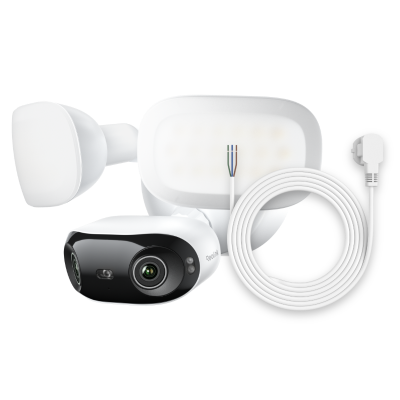
4K 180° Ultra-Wide Wired Floodlight Security Camera
3000-Lumen Dimmable Lighting, Adjustable Color Temperature, Local AI Video Search, Local Storage, Dual-Band Wi-Fi 6.
Lumen vs. Lux: Recommended Levels for Different Settings
Every room or task has lighting guides built on years of eye-strain studies and accident records. Agencies such as IES in the U.S. publish these numbers, and smart lighting apps already embed most of them.
- General living room: 100-300 lux on the sitting surfaces. A 12 ft x 15 ft living room (approximately 17 square meters) would require about 1700-5100 total lumens of all the fixtures combined.
- Kitchen countertop: 500 to 1000 lux for food prep. A 4000-8000 lumen downward light beam can be useful on an eight-foot island to counter overhead losses.
- Home office reading space: 300-500 lux on the desk. A one-square-meter desk can depend on a 500-lm task lamp up close or a 3000-lm ceiling lamp at a greater distance.
- Walk-in closet: 100-200 lux on shelving. Shelves 1 meter wide can be illuminated with 150 lux by an LED strip mounted 12 inches away with a 300-lm LED strip.
- Garage workshop: 300-750 lux on the bench. A two-car garage (approximately 36 m 2 ) requires 10,00027,000 lumens distributed evenly, so high-bay LEDs or four-foot LED tubes are usual.
How to Measure Lux and Lumens?
Handheld lux meters look like thick calculators with a white dome. You switch them on, set the range, and place the sensor at the height where work is done. Within seconds, the display shows lux at that spot. Moving the meter two feet forward can double the reading if the beam still narrows.
To convert between the two readings for square rooms, use this simple formula:
Lux = Lumens ÷ Area (in square meters).
FAQs
Is 5000 lux the same as 5000 lumens?
No. The raw value of the lamp is 5000 lumens, and 5000 lux is a density measurement on a surface that measures 1 square meter with all the 5000 lumens converging on it. On doubling the area of light to two square meters, the lux is reduced to 2500, with lumens remaining 5000.
What is better, lux or lumens?
Neither is superior; each addresses a different question. Use lumens when you purchase sources and check final results on a task surface with lux.
Is 10,000 lux the same as 10,000 lumens?
Again, no. A 10,000-lumen source would only produce 10,000 lux when the beam was limited to a space the size of one square meter, which is an unusual situation in real rooms.
Does 1 lux equal 1 lumen?
Only when the surface area is exactly one square meter. In a wider room, one lumen can produce far less than one lux.
Conclusion
When the topic of the conversation is the luxury of light, it is necessary to remember what the words lux and lumens denote. Lumens are constant in terms of the amount of light a source provides; Lux is variable in terms of distance, lens, and the color wall because it is a measure of the light that actually gets to where human beings and cameras observe the light.
Selecting the appropriate unit at the appropriate time-lumens at the cashier, lux at the worktable-will eliminate guesswork, energy waste, and compliance with safety codes. Did this article succeed in separating the facts and the box labels? Hopefully, you will share your own experience or a question that remained unanswered in the comments section below.
Search
Subscribe for the Latest Updates
Security insights & offers right into your inbox