
Coax vs Fiber: Which Internet Connection is Right for You?
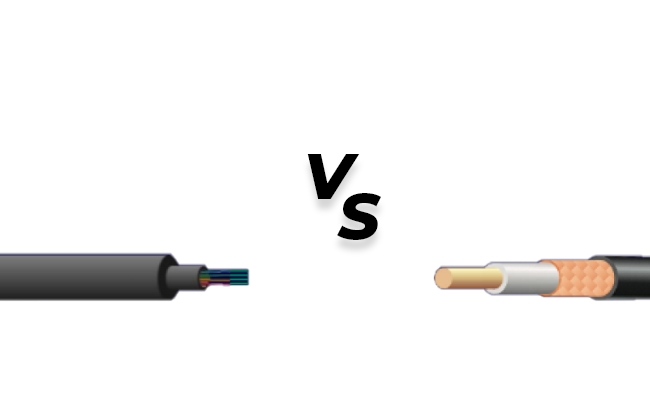
Fast internet is everyone's preference to ensure a smooth internet experience. Coax and fiber are the two common internet connections these days, and while installing a new internet connection, you have to decide which one to go with.
In this article, we will compare coax and fiber internet connections and explain their key differences. We will explain how these work and which one is better for your needs.
Coax vs. Fiber: Key Difference Between Them
The purpose of both cables is common, which is to transmit data. However, the properties vary by the transmission medium, material, speed, and bandwidth.
Coaxial cables were commonly used before and are still in demand for some purposes. On the other hand, fiber optics is the future and most in demand these days. Both connections are worthy, but fiber optics is way ahead of coax.
One of the major differences is the transmission medium. Coax cables use electrical signals over copper wire. While fiber optics uses light pulses passed through the glass and plastic fibers. The speed of data transmission via fiber optic is much higher than that of coax cables.
Fiber optics has a high bandwidth and low latency. On the other hand, Coax cables have low bandwidth and high latency, which may potentially cause delays in data transmission.
Coax vs. Fiber: Comparison Table
Coax vs Fiber: Basics Of Coax Internet
What is Coax?
Coaxial internet is usually referred to as cable internet due to its bulky wires. The data transmission is done through the same cable used in television. It has a few components, and each of them is highly essential to make it operational.
Here's a list of components used in Coax Internet.
- Cable Modem Termination System (CMTS)
- Cable Modem
- Coaxial cables
- Amplifiers
- Splitters
- Tap or Node
- Router
- Connectors
How Does Coax Work?
At first, the internet data is transmitted from ISPs to the Cable Modem Termination System (CMTS). The CMTS will then send this data to the relevant tap or node via coaxial cables. From the relevant node, the coaxial cable is supplied to the user's home. Here, it will be delivering signals to the cable modem, which is responsible for converting the incoming signals into usable data.
The data is further transmitted to a router from which a user connects the devices. The splitters are responsible for distributing the output in several neighborhoods, which can degrade the internet speed. To resolve the speed degradation, amplifiers are installed to boost the signals at longer runs to provide a smooth internet experience to households and businesses.
Coax vs. Fiber: Basics Of Fiber Internet
What Is Fiber Internet?
Fiber Internet provides the fastest data transmission via light over glass or plastic fiber. The new technology is being adopted everywhere because of its reliability and a smooth internet experience. It has unmatched upload and download speeds that can provide results within seconds.
It is primarily used in high-tech computing, streaming, and other high-end purposes.
Here are the necessary components responsible for the transmission.
- Optical Line Transmission (OLT)
- Fiber Optics Cable
- Fiber Distribution Hub
- Optical Splitters
- Optical Network Terminal
- Router
How Does Fiber Work?
The Optical Line Transmission (OLT), located at the service provider, is responsible for sending the data using light through the fiber-optic cable. The data is transmitted to the distribution hub at almost the speed of light. The signals are then en route to multiple users, which are separated using optical splitters.
The ONT is installed at the user's place and is responsible for converting the light signals into usable data. It is further connected to the Wi-Fi router, either 2.4 GHz/5 GHz, which enables users to connect multiple devices. The speed is consistent in fiber optics due to the transmission speed and different splitting.
Coax vs Fiber: Which Is Better? How To Choose?
Fiber internet capability is beyond expectations, which is better in every measurable way. It provides the fastest speed with symmetric download and upload speeds. It also remains unaffected in harsh weather conditions. The technology is highly scalable for future applications.
Moreover, it stands out as highly consistent in providing uniform internet speeds. It is suitable for real-time applications because of its low latency. Coax still exists in large volumes but is becoming obsolete due to high internet speed requirements.
Choosing between coax and fiber depends upon several factors. It is highly dependent on your location; if fiber is available, it would be a great option. The 2nd factor is your budget; if your budget is higher, you must prefer fiber optics. It is also highly dependent on the network speed requirements. Fiber is considered an ideal choice for high-end gaming and 4K/8K streaming.
Note: If you want a smooth experience in CCTV camera live feed, you also need an advanced camera that ensures fast speed and reliable connectivity. Reolink Duo 3 Wi-Fi is a dual-band Wi-Fi 6 security camera. It offers 16MP Ultra HD videos and real-time alerts without any lag.
FAQs
1. What are the disadvantages of fiber cable?
Fiber has limited availability in underdeveloped and remote areas. Its installation cost is higher compared to coax. It requires specialized installation and repair technicians. The cable is highly sensitive, so extreme bending would break the glass fibers inside.
2. Is Coax Obsolete?
No, Coax is not obsolete. People are still using Coax due to its affordability and availability. It might get outdated after a few years when the requirements become very high, and compatibility issues arise with high-tech devices and software.
3. Will fiber replace coax?
Yes, it is slowly replacing coax due to its high-speed data transfer. Moreover, it is the most reliable and robust option. The substitute is still in process due to high cost and low availability.
Conclusion
Fiber and Coax internet differ in the process of transmitting data. They have distinct capabilities. Fiber is a new technology with incredible performance, but it costs more. Coax is widely available and affordable, but it is not as fast as fiber. You have to decide based on the availability, budget, usage, and other factors. For future-proofing, there is nothing better than fiber.
Search
Subscribe for the Latest Updates
Security insights & offers right into your inbox