
What is CCTV? CCTV Full Form Explained and How It Works

If you’re wondering what CCTV means, this guide will give you a clear and simple explanation. CCTV stands for Closed-Circuit Television, a system that uses cameras to send video footage to a limited set of monitors for monitoring and security purposes.
While most people associate CCTV with security cameras, the term can also appear in different technical or industry contexts. In this article, we’ll explain the full form of CCTV, how it works, and its common uses in everyday life and security systems.
- What Is the Full Form of CCTV?
- Key Professional Terms Related to CCTV Full Form
- Interesting Facts About CCTV Meaning
- What Are Basic Parts of CCTV?
- How Do CCTV Cameras Work?
- Why Use CCTV in Modern Surveillance? Key Benefits Breakdown
- Where Is Commonly CCTV Used?
- What Are Common Types of Reolink CCTV and Its Advantages?
- FAQ
- Conclusion
What Is the Full Form of CCTV?
The full form of CCTV is Closed-Circuit Television.
Unlike standard broadcast television, which transmits signals openly to the public, a CCTV system operates on a private, "closed" loop. The video signals captured by the cameras are sent exclusively to a designated, limited set of monitors or recording devices managed by authorized users.
Because of their widespread use in property protection, a "CCTV camera" has become the industry-standard term for a security or surveillance camera used in residential and commercial environments.
Key Professional Terms Related to CCTV Full Form
CCTV Hardware Full Form
To better understand modern surveillance systems, it helps to know the specific technical abbreviations used alongside CCTV:
-
PTZ: Pan / Tilt / Zoom (Cameras that can mechanically rotate, tilt vertically, and zoom in on targets).
-
DVR: Digital Video Recorder (A recording device used primarily for analog CCTV systems).
-
NVR: Network Video Recorder (A digital recording device used for modern IP/digital CCTV systems).
-
PIR: Passive Infrared (A sensor technology that detects motion based on changes in heat signatures).
-
PoE: Power over Ethernet (A technology that transmits both data and electrical power through a single network cable).
-
IR: Infrared (Light spectrum used by cameras to capture clear black-and-white video in complete darkness).
Below are other important abbreviations related with CCTV cameras.
Core CCTV Storage, Streaming, and Compression Full Form
Beyond basic hardware, modern CCTV systems rely on specific network protocols, local storage architectures, and compression algorithms to transmit and save video data.
-
FTP (File Transfer Protocol): A standard network protocol used to securely transfer recorded video files from a CCTV camera over the internet to a remote server or offsite backup system.
-
NAS (Network-Attached Storage): A dedicated, hard-drive-equipped storage device connected to your local network. It allows multiple CCTV cameras to save and archive footage to a centralized location without requiring a dedicated NVR.
-
RTSP (Real-Time Streaming Protocol): A networking protocol designed to manage and control live video streams. It acts as the "bridge" that allows third-party software, smart home displays, and media players to pull a direct live feed from a CCTV camera.
-
RTMP (Real-Time Messaging Protocol): A protocol optimized for high-performance streaming of video, audio, and data over the internet. It is commonly utilized when broadcasting a CCTV camera's live feed directly to online platforms like YouTube or Facebook Live.
-
Home Hub: A centralized smart home management console or local server that bridges security cameras, sensors, and smart devices together, allowing for unified automation, local AI processing, and secure storage management.
-
H.264 / H.265 (Advanced Video Coding / High-Efficiency Video Coding): Industry-standard video compression codecs. While H.264 is the legacy standard, H.265 is the modern successor. It compresses high-resolution video files (like 4K and 16MP) up to 50% more efficiently than H.264, cutting storage space and internet bandwidth consumption in half without losing image quality.
Interesting Facts About CCTV Meaning
Apart from its basic definition, there are also fun facts about CCTV meaning. Check them below:
-
The earliest documented application of the CCTV camera system dates back to 1942 – longer than you may think. Walter Bruch, a noted German engineer, designed and installed the system that used CCTV cameras to observe the launch of V2 rockets on monitors.
-
It wasn't until 1949 that the CCTV system was first used commercially. In that year, an American company launched Vericon, to keep an eye on dangerous industrial processes or bring a close-up of surgical operations to students.
-
Thanks to CCTV technology, audiences can enjoy pay-per-view sports streaming in the 1970s. "The Rumble in the Jungle" fight alone drew jaw-dropping 50 million CCTV viewers worldwide at that time – a quite historical event!
-
The primitive CCTV systems was not applied in security monitoring until 1968 when New York was first to install video cameras in an effort to fight crime. Since then, CCTV cameras began to spread across the world – rapidly and unstoppably.
-
There are more than 350 million CCTV cameras worldwide mainly for security monitoring in public areas or private residences – a truly enormous amount!
-
If you are in the US, you will be captured by security cameras over 200 times a day - not a surprise if you know every 10 people in America own more than one security camera.
-
People in different countries may have different names for security cameras, like surveillance cameras or IP cameras. The British prefer to use “CCTV cameras” when they mention security cameras.
-
A majority of CCTV cameras are IP cameras that connect to the Internet and can be accessed wherever the Internet is available. That means CCTV cameras are not totally “closed-circuit” anymore.
What Are Basic Parts of CCTV?
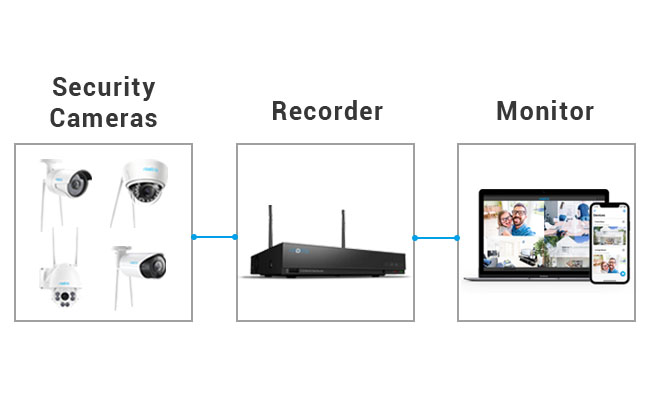
A CCTV system is made up of several core components that work together to capture, transmit, and store video footage.
1. Security Cameras
These are the “eyes” of the system. They capture video footage of the monitored area using image sensors.
2. Transmission System
This is the connection that carries video from the camera to the recorder.
- Wired systems use Ethernet (PoE) or coaxial cables
- Wireless systems use Wi-Fi networks
3. DVR or NVR (Video Recorder)
This device records and manages video footage.
- DVR works with analog cameras
- NVR works with IP (digital) cameras
4. Storage Device
This is where video footage is saved.
- Hard drives inside DVR/NVR systems
- SD cards in cameras
- Cloud or NAS storage for remote backup
5. Display Device
This allows you to view live or recorded footage.
- Monitor connected to the system
- Mobile app or web browser for remote access
How Do CCTV Cameras Work?
A CCTV camera system originally consisted of security cameras and monitors. Over time, recording devices were added, allowing users to store and review footage whenever needed.
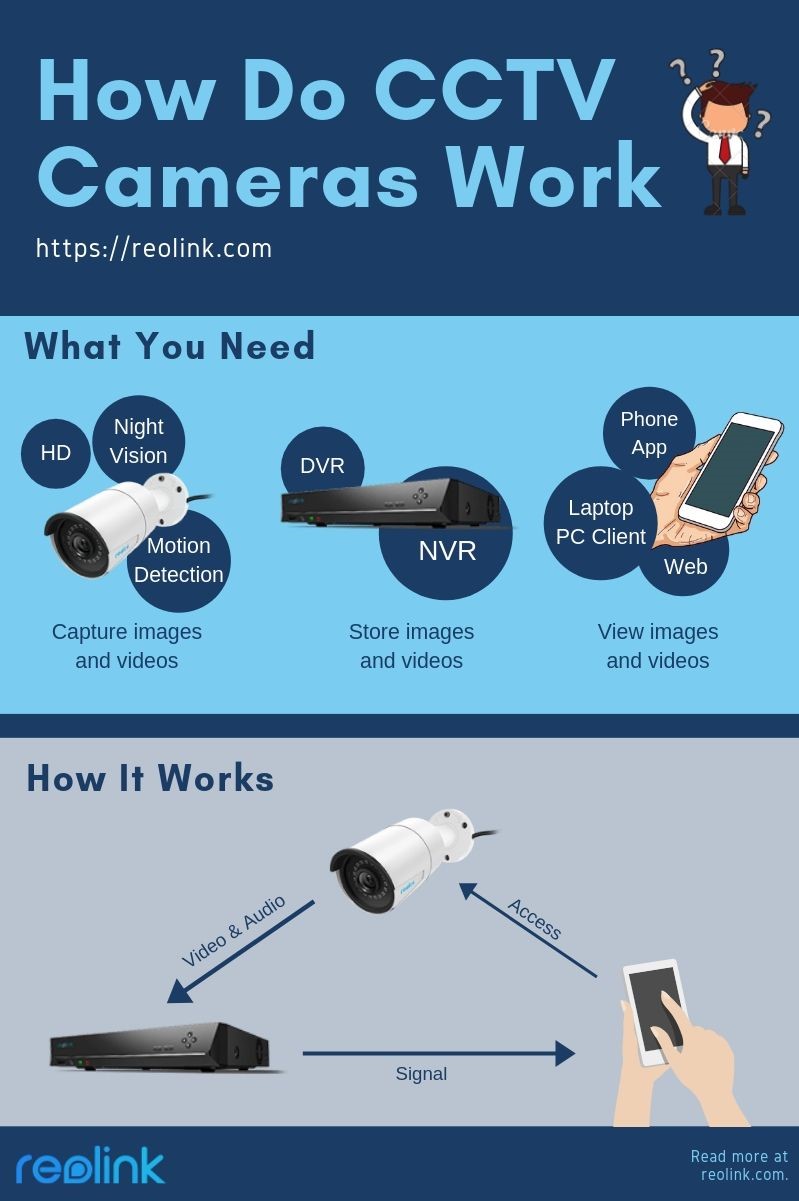
A typical CCTV system works through the following process:
1. Security Cameras Capture Video and Audio
Security cameras use lenses and image sensors to capture live video streams. After years of development, modern surveillance cameras can provide higher resolution images and clearer audio than ever before.
Many cameras also support color night vision, allowing them to capture clear, full-color footage even in low-light or nighttime conditions.
2. Motion Detection Helps Identify Activity
Most CCTV cameras are equipped with motion detection sensors that can trigger alerts when movement is detected.
These features help users monitor important events and serve as a dependable safeguard against burglary and theft.
3. Footage Is Sent to a Recorder
After capturing video or audio, CCTV cameras transmit signals to security camera recorders for storage and playback.
The most common recording devices are:
- DVR (Digital Video Recorder) — typically used with analog CCTV cameras
- NVR (Network Video Recorder) — typically used with IP security cameras
These recorders enable 24/7 continuous recording and make it easy to review important moments later.
4. Videos Can Be Stored Locally
In addition to DVRs and NVRs, some high-end CCTV cameras also include a microSD card slot.
This allows motion-triggered video clips to be stored directly on the camera for local backup and easy access.
Note: Some advanced CCTV cameras support both recorder-based storage and microSD card storage.
5. Users Can View Footage Anytime
Recorded videos stored on DVRs, NVRs, or SD cards can be replayed at any time.
Users can access footage through:
- Mobile phones
- Computers
- TV monitors
Many modern CCTV systems also support remote viewing, allowing you to monitor your property even when you are far away.
Why Use CCTV in Modern Surveillance? Key Benefits Breakdown
Where Is Commonly CCTV Used?
CCTV cameras, the abbreviation of closed-circuit television cameras, are applied in wide range for different purposes.
1. Crime Prevention and Detection
The primary use of a closed-circuit television camera (the CCTV camera of full form) is warning and deterring burglars, thieves and other criminals.
For example, Reolink OMVI 3i PoE has a motion detector and a built-in siren alarm. When detecting invaders’ movements, it can trigger siren sounds that are effective deterrents for the crime.
At the same time, this camera would send instant push notifications or emails to your mobile phone for you to take response actions and protect your properties.
2. Taking Care of Elders, Children & Pets
Many families use closed-circuit television cameras, the full form of CCTV cameras, in home to keep track of elders, children or pets. After an appropriate setup, you can check in CCTV cameras if elders fall down, children arrive home safely or pets eat food on time.
3. Record Valuable Moments
The beautiful moments of life won't be missed out or blurred over time, thanks to your CCTV cameras that can always witness and record something unbelievable, memorable or even crazy.
You can review the snowball fight with your kids or interesting Halloween party on your phone anytime, or download it on your computer for a backup.
4. Business Monitoring
Monitoring of critical areas such as storefronts, offices or warehouses mainly requires the system of closed-circuit television (the CCTV long form) to take care of your properties or improve employees’ productivity.
No matter you own small or big businesses, with or without Internet access, you can choose the most suitable security camera for your business based on your specific needs.
What Are Common Types of Reolink CCTV and Its Advantages?
Reolink has established itself as an industry leader in modern surveillance by offering high-performance, subscription-free security ecosystems. Their product lineup moves away from complicated legacy closed-circuit layouts, focusing instead on user-friendly, intelligent digital setups.
Reolink CCTV cameras generally fall into three distinct categories, each engineered to address specific layout challenges and structural environments.
1. PoE (Power over Ethernet) Cameras
PoE cameras represent the gold standard for high-bandwidth, professional-grade home and commercial surveillance. These digital IP cameras utilize a single Cat5e or Cat6 network line to transmit ultra-high-definition video data and 48V of stable DC electrical power simultaneously.
Top Examples:
Reolink Duo 3V PoE (16MP ultra-wide dual-lens panorama)
Reolink OMVI 3i PoE (18MP triple-lens multi-tracking PTZ setup).
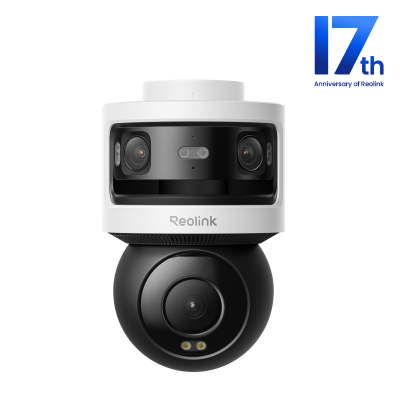
All-in-one Triple-Lens 180° Panoramic Pan-Tilt Security Camera
10MP Dual-Lens 180° View, 4K 360° Full Coverage, SyncTrack with auto framing & auto tracking, Local Storage (No Monthly Fees), Local AI Video Search.
Key Advantages:
-
Rock-Solid Reliability: Free from Wi-Fi dropouts, signal interference, or battery drainage issues.
-
Extreme Resolution Support: Capable of streaming massive, uncompressed 4K and 16MP video files effortlessly.
-
Long-Distance Runs: A single cable can safely transmit data and power up to 330 feet (100 meters) away from an NVR or PoE switch.
2. Standalone Wi-Fi Cameras (Plug-in & Dual-Band)
Designed for properties where routing Ethernet lines through walls or attics is structurally impossible, Reolink’s dual-band Wi-Fi cameras offer high-resolution monitoring using traditional electrical plug-in power.
Top Examples: Reolink E1 Zoom or the Reolink TrackMix Wi-Fi.

PTZ Wireless Smart Home Camera
Smart, Powerful and Affordable All-Round Home Protection. 355° Pan and 50° Tilt; 4K Ultra HD, 3X Optical Zoom, Two-Way Audio, 2.4/5 GHz WiFi, with Google Assistant Integration.
Key Advantages:
-
Dual-Band Connectivity: Operates on both the 2.4GHz band (for long-range penetration through walls) and the 5GHz band (for high-speed, low-latency video streaming).
-
Continuous 24/7 Recording: Because they plug into local electrical outlets, they are not constrained by battery-saving sleep cycles and can record non-stop straight to an internal microSD card or a local NAS setup.
3. Battery & Solar-Powered Wire-Free Cameras
The ultimate solution for remote locations, off-grid cabins, construction sites, or detached fence lines where neither power cords nor network cables can reach.
Top Examples: Reolink Altas PT Ultra (4K continuous recording battery camera) or the Reolink Argus series.
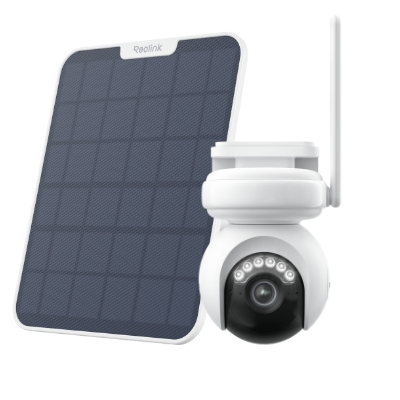
Industry-leading 4K Continuous Recording Battery Camera
4K UHD Continuous Recording; ColorX Night Vision; Pan & Tilt; Automatic Tracking; All Recordings Stored Locally.
Key Advantages:
-
Zero Cable Infrastructure: 100% wire-free operation makes installation as simple as mounting a bracket onto a tree or post.
-
Eco-Friendly Continuous Power: Paired with a Reolink Solar Panel, the high-capacity onboard batteries remain continuously topped off, eliminating the need to manually take cameras down to recharge them.
Core Advantages of the Reolink CCTV Ecosystem
Regardless of which camera type you choose, the Reolink platform provides several distinct structural advantages over traditional CCTV networks:
Local, On-Board Edge AI Processing
Reolink cameras analyze video data right at the source. The system accurately classifies people, vehicles, and animals in real time. This filters out 95% of false alarms (like blowing wind or passing bugs) and enables lightning-fast keyword archive filtering without needing a costly cloud server.
No Mandatory Subscription Fees
Unlike many competitors that lock core features behind monthly paywalls, Reolink offers a true buy-it-and-own-it pricing model. High-end features—such as smart AI person/vehicle detection, instant push alerts, time-lapse creation, and multi-user remote smartphone streaming—are completely free and processed locally on the hardware.
Flexible Open-Protocol Storage Options
Reolink software leaves your data architecture entirely in your hands. While they sell dedicated Network Video Recorders (NVRs), their wired and plug-in cameras natively support RTSP, RTMP, and FTP transmission protocols. This allows you to stream live video seamlessly to third-party dashboards, integrate with a smart Home Hub, or archive weeks of footage directly to your own local NAS setup.
High-Efficiency Video Coding (H.265)
To accommodate massive video files like their signature 16MP panoramic feeds, Reolink utilizes advanced H.265 compression codecs. This technology cuts bandwidth and local hard drive consumption by up to 50% compared to older legacy systems, ensuring your local storage drives last twice as long without losing any fine-grain visual detail.
FAQ
What does CCTV stand for?
CCTV stands for Closed Circuit Television. Essentially, it's a system that uses video cameras to transmit signals to a specific set of monitors. The "closed circuit" part of it means that the cameras are connected to the monitors through a private transmission system, which ensures that only authorized individuals can view the footage.
What is the difference between CCTV and surveillance cameras?
CCTV cameras are a type of surveillance camera, but surveillance cameras can include a wider range of modern, internet-connected security solutions. CCTV cameras often operate on a closed system, while surveillance cameras include IP cameras, wireless cameras, and cloud-based security systems..
What is the main purpose of CCTV?
The main purpose of CCTV is to provide continuous monitoring and surveillance for security and safety. It can help you deter crimes and monitor daily activities effectively.
Conclusion
Our explanation of the full form of CCTV provides insight into its vital role in surveillance solutions. If you have any other ideas about CCTV meaning in the security industry, its types and uses, please feel free to leave comments below.
Search
Subscribe for the Latest Updates
Security insights & offers right into your inbox