
Solar Doorbell Camera: Eco-Friendly Security
Choosing the right solar doorbell camera depends entirely on your home's daily sunlight exposure, localized climate conditions, and your preferred local storage setup. If you want continuous front door monitoring without drilling, messy wiring, or monthly electricity costs, a solar-powered system is a highly efficient choice.
However, before you buy, it is critical to understand how these devices manage power in winter, what technical specifications guarantee reliable streaming, and when a wired or battery alternative makes more sense for your property.
- What Is a Solar Doorbell Camera?
- How Does a Solar Powered Doorbell Camera Work?
- Why Choose Solar Doorbell Cameras for Home Security?
- 5 Key Features to Look for in the Best Solar Doorbell Camera
- Best Solar Doorbell Camera for Your Home Setup
- How to Install and Set Up a Solar-Powered Video Doorbell for Maximum Performance?
- Solar Doorbell Camera vs Other Types: What's the Difference?
- What Users Say About Solar Doorbell Cameras?
- FAQs
- Conclusion
What Is a Solar Doorbell Camera?
A solar doorbell camera is a wire-free smart video doorbell that relies on a dedicated solar panel to continuously recharge an internal battery. It provides real-time front door monitoring and wireless Wi-Fi streaming without needing a connection to your home's electrical grid.
Unlike traditional hardwired models, a solar video doorbell functions as a self-sustaining security device. Structurally, it shares the exact same core features as a standard Wi-Fi smart doorbell—such as high-definition video capturing, motion sensors, and two-way audio.
The defining difference is its power infrastructure, which completely eliminates the need for manual battery recharging or running specialized low-voltage transformer wiring through your walls. For networking and data transmission, the device connects to your local 2.4 GHz or 5 GHz Wi-Fi router subnet, streaming live feeds and alerts to your smartphone or local storage hub.
How Does a Solar Powered Doorbell Camera Work?
Solar-powered doorbells use a solar panel to convert ambient sunlight into electrical energy, feeding power directly into a high-capacity rechargeable battery.
The solar panel may be built into the doorbell or installed separately in a sunnier location, which is useful for shaded porches.
At night or during cloudy weather, the doorbell runs on stored battery power. This allows it to continue sending motion alerts, recording video, and using night vision without an AC outlet or PoE connection.
Why Choose Solar Doorbell Cameras for Home Security?
Continuous Local Security Recording
Solar-powered video doorbells enhance property security by providing a localized, round-the-clock visual record of all front-door activity. The system uses intelligent triggers to log every meaningful motion event, ensuring you have clear video documentation of deliveries, visitors, or suspicious activity.
Instant Remote Access Anywhere
You can access your solar doorbell's live video stream globally right from your smartphone. Using a secure companion mobile application, you can pull up a real-time live preview of your entryway at any moment, whether you are at work or traveling abroad.
Real-Time Two-Way Communication
The integration of two-way audio allows you to speak directly with visitors and delivery drivers through your phone. If you are unavailable or away from home, you can tap into the app to play pre-recorded voice messages to safely instruct visitors or couriers.
Complete Grid-Independence During Power Outages
Because a solar video doorbell relies on its localized battery reservoir, it remains 100% operational during blackouts or electrical grid failures. Your home perimeter protection stays active even when traditional wired security systems go dark.
Zero Utility Costs and Minimal Installation Fees
Solar doorbells operate with absolutely zero ongoing electricity expenses and require no specialized wiring. There is no need to hire an electrician to run long extensions or invest in costly Power-over-Ethernet (PoE) cabling to power up the unit.
Effective Proactive Deterrence
The visible presence of a smart doorbell camera acts as a psychological barrier that actively deters opportunists and intruders. Visible lenses, coupled with customizable motion-activated alerts, signal to passersby that your property is actively monitored, preventing crime before it happens.
5 Key Features to Look for in the Best Solar Doorbell Camera
Peak Sunlight Exposure and Panel Orientation
A solar doorbell panel requires a minimum of 2 to 4 hours of unshaded, direct sunlight daily to properly offset the energy consumed by daytime video capture and alert processing. Without sufficient light exposure, the internal battery will slowly drain, eventually requiring a manual plug-in charge.
When evaluating your front entrance, check if the mounting location is blocked by roof overhangs, deep porches, or heavy tree foliage.
If you choose a model with a solar panel integrated directly onto the doorbell frame, the entire unit must face toward open sky. For entryways that sit in permanent shadow, the most reliable alternative is an external, adjustable solar panel connected to the doorbell via a thin, weatherproof low-voltage wire. This configuration allows you to mount the camera in the shade while placing the photovoltaic panel higher up on a sun-drenched fascia or gutter line.
Internal Battery Capacity and Efficient Recharging Cycles
The device's internal lithium-ion battery must feature a high enough mAh capacity to power the device for at least 24 to 48 hours of continuous, sunlight-free operation. At the same time, the solar panel's wattage must be powerful enough to efficiently charge that battery within a few hours of peak daylight.
The solar panel acts purely as a trickle charger during daylight hours; during high-traffic periods and throughout the night, the doorbell draws 100% of its operational current straight from the battery reservoir.
Additionally, look for systems engineered to charge efficiently even in low-light environments, ensuring that a brief window of sunlight is enough to stabilize the battery levels.
Certified Weather Resistance Ratings
Because the camera is completely exposed to outdoor environments, it must feature a certified Ingress Protection rating of at least IP65 or IP66 to guarantee complete protection against heavy downpours, blowing snow, and dust intrusion.
Outdoor surveillance hardware faces severe seasonal stress, from freezing winter snow to intense summer UV radiation. Cheaper hardware models with poorly sealed seams easily fall victim to internal moisture condensation, which permanently shorts out the motherboard and fogs up the optical lens.
Ensure the manufacturer explicitly certifies the unit's operating temperature range matches your local climate, paying close attention to the rubberized sealing boots that shield the MicroSD slots and power input ports.
WiFi Signal Strength and Frequency Bands
A solar doorbell requires a stable, high-throughput wireless connection at the installation spot to prevent lag, pixelation, or missed motion alerts.
Because solar units completely discard physical Ethernet data cables, they are entirely dependent on your local home Wi-Fi network to stream video data. Exterior brick, stucco, and reinforced concrete walls block wireless frequencies heavily, meaning a router located in the center of the house may struggle to push a clean signal to your front door.
Note on Bandwidth: Dual-band doorbells that support both 2.4 GHz and 5 GHz frequencies offer the best flexibility. The 2.4 GHz band provides longer range and penetrates solid walls more effectively, while the 5 GHz band offers much faster data transmission speeds for crisp, high-resolution streams. If your signal is weak, installing a dedicated Wi-Fi extender near the front wall is highly recommended.
Advanced Smart Features and Optical Clarity
To deliver actionable security, a solar doorbell camera should feature a resolution of at least 2K (4MP), responsive two-way audio, and advanced ambient night vision capabilities.
-
Video Quality: Upgrading from standard 1080p to a minimum of 2K or 4K resolution allows you to digitally zoom in on small, distant details—such as delivery labels—without the image dissolving into pixels.
-
Audio and Ecosystem Integration: Two-way audio is a fundamental safety feature, enabling you to clearly instruct couriers or deter unwanted loiterers from your phone. Finally, verify that the doorbell natively integrates with your existing smart home hubs (like Google Home, Amazon Alexa, or localized Wi-Fi NVR networks) to build a unified perimeter defense.
Best Solar Doorbell Camera for Your Home Setup
For a flexible, wire-free front-door setup, consider the Reolink Video Doorbell (2nd Gen). When paired with the Reolink Doorbell Solar Charger (sold separately), it can use solar energy to help maintain the battery and reduce manual recharging.
Built with the Qualcomm® Micro-Power Wi-Fi solution, the doorbell can deliver up to 300 days of runtime per charge under Reolink’s test conditions. It also provides 2K 4MP video, a 1:1 head-to-toe view, dual-band Wi-Fi, two-way audio, and smart detection for people, vehicles, animals, packages, and visitors.
For subscription-free recording, it supports a microSD card of up to 512GB, Reolink Home Hub, compatible NVRs, and FTP storage. This makes it a practical choice for sunny entrances, rental homes, and locations where running new power cables is difficult.
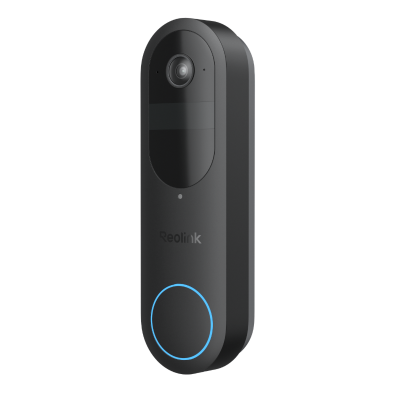
2K Battery Wi-Fi Video Doorbell with Smart Detection
- 2K 4MP Head-to-Toe View
- Person/Vehicle/Animal/Package Detection
- 300-Day Lasting Battery Life
- No Monthly Fees for Local Storage
How to Install and Set Up a Solar-Powered Video Doorbell for Maximum Performance?
Step 1: Optimize Panel Orientation
- Ensure the solar panel receives 2 to 4 hours of unshaded, direct sunlight daily to prevent slow battery drainage.
- Mount the panel on a south- or west-facing surface (if in the Northern Hemisphere) to achieve maximum solar yield.
- If your doorway sits under a deep shadow or porch awning, use an external panel mounted higher up on an unshaded roof or gutter line.
Step 2: Audit Wi-Fi Strength
-
Verify your wireless signal reading at the exact mounting spot to prevent streaming lag and pixelation.
-
Select the 2.4 GHz frequency band over the 5 GHz band because its longer wavelengths penetrate solid exterior walls far more effectively.
-
Install a wireless extender near the front wall if building materials (like brick, stone, or concrete) choke your connection.
Step 3: Secure Weather-Resistant Seals
-
Verify your hardware carries a certified rating of at least IP65 or IP66 to withstand severe rain, snow, and wind.
-
Ensure all protective rubber boots over internal card slots and power ports are perfectly flush and seated.
-
Apply a thin bead of outdoor silicone around the top and sides of the mounting bracket to keep moisture from pooling near the electronics.
Step 4: Configure Smart Motion Zones
-
Switch from standard PIR motion tracking to AI-based Smart Detection to focus exclusively on People, Vehicles, or Packages.
-
Mask busy sidewalks and streets out of the camera's view to eliminate dozens of false alerts each day.
-
Restricting the camera to trigger only when a visitor approaches the porch significantly reduces processing loops and saves battery life.
Solar Doorbell Camera vs Other Types: What's the Difference?
While Wi-Fi, PoE, and solar doorbell cameras share similar software features, they differ fundamentally in their infrastructure—specifically in how they harvest electrical power and how they transmit data across your property.
To help bring further clarity to what’s best for you, we created a comparison table to make it easier for you to compare choices with confidence:
What Users Say About Solar Doorbell Cameras?
Community discussions reveal that while users highly value solar power to avoid costly electrical wiring, they frequently struggle with wireless signal blockages and feature limitations compared to hardwired units.
Users choose solar-assisted doorbells primarily to avoid the high inconvenience and financial expense of hiring an electrician to route traditional low-voltage wiring.
At the same time, a primary demand among privacy-first consumers is the ability to securely store surveillance video locally without being locked into expensive monthly cloud subscription plans.
Homeowners prefer staying within a unified hardware ecosystem, but frequently express confusion regarding exactly which battery models natively support solar expansion kits.
FAQs
1. Why is my solar panel not charging my camera?
Ensure the wire is properly connected to the camera and the solar panel is receiving adequate sunlight. If everything is perfect, there could be an issue with the solar panel or battery. Contact customer support to get this issue resolved.
2. Does solar doorbell camera need Wi-Fi?
Yes, solar doorbell cameras work on Wi-Fi. They transfer data to the NVR through Wi-Fi and offer remote access to the devices.
Conclusion
A solar doorbell camera can be an excellent choice to save electricity costs and make installation easier. It uses a solar panel to charge the doorbell battery. You can use it 24/7 to monitor your door and ensure the security of your property. It is similar to other video doorbell cameras in functionality, but it differs in how it is powered. It can be used at any place where sunlight exposure is guaranteed.
Search
Subscribe for the Latest Updates
Security insights & offers right into your inbox