
Reolink P Series vs RLC Series: What's the Difference?
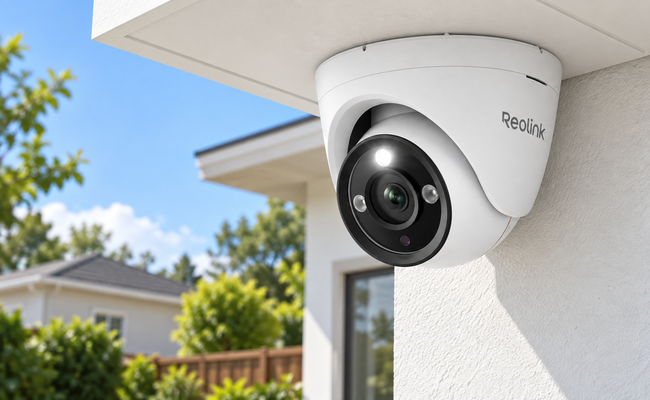
The main difference between Reolink P Series and RLC Series cameras is their model naming and sales channels, not necessarily their camera technology. Many P Series PoE cameras have closely corresponding RLC models with similar resolution, lenses, and smart detection features.
For example, the P430 corresponds closely to the RLC-811A, while the P437 is similar to the RLC-843A. However, storage limits, hardware revisions, firmware, and compatibility may differ. Always compare the exact model specifications before buying.
- What Is the Reolink P Series?
- What Is the Reolink RLC Series?
- Reolink P Series vs RLC Series: Key Differences
- Which Reolink P Series Cameras Match RLC Models?
- Which Reolink P Series Cameras Match RLC Models?
- Can P Series and RLC Series Cameras Use the Same NVR?
- Can P Series and RLC Series Cameras Use the Same Firmware?
- Should You Buy Reolink P Series or RLC Series?
- FAQs About Reolink P Series vs RLC Series
- Conclusion: P Series or RLC Series?
What Is the Reolink P Series?
The Reolink P Series consists of PoE IP security cameras that use a single Ethernet cable for power and transmission. They are retail-equivalent models to cameras in Reolink's standard RLC family, sharing the same key architecture.
Where Are Reolink P Series Cameras Sold?
P Series cameras commonly appear through third-party retail channels, including stores such as Best Buy, Costco, Walmart, B&H Photo Video, and other authorized Reolink retailers. The models available at these stores can vary depending on location, current inventory, and retail agreements.
Some P Series models also appear on Reolink's official website, where customers can review product information and technical specifications. Buyers should confirm that a retailer carries the particular P model they want rather than assuming every store offers the complete lineup.
Why Does Reolink Use P Series Model Numbers?
Different model designations help identify cameras across retail listings and product channels. A shopper might find a P430 at a retailer and later discover the RLC-811A while browsing Reolink's website.
Although the two cameras have similar specifications, their names can make them appear to be unrelated products. This creates confusion when customers compare prices, accessories, and recording compatibility.
What Is the Reolink RLC Series?
The Reolink RLC Series is an established family of IP security cameras designed for residential and commercial monitoring. It includes models with different resolutions, camera shapes, lenses, night vision systems, and recording capabilities.
Many RLC cameras support PoE connections, while the broader RLC lineup also includes other network connection options. Depending on the model, customers can select fixed lenses, optical zoom, smart detection, and local recording through a microSD card or compatible network video recorder (NVR).
Reolink P Series vs RLC Series: Key Differences
The main distinction concerns how Reolink identifies its cameras. P Series models often have alternative names that correspond closely to established RLC products, although buyers should verify the specific pairing.
Camera Type
Both groups include IP security cameras that connect to networks for video monitoring and recording. Many models use PoE, which carries electrical power and network data through one Ethernet cable.
The RLC lineup covers a broader selection of IP camera designs and connections, including plug-in WiFi cameras and PoE cameras. For buyers comparing two corresponding PoE models, the basic installation requirements are generally similar.
Sales Channel
P Series cameras commonly appear in retail listings, while RLC cameras are widely available through Reolink's website and other sellers. Availability can change depending on the camera model and geographic region.
Retailers may also offer different package contents, discounts, or return policies. Therefore, customers should compare the complete purchase offer rather than focusing only on the camera's listed price.
Core Features
The main features depend on the camera itself rather than its series designation. Corresponding models may offer similar video recording, motion alerts, weather protection, spotlights, and audio communication.
However, some differences may appear in supported storage capacities, hardware revisions, or software functions. Buyers should compare the official specification sheets to understand what each camera provides.
Resolution
Neither series has an automatic advantage in video resolution because both include cameras with different megapixel ratings.
For example, P430 and RLC-811A offer 8MP recording, while P340 and RLC-1212A provide 12MP recording. Higher resolution can capture more image detail, but lens quality, lighting, and camera placement also affect the final recording.
Lens and Zoom
Lens specifications determine how much of an area a camera can monitor and how closely it can capture distant objects. Some cameras use fixed lenses, while others provide optical zoom.
The P430 and RLC-811A both offer 5× optical zoom, allowing users to adjust their viewing area without relying entirely on digital enlargement. Buyers should compare focal length and field of view when choosing cameras for specific locations.
Smart Detection
Reolink offers smart detection features that help cameras identify people, vehicles, and animals. These functions can reduce unnecessary notifications caused by general movement.
Corresponding P and RLC models may offer the same detection categories, but buyers should review the exact specifications and hardware version. Automatic tracking is a separate feature and should not be assumed simply because a camera supports smart detection.
NVR Support
Many P Series and RLC Series cameras work with compatible Reolink NVR systems for centralized recording and management.
However, compatibility depends on the NVR model, hardware version, supported resolution, and firmware. Older recorders may have limitations when connecting newer 8MP or 12MP cameras, even when the camera and recorder use PoE technology.
Price and Availability
The better purchase depends on the features needed for the installation and the total cost of ownership. A lower-priced P model may offer excellent value when it closely matches a more expensive RLC camera.
Which Reolink P Series Cameras Match RLC Models?
Identifying corresponding models is one of the most useful steps when comparing Reolink P Series and RLC Series cameras. Several popular cameras share similar designs and major specifications, making direct comparisons possible.
Which Reolink P Series Cameras Match RLC Models?
Several Reolink P Series cameras have closely corresponding RLC models with similar resolutions, lenses, and smart detection features. However, they are not always identical in every specification. For example, the P430 and P437 support microSD cards up to 256GB, while their corresponding RLC models list support for up to 512GB.
The following comparisons are based on Reolink's published product specifications. Buyers should also check hardware versions and NVR compatibility before purchasing or replacing a camera.
Reolink P430 vs RLC-811A
The Reolink P430 and RLC-811A are 4K 8MP PoE bullet cameras with 5× optical zoom. Both record at 3840 × 2160 resolution and use a 2.7–13.5mm motorized lens with a horizontal field of view ranging from 105° to 31°.
Their optical zoom adjusts the lens to capture more detail from distant objects without relying on digital enlargement. A wider view works well for monitoring driveways and entrances, while the narrower view is useful for checking vehicles, gates, and other objects farther away.
Both cameras feature infrared night vision up to 100 feet (30 meters) and built-in 450-lumen spotlights for color recording after dark. Person, vehicle, and animal detection helps identify relevant activity, while two-way audio and light-and-siren alerts provide additional security functions.
The main published difference is local storage capacity. The P430 supports microSD cards up to 256GB, while the RLC-811A supports up to 512GB. Both also offer recording through compatible Reolink NVRs or FTP servers.
Which should you choose? Both models are suitable for outdoor monitoring that requires adjustable optical zoom. The RLC-811A is worth considering if you need more microSD storage capacity. If 256GB is sufficient, compare retailer availability and other purchase terms before deciding.
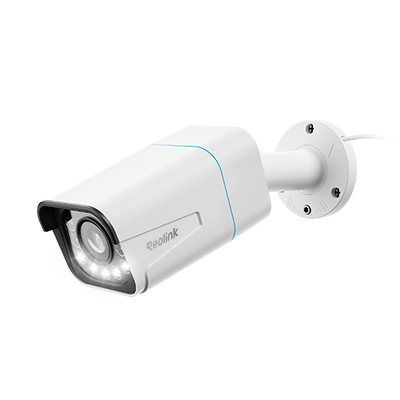
4K Smart PoE Camera with 5 Spotlights
4K 8MP Ultra HD Day & Night, Person/Vehicle Alerts, 5X Optical Zoom, Two-Way Audio, Built-in Siren, Color Night Vision, Live View Anywhere.
Reolink P437 vs RLC-843A
The Reolink P437 and RLC-843A are 4K 8MP PoE dome cameras designed for outdoor monitoring. Both feature a 2.7–13.5mm motorized lens with 5× optical zoom and a published diagonal field-of-view range of 123° to 39°.
The adjustable lens lets users switch between wider coverage and a closer view of distant objects. This makes both cameras practical for monitoring storefronts, building entrances, shared parking garages, and commercial properties.
Both models feature an IK10-rated vandal-resistant housing and IP67 weatherproof protection. Under the IEC 62262 standard, IK10 represents resistance to a 20-joule impact under specified test conditions. IP67 indicates dust-tight protection and resistance to temporary water immersion under standardized conditions. These ratings are useful for outdoor cameras installed in accessible locations where physical impacts and weather exposure are concerns.
For nighttime monitoring, both cameras offer infrared night vision up to 100 feet (30 meters) and built-in spotlights for color footage. Smart detection identifies people, vehicles, and animals, while two-way audio and light-and-siren alerts support remote communication and deterrence.
The main published difference is microSD storage capacity. The P437 supports up to 256GB, while the RLC-843A supports up to 512GB. Both support recording through compatible Reolink NVRs.
Which should you choose? Both cameras offer similar resolution, zoom, and protective housing features. The RLC-843A provides a higher published microSD storage limit, while the P437 may suit buyers who need less onboard storage. Check your NVR compatibility and the camera's hardware version before purchasing.
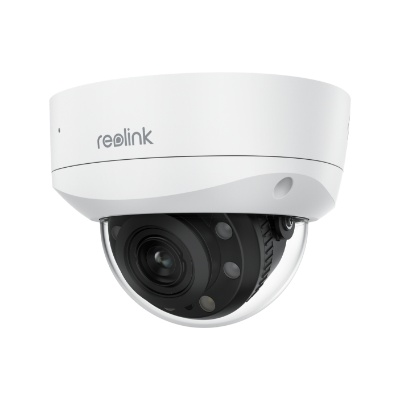
Smart 4K PoE IK10 Camera with 5X Optical Zoom
IK10 Vandal-Proof, 4K 8MP Ultra HD, 5X Optical Zoom, Color Night Vision
Other P Series and RLC Series Equivalent Models
Reolink offers additional P models that closely correspond to RLC cameras. The following table highlights several examples and the main features they share.
Can P Series and RLC Series Cameras Use the Same NVR?
Many P Series and RLC Series cameras can work with the same Reolink NVR, but compatibility depends on the camera and recorder specifications.
Can You Connect a P Series Camera to a Reolink NVR?
Yes, compatible P Series cameras can connect to Reolink NVR systems for recording and centralized management. The NVR receives video from the connected cameras and stores recordings on its supported hard drive.
Before installation, buyers should check the recorder's maximum supported resolution, hardware version, available channels, and firmware. An older NVR might recognize a newer camera without supporting its highest resolution or all smart detection features.
Can You Mix P Series and RLC Cameras on One NVR?
A compatible Reolink NVR can manage cameras from both groups within the same security system. For example, a user could install a P430 near a driveway and an RLC-843A near a building entrance.
Can P Series Cameras Work Without an NVR?
Many P Series PoE cameras can operate independently without a dedicated NVR. Models such as the P430 and P437 support microSD cards for local recording.
For standalone operation, the camera still needs suitable power and network connectivity, such as a compatible PoE switch or injector connected to the network. Users can then manage supported functions through the Reolink app or desktop client.
Do P Series Cameras Support ONVIF and RTSP?
Many Reolink PoE cameras support ONVIF and RTSP, which allow communication with compatible third-party recording software and systems.
RTSP provides access to video streams, while ONVIF helps compatible devices and software communicate with IP cameras. Reolink lists these functions for models such as P437, while its support documentation also includes P430 among cameras that support these connection methods.
Can P Series and RLC Series Cameras Use the Same Firmware?
Corresponding P Series and RLC Series cameras should not automatically receive the same firmware, even when they share similar specifications and housing designs.
Firmware controls camera functions, recording behavior, and communication with other devices. Different hardware revisions may require separate firmware files, and installing an unsuitable version can cause operational problems.
Should You Buy Reolink P Series or RLC Series?
The purchase decision should depend on the camera's exact specifications, price, retailer, warranty, included accessories, and compatibility with the intended security system.
Choose P Series If...
A P Series camera may offer better value when a retailer provides a lower price, useful promotion, or package that includes the accessories required for installation.
Choose RLC Series If...
An RLC camera may be the better option when its specific features or hardware version match an existing Reolink system. Buyers expanding a current installation may find it easier to confirm compatibility using the model details already provided in their recorder's documentation.
What Should You Check Before Buying?
A careful specification review can prevent compatibility problems and unexpected installation expenses. Customers should confirm the following details before selecting a camera.
- Exact model number: Identify the camera and its corresponding RLC or P model.
- Hardware version: Check whether the model has different hardware revisions.
- Resolution: Confirm that the image quality meets the intended monitoring requirements.
- Lens and zoom: Review viewing angle, focal length, and optical zoom.
- Night vision: Compare infrared range, spotlights, and color recording options.
- Smart detection: Confirm the available detection categories and alerts.
- NVR compatibility: Check supported resolution, channels, and recorder hardware.
- Storage: Review microSD capacity and other recording options.
- Warranty and price: Compare retailer terms, accessories, and total cost.
FAQs About Reolink P Series vs RLC Series
Can I mix Reolink P series and RLC series cameras on one NVR?
Yes. Compatible Reolink P Series and RLC Series cameras can connect to the same Reolink NVR. For example, you may use a P430 for driveway monitoring and an RLC-843A for an entrance, provided the NVR supports both models.
Before connecting them, check the NVR model, hardware version, firmware, supported camera resolution, and available channels. Compatibility with basic recording does not always guarantee support for every smart feature.
Are Reolink P Series cameras retail versions of RLC cameras?
Many P Series models commonly appear through retail channels and have closely corresponding RLC models. The P430 and RLC-811A provide a clear example because they share resolution, optical zoom, night vision, and smart detection capabilities.
Is the Reolink P430 the same as the RLC-811A?
The P430 and RLC-811A share several major specifications, including 8MP resolution, 5× optical zoom, infrared night vision, spotlights, smart detection, and two-way audio.
Are P Series cameras only available from retailers?
P Series cameras commonly appear through retail partners, but they are not limited to third-party listings. Reolink also maintains official product pages for several P models, allowing customers to review their features and specifications.
Is Reolink P Series or RLC Series better?
Neither group is inherently better because camera performance depends on the individual model. A P camera can offer similar recording and detection features to its corresponding RLC camera.
Can P Series and RLC Series cameras work together?
Yes, compatible cameras from both groups can operate within the same Reolink security system. Users can connect different models to a supported NVR and manage their recordings through one interface.
Can I use RLC firmware on a corresponding P Series camera?
Users should not install RLC firmware on a P Series camera solely because the two models share similar features. Firmware compatibility depends on the specific camera model and hardware version.
Conclusion: P Series or RLC Series?
Reolink P Series and RLC Series cameras should not be viewed as two completely different security camera technologies. P Series models commonly use alternative names for PoE cameras sold through retail channels, while many have closely corresponding RLC models with similar recording and monitoring features.
The P430 and RLC-811A, along with the P437 and RLC-843A, show how closely corresponding cameras can share their main functions while still having differences in published specifications.
Search
Subscribe for the Latest Updates
Security insights & offers right into your inbox