
PoE Max Distance: How Far Can Power over Ethernet Reach?
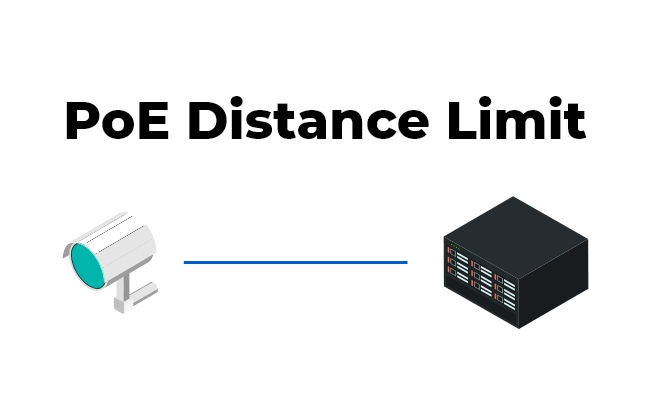
Power over Ethernet (PoE) simplifies network installations by delivering data and electrical power through a single Ethernet cable. But how far can PoE actually reach? For standard Ethernet connections, the maximum channel length is 100 meters (328 feet).
Real-world PoE performance also depends on device power consumption, cable resistance, conductor quality, temperature, and installation conditions. Understanding these factors helps maintain reliable connections for PoE security cameras, WiFi access points, VoIP phones, and other network devices, especially over long cable runs.
Key Takeaways:
-
100-Meter Standard Limit: PoE, PoE+, and PoE++ (IEEE 802.3af/at/bt) are designed around a maximum standard Ethernet channel length of 100 meters (328 feet)..
-
Cable Category Doesn't Extend the Limit: Cat5e, Cat6, and Cat6a can all operate within the standard 100-meter limit. Higher-quality cabling may improve power and thermal margins, but it does not increase the IEEE Ethernet distance limit.
-
PoE Can Go Beyond 100 Meters: For longer installations, use PoE extenders, intermediate switches, fiber with local PoE, or compatible long-range PoE modes. Exact maximum distances depend on the equipment, power requirements, cable, and available bandwidth.
- What Is the Maximum PoE Distance Limit?
- PoE vs PoE+ vs PoE++ Distance Limits
- Does PoE Really Work at 100 Meters?
- What Affects PoE Limit Distance in Real Installations?
- Does Cable Type Change PoE Distance?
- PoE Distance for Security Cameras and Other Devices
- How to Extend PoE Limit Distance Beyond 100 Meters?
- PoE Distance Planning & Common Mistakes to Avoid
- FAQs
- Conclusion
What Is the Maximum PoE Distance Limit?
The standard maximum copper Ethernet channel length is 100 meters (328 feet). A typical structured cabling channel consists of up to 90 m of permanent horizontal cable plus patch cords at each end.
PoE does not create a different Ethernet distance limit. Whether you use 802.3af, 802.3at, or 802.3bt, the standards are designed around compliant Ethernet cabling up to the 100 m channel limit.
Why Is the Standard Limit 100 Meters?
The 100-meter PoE distance limit comes primarily from Ethernet transmission requirements, not PoE itself. As copper cable gets longer, signal attenuation increases, which can eventually affect reliable data transmission. For PoE connections, longer cables also create electrical resistance and voltage drop, leaving less power available to the device.
That is why cable quality, conductor resistance, connectors, temperature, and device power consumption become particularly important as a cable run approaches 100 meters.
Does PoE Generation Change the Distance?
No. 802.3af, 802.3at, and 802.3bt all operate within the same standard 100-meter Ethernet channel. Moving from PoE to PoE+ or PoE++ increases the amount of power that compatible equipment can deliver; it does not increase the standard transmission distance.
PoE vs PoE+ vs PoE++ Distance Limits
Does PoE Really Work at 100 Meters?
Yes. PoE can reliably deliver both power and data up to 100 meters (328 feet) when compliant Ethernet cabling and compatible PoE equipment are used. The 100-meter distance is not just a theoretical maximum—it is the standard Ethernet channel length that PoE equipment is designed around.
However, performance near the limit depends on real-world conditions. Longer cables have greater electrical resistance and voltage drop, while poor-quality cable, high temperatures, damaged connectors, or high-power devices can further reduce the available power margin.
For a reliable long-distance PoE connection:
- Use solid-copper Cat5e, Cat6, or Cat6a cable rather than copper-clad aluminum (CCA).
- Match the PoE switch or injector output to the device's power requirements.
- Use quality connectors and avoid unnecessary couplers or damaged cable.
- Consider temperature and cable bundling for outdoor or high-power installations.
- For distances beyond 100 meters, use a PoE extender, intermediate switch, or fiber-based solution.
What Affects PoE Limit Distance in Real Installations?
In addition to PoE generation and cable grade, several other important factors impact the achievable PoE distances in real deployments:
Device Power Draw
Higher current requirements accelerate voltage drop across copper cabling. Devices drawing high power (such as motorized cameras with pan-tilt-zoom capabilities or active floodlight units) lower the available operational voltage at the end of a long run faster than low-draw fixed cameras or VoIP phones.
Cable Gauge and Copper Quality
Conductor composition directly dictates electrical resistance. Standard 23 AWG or 24 AWG solid bare copper cables maintain full signal integrity and low resistance across long distances. Conversely, thin cables (26–28 AWG) or low-grade Copper-Clad Aluminum (CCA) severely restrict usable distance due to excessive heat generation and voltage loss.
Temperature and Cable Bundling
Bundling multiple PoE cables in tight conduits restricts heat dissipation, increasing line resistance. Ambient heat from outdoor conduits exposed to direct sunlight or hot attic spaces further degrades power delivery and increases signal attenuation.
Switch/Injector Power Budget
The Power Sourcing Equipment (PSE) must supply sufficient power margin to compensate for inline resistance. Poorly crimped RJ45 connectors, oxidized punch-down blocks, and unshielded couplers introduce localized resistance points that degrade network speed and trigger premature power cutoffs.
Connector and Installation Quality
Poor connectors and improper installation can reduce PoE reliability, especially on longer cable runs. Loose RJ45 terminations, damaged cables, excessive bends, and unnecessary couplers can increase resistance or cause data transmission problems. For stable PoE performance, use quality connectors, terminate cables correctly, and keep the cable run within the 100-meter (328-foot) Ethernet limit.
Does Cable Type Change PoE Distance?
The Ethernet cable category does not change the standard 100-meter (328-foot) PoE distance limit, but it can affect power efficiency and reliability, especially for high-power devices or long cable runs. Cable quality, conductor gauge, resistance, and temperature are generally more important for PoE performance than simply choosing a higher category.
Cat5e
Cat5e supports PoE up to the standard 100-meter distance when compliant, solid-copper cable is used. It is sufficient for many IP cameras, VoIP phones, and other standard PoE devices. For higher-power PoE+ or PoE++ equipment, pay closer attention to conductor resistance and cable quality.
Cat6
Cat6 also supports PoE up to 100 meters and provides higher bandwidth than Cat5e. It is a popular choice for PoE security cameras and newer network installations. Conductor gauge varies by manufacturer, so do not assume every Cat6 cable provides better power delivery than Cat5e; check the cable specifications and choose solid-copper conductors.
Cat6a
Cat6a maintains the same 100-meter PoE limit, but its construction can make it a strong choice for high-power PoE deployments and large cable bundles. It also supports 10 Gigabit Ethernet over the full 100-meter channel. Suitable for installations where additional network performance and power margin are priorities.
Cat7
Cat7 does not extend the standard PoE distance beyond 100 meters. Although it offers higher shielding and bandwidth capabilities, it generally provides little practical distance advantage over quality Cat6a for typical PoE security camera installations. For runs beyond 100 meters, use a PoE extender, intermediate switch, or fiber solution rather than upgrading to Cat7 solely for extra distance.
PoE Distance for Security Cameras and Other Devices
Security Cameras
High-resolution PoE cameras (such as the Reolink Duo 3 PoE, which consumes up to 12W/15W) increase their power draw dramatically when night-vision IR LEDs or spotlights activate. Under a tight 15.4W (802.3af) budget, line resistance causes voltage drop, often resulting in night-time camera brownouts beyond 50–60 meters. Upgrading to a PoE+ (802.3at) switch port provides the necessary headroom to reach the full 100 meters.
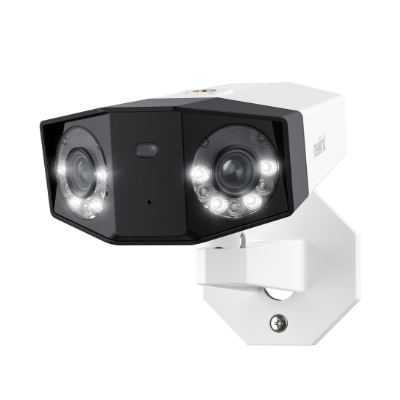
Groundbreaking 16MP Dual-Lens PoE Camera
16MP UHD, Dual-Lens, Motion Track, 180° Wide Viewing Angle, Power over Ethernet, Color Night Vision.
WiFi Access Points
While low power draw (5–8W) allows an access point to maintain enough voltage over long runs, Cat6a cabling does not inherently cap out at 80 meters. Solid-core copper Cat6a is fully rated to support both data and power up to the full 100-meter (328 ft) IEEE channel limit. An 80-meter run is completely within standard limits rather than a restriction.
VoIP Phones
With PoE power needs as low as 3-5W, a VoIP desk phone itself permits distances approaching 90 meters over Cat5e in ideal situations. The main limit becomes the Ethernet cable length to desks. PoE range is less critical for phones than cameras or access points.
IoT Devices
Many IoT sensors consuming 1W or less allow PoE distances nearing the 90-meter mark over good Cat5e cable with minimal voltage drop issues. However, concentrated clusters of many PoE IoT devices can require PoE switches placed closer than 100 meters.
How to Extend PoE Limit Distance Beyond 100 Meters?
PoE Extenders
PoE extenders act as plug-and-play inline signal boosters powered directly by the main PoE switch. Placed every 100 meters, they regenerate both data packets and voltage without requiring an AC power outlet along the run.
An extender consumes roughly 4–5 Watts to run itself. When cascading multiple extenders (daisy-chaining), ensure your source switch supports high-wattage outputs (PoE+ 30W or PoE++ 60W/90W) so sufficient power reaches the end device.
Intermediate Switch
Deploying an unmanaged or managed PoE switch midway through a long line resets the 100-meter Ethernet timer for both data and power.
This approach provides additional local network ports for expanding nearby connections, but it requires a clean, weather-protected location with a reliable local AC power source at the halfway point.
Fiber + Local PoE
Because fiber optic cables transmit data via light pulses rather than electrical current, fiber is immune to electrical resistance and distance-based voltage drop, easily spanning distances over 10 kilometers.
Run fiber optic cable from the main network switch to the remote location. At the far end, connect the fiber to a local PoE media converter or PoE fiber switch powered by local AC power to output standard copper PoE to your camera or device.
Long-Range PoE Modes
Many modern managed and unmanaged PoE switches feature a built-in toggle labeled "Extend," "CCTV," or "Long Reach."
Activating this mode changes the signal modulation to allow data and power delivery up to 250 meters (820 feet) over standard copper cable. However, it automatically caps port speed from 100/1000 Mbps down to 10 Mbps. While 10 Mbps is insufficient for multiple network devices, it is plenty of bandwidth for a single 4K IP security video stream.
Quick choice: Use a PoE extender for a straightforward single-camera extension, an intermediate switch when several remote devices need connections, and fiber + local PoE for long-distance or large-property deployments. Use long-range PoE modes only when both the switch and connected device meet the manufacturer's requirements.
PoE Distance Planning & Common Mistakes to Avoid
Common PoE Distance Mistakes to Avoid
-
Exceeding the 100-meter limit: Don’t run standard Ethernet beyond 100 meters (328 feet) without a proper PoE extension solution.
-
Using CCA cable: Copper-clad aluminum has higher resistance than solid copper and can increase voltage drop and heat, especially on long runs.
-
Ignoring the PoE power budget: Make sure the switch or injector can provide enough power for high-draw devices such as PTZ cameras, heaters, and spotlights.
-
Assuming Cat6 or Cat6a extends PoE distance: Better cable can improve power and performance margins, but the standard Ethernet limit remains 100 meters.
-
Using too many couplers or poor connectors: Extra connection points and improper terminations can introduce resistance and network instability.
-
Ignoring outdoor conditions: Heat, moisture, tight bends, and physical cable damage can affect long-term reliability. Use properly rated cable for outdoor installations.
-
Choosing an extender without checking power needs: PoE extenders consume power themselves, so verify that enough power reaches the end device.
FAQs
How far can I run PoE+?
PoE+ (IEEE 802.3at) supports a standard maximum Ethernet channel length of 100 meters (328 feet). Higher power delivery does not extend this distance, so longer runs require an extender, intermediate switch, or fiber solution.
Will PoE work over 100m?
Yes, but not over a standard single Ethernet segment. To extend PoE beyond 100 meters, use a PoE extender, intermediate switch, fiber with local PoE, or a compatible long-range PoE mode.
How to run Ethernet over 300 feet?
Since 300 feet (about 91 meters) is within the standard 100-meter Ethernet limit, you can typically use quality Cat5e, Cat6, or Cat6a cable directly. For PoE devices, also confirm that the cable and PoE switch or injector meet the device's power requirements.
Conclusion
While 100 meters is the formal maximum distance for Power over Ethernet, real-world limitations imposed by cable resistance and voltage drops often constrain usable PoE distances to less, especially as power needs increase. Network administrators must carefully balance equipment power budgets, cable types, PoE standards, and required cable distances when planning out PoE-enabled devices and networks.
Do you know the distance limit of your PoE devices? Share your experiences with us in the comment section below! Let's discuss them together!
Search
Subscribe for the Latest Updates
Security insights & offers right into your inbox