
Dual Band vs Tri Band: What’s the Best WiFi for Your Home?

A reliable WiFi connection is no longer a luxury; it is a basic need for every household. Two labels keep popping up when shoppers look at new routers: dual band vs tri band.
The words look simple, but they decide how smooth your video calls feel and how fast your game loads. Stick around, and you will see exactly how tri band vs dual band router features fit real homes.
Dual Band vs Tri Band: Key Differences
Dual-band routers use 2.4 GHz and 5 GHz bands for everyday use, while tri-band routers add an extra 5 GHz (or 6 GHz with Wi-Fi 7) band to create more traffic lanes. This reduces congestion and allows smoother gaming, streaming, and smart-home performance in device-heavy homes. Let's see the details:
Total bandwidth and speed
A typical dual-band product on today’s market offers 600 Mbps on 2.4 GHz and about 1200 Mbps on 5 GHz for a combined 1800 Mbps. A tri-band model of the same generation often bumps the first 5 GHz radio to 2400 Mbps and keeps a second 5 GHz stream at 2400 Mbps alongside a 600 Mbps 2.4 GHz line.
The numbers on paper jump from roughly 1800 Mbps to 5400 Mbps. Real-world numbers are always lower due to walls, interference, and device limits, yet the jump still shows how much more raw data can flow at once.
Client count and congestion
Two radio bands behave like two doorways at a concert venue. When thousands of fans arrive, both doors soon clog up with long lines. Tri-band routers open a third door, slicing the queue and letting more people enter at once.
In WiFi terms, phones, tablets, game consoles, cameras, thermostats, light bulbs, and fire sticks split across three bands instead of two, cutting wait time and stutter. Crowded homes with twenty or more devices see the clearest win here.
Mesh backhaul
Dual band vs tri band mesh systems show another clear split. Every mesh needs a hidden lane for the nodes to talk to each other. A dual-band mesh uses one of its two bands for both clients and backhaul, so average speed drops by about half in the worst moment.
A tri-band mesh keeps one 5 GHz lane solely for backhaul traffic, leaving the other lanes for real devices. The WiFi speed from the living room to the backyard office stays strong even when five teenagers stream at the same time.
Price and power
Two extra radios and extra antennas cost more money. Tri-band models sit one price tier above dual-band hardware, often by forty to seventy dollars at the low end and by hundreds of dollars at the high end.
Dual Band vs Tri Band Router: Comparison Table
Keep this table in mind while you look at shelf tags. The quick view shows where each choice shines or falls behind.
Tri Band vs. Dual Band: Understanding the Basics
It is always good to see the big picture and remind ourselves of the terminology before we get into the details. Let’s take a look a the basics of each band:
What is a dual-band router?
A dual-band router broadcasts two different wireless signals. One signal sits on the 2.4 GHz band. The second sits on the 5 GHz band. Either side can connect to your phone or your laptop, or even your smart speaker. The 2.4 GHz is more affected by walls and furniture; although it travels further, it is congested by the fact that the microwaves, baby monitors, and other older devices share the same frequency.
What is a tri-band router?
A tri-band router maintains the 2.4 GHz frequency and then adds two independent 5 GHz frequencies. The low channels of the band support the first 5 GHz stream. The second runs on the high channels. Each is seen by the router as a roadway of its own, thus your network will have an additional lane when all the traffic jams.
Dual vs Tri Band Router: Pros and Cons
Nothing is perfect in home networking, so let us weigh the upsides and downsides side by side.
Dual band routers: pros and cons
Pros:
- Lower purchase price stretches any household budget.
- Lower power draw, so the unit runs cooler and quieter.
- Setup takes minutes because the firmware offers two clear choices: 2.4 GHz or 5 GHz.
- Works very well for basic tasks such as web browsing, voice calls, and small-screen streaming.
Cons:
- Shared spectrum fills fast when multiple 4K streams or game updates run at the same time.
- Mesh performance can fall off sharply when distant nodes share the already busy 5 GHz for backhaul.
- Less headroom for future growth, such as new smart cameras or faster internet plans above 500 Mbps downlink.
Tri band routers: pros and cons
Pros:
- The third 5 GHz band splits traffic and holds speed under load from heavy, simultaneous use.
- Mesh backhaul keeps full speed from the basement node to the attic node without touching the devices.
- Ready for gigabit internet plans and next-generation gadgets that stream 8K video or virtual reality.
Cons:
- Higher upfront cost compared to the price of two or three budget dual-band units.
- Larger chassis and a small bump in power draw create slightly more heat under a table or inside a closet.
- Extra 5 GHz radios have little value if your house only houses a few phones and one smart TV.
Dual Band vs Tri Band: Which One Should You Choose?
Think through your real day-to-day use instead of chasing flashy spec sheets. The list below guides you to the right shelf in the store.
- If your household has five or fewer devices online at any moment, a good dual-band unit will feel instant and cost less.
- If four or more people live under the same roof and everyone is on video calls at the same time, the tri-band extra lane pays off in lower lag for every user.
- For families already paying for fiber or cable plans above 500 Mbps, the dual-band radio maxes out easily under heavy uploads, while tri-band shares the load and keeps speed close to the service rating.
- Small homes under 1200 square feet with thin interior walls rarely need mesh, so a budget dual-band is enough; tri-band only adds extra radios that go unused in tight spaces.
Dual Band or Tri Band for WiFi Security Cameras?
WiFi security cameras send a steady trickle of small uploads during calm hours, followed by sudden, heavy bursts when trees sway or a dog walks past. Either choice will stream the actual video, yet tri-band cuts the risk of frame drop. The cameras quietly live on one 5 GHz lane while your tablet and laptop race on the second 5 GHz lane.
Dual-band models can still work if you limit the camera bitrate, but expect occasional stutter when the router has to juggle evening streaming plus camera bursts all on the same highway. If cameras record in 4K or send clips to cloud storage, the tri-band setup gives the safest margin for stable uploads.
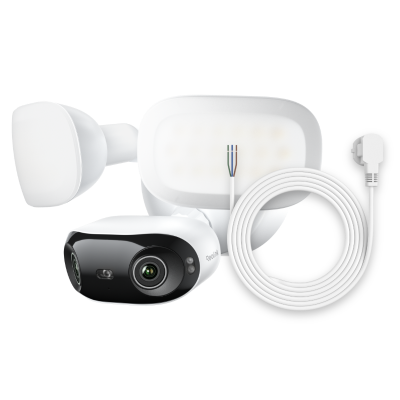
4K 180° Ultra-Wide Wired Floodlight Security Camera
3000-Lumen Dimmable Lighting, Adjustable Color Temperature, Local AI Video Search, Local Storage, Dual-Band Wi-Fi 6.
FAQs
WiFi 7 dual band vs tri band: What's the difference?
WiFi 7 dual-band routers operate on two frequency bands (typically 2.4 GHz and 5 GHz, or 2.4 GHz and 6 GHz). They’re suitable for everyday browsing, streaming, and light smart-home use.
WiFi 7 tri-band routers add a third band—usually an extra 5 GHz or 6 GHz band—creating more available bandwidth. This reduces network congestion, improves speeds in multi-device homes, and supports smoother gaming, 4K/8K streaming, and mesh backhaul connections.
Is tri-band better than dual band WiFi?
Tri-band is better only when your network serves many devices at high speed. Homes with only a dozen light gadgets will not notice the extra 5 GHz lane.
What is the difference between tri-band and dual band radio?
The plain difference is the count of usable radios. Dual-band offers two, tri-band offers three. More radios split traffic and lower congestion inside your walls.
Is WiFi 7 tri-band or dual band?
WiFi 7 itself is a standard, not a fixed band plan. Early WiFi 7 routers arrive in tri-band form with two 5 GHz and one 6 GHz radio, although future dual-band WiFi 7 units could appear for tighter budgets.
What is the difference between dual-band and tri-band phones?
A dual-band GSM phone can operate on two frequency bands, allowing users to roam automatically between networks that use those bands. Most GSM phones sold in these regions support dual-band operation.
A tri-band GSM phone supports three frequency bands, making it necessary for international roaming across Asia/Pacific, Europe, and North America, since GSM networks in North America mainly use the 1900 MHz spectrum.
Conclusion
The duel between dual band vs tri band comes down to how busy your house really is. Dual-band routers serve casual web browsing, small families, and tight budgets in a steady and simple package. Tri-band routers cut congestion for large households, busy mesh setups, and plans above 500 Mbps.
Review your device count, internet speed, and future upgrade path. Choose the hardware that matches real life rather than paper specs, then enjoy faster and calmer WiFi under your roof. Share your own results after setting up either model so the next shopper has real numbers instead of guesswork.
Search
Subscribe for the Latest Updates
Security insights & offers right into your inbox