
Cabin Security Cameras: What Actually Works Off-Grid
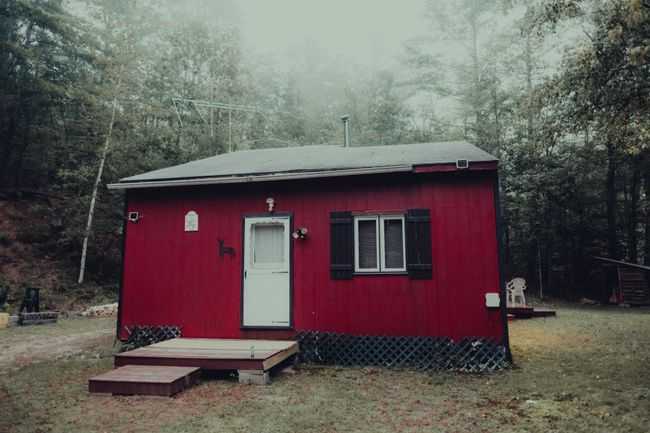
If your cabin doesn’t have WiFi and it doesn’t have mains power either, that means your camera needs to run on cellular data and store footage locally. If you're wondering what's a suitable camera for your remote cabin, this guide is for you. not the cottage owner with WiFi and neighbors.
- Cabin Security Camera: A Different Problem Than a Regular Home
- Test Your Cellular Signal at the Remote Cabin First
- How Long Your Cabin Sits Empty Decides Storage and Alerts
- Power That Has to Last the Whole Gap
- An Insurance Detail All Cabin Owners Need to Know: Vacancy Clauses
- What to Check Before You Buy a Cabin Camera
- Reolink Top Cabin Security Camera Picks
- FAQs
- Choosing a Camera for your Cabin
Cabin Security Camera: A Different Problem Than a Regular Home
A typical indoor security camera assumes you have reliable electricity and Wi-Fi at home. But, a cabin security camera assumes neither, and may go weeks without any human interaction at all. Buying with that in mind changes your priorities.
Almost every decision to cabin security camera comes down to two questions:
- Does the cellular network reach your cabin and how well?
- How often do you visit the cabin?
Video resolution, brand reputation and cost are all important, but they are secondary to the answers of the questions above.
Test Your Cellular Signal at the Remote Cabin First
The coverage map of a carrier is a good place to start. Start by standing in the cabin with a phone. Take the phone and walk out to where the camera will actually be mounted and see how many bars you get there. Never test coverage from the road or nearest town, as those locations do not accurately represent the signal available at the cabin. A ridge, valley, or dense tree cover can turn a seemingly covered area into a dead zone.
Since carriers use different towers, no bars on one network doesn't mean there won't be another. If possible, test using a phone from each of the major carriers. Reolink's cellular cameras support T-Mobile and AT&T in the US, and Reolink recommends T-Mobile prepaid data.
If you find the cellular signal is weak but not completely dead, there are ways to remedy the problem. Try moving the camera to a spot with better signal, or ask Reolink Support whether your model accepts an external antenna. Be sure to try both before you eliminate cellular as an option.
If it's a true dead zone, no antenna can create a signal where none exists. If none of the carriers can reach your site, a trail or game camera with SD card storage is the better solution. You can simply retrieve the footage during your next visit. It's a practical choice for locations without cellular coverage.
How Long Your Cabin Sits Empty Decides Storage and Alerts
Visit frequency affects two decisions:
- how much space you’ll need
- how valuable real-time alerts are.
If you’re visiting a cabin every other weekend, storing a few days’ worth of clips is sufficient. If you’re visiting a cabin only twice a year, the card must save months’ worth of motion events before the oldest clips are overwritten.
If you have long gaps between visits, configure the camera to record less. These could be settings such as creating detection zones to exclude a swaying branch or decreasing the motion sensitivity. If you are really short on space,try "recording" photos instead. A security camera such as the Go Ranger PT has Picture Mode, which enables the camera to take burst photos and save only the best.
Real-time alerts matter more at a cabin than at a primary residence. At home, you can get back quickly if something seems off, and someone is often around to notice. A cabin may be hours away and empty for weeks, so an alert might be the only way you learn about a problem before your next visit. With one, you can call a neighbor or the local sheriff right away.
Canadian police describe the same problem at seasonal properties. The Nova Scotia RCMP says cottages are often in isolated areas, so criminal activity is less likely to be noticed. In Ontario, the OPP's Kenora detachment reported that numerous cottage owners returned at the end of winter to find their properties breached and searched. A cabin works the same way: if nobody is there to see a break-in, it can go undiscovered until your next visit.
Power That Has to Last the Whole Gap
For remote cabins, it's always wise to plan your power needs as if nobody will ever come to recharge anything. The battery-only camera will have to make it through the entire span between visits on battery power alone. If visits will be months apart, solar is strongly recommended.
Trees also present a solar issue, especially when they are big enough with canopies. Unless you’re lucky, a solar panel that’s just pressed against a wall will operate in dappled shade and seriously underperform. It's always best to mount solar panels on an adjustable bracket and point it at the sky rather than trees.
Cameras such as the Go Ranger PT and Go PT Ultra are both compatible with Reolink’s 6W Solar Panel 2. With it, Reolink says just 10 minutes of charging a day is enough to keep the Go PT Ultra running.
Battery capacity can drop sharply in freezing weather, so expect shorter run times in winter. If you'd like to know more, see our guide to cold-weather security cameras.
An Insurance Detail All Cabin Owners Need to Know: Vacancy Clauses
HO3 homeowners policies typically include a vacancy clause, and it can decide whether a claim on an empty cabin gets paid. Once a home has been vacant for a set number of consecutive days, coverage for theft, vandalism and water damage can be limited or suspended. According to the Insurance Information Institute (Triple-I), that threshold is typically 30 to 60 consecutive days.
Some policies distinguish between a vacant home and an unoccupied one, while many treat the two alike. Where a policy does draw a line, a vacant home lacks enough furniture or belongings to be considered lived in, and an unoccupied home is one where the residents are away for now but plan to return. Policies word these terms differently, so don't assume. Ask your agent how yours treats a cabin that sits empty between visits.
Cameras don't change how your policy classifies the cabin. Your policy wording does that. What a camera can do is alert you to problems sooner, and Fuller Insurance also recommends regular property checks and remote monitoring for homes that sit empty. Before you rely on any of this, read how your policy defines vacancy and counts the days, then confirm the details with your agent, including whether camera footage helps with a claim.
What to Check Before You Buy a Cabin Camera
Carrier and Band Support
Make sure the camera lists the LTE bands your carrier uses where the camera will actually be mounted. Bands listed on the US Go Ranger PT include B2, B4, B5, B12, B13, B14, B66 and B71.
Storage for Your Longest Visit Gap
Choose a microSD card large enough to hold footage for the longest stretch between visits. Format the card and configure the recording settings to cover that stretch.
Low Profile After Dark
If nobody is watching the camera, it shouldn’t announce its position to would-be vandals. No-glow infrared can help conceal a camera's location at night, and a camera like the Reolink Go Ranger PT has 940nm LEDs.
Weatherproofing and Field of View
When planning your security setup, consider whether separate structures like sheds or boathouses require dedicated camera coverage. Most Reolink cellular cameras carry an IP65 weatherproof rating for reliable outdoor use.
Data Budget
Reolink recommends about 2GB of 4G data a month for normal use. Local recording to the microSD card won’t use any. Consider which one works better for you.
Reolink Top Cabin Security Camera Picks
Compare your signal and visit frequency to one of these scenarios.
- Decent signal, frequent visits, tight budget? Go PT S Lite.
- Decent signal, and you want detail at distance? TrackMix LTE.
- Weak signal, long visit gaps, or wildlife-dense land? Go Ranger PT.
- Fully off-grid cabin with zero infrastructure? Go PT Ultra.
Check out more details on our top cabin security camera picks below.
Go PT Plus – Best Cellular Solar PT Camera for Budget and Frequent Visits
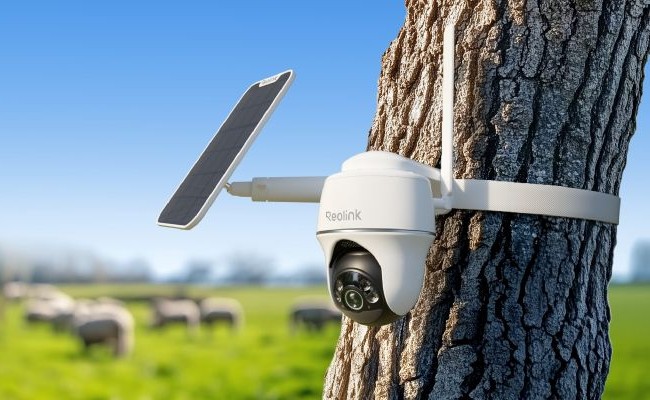
The Reolink Go PT Plus gives you cellular, solar-compatible, and pan-tilt capabilities at a budget-friendly price. It's a 4G LTE camera that runs on a 6000mAh battery or a Reolink solar panel (sold separately), and it features 355° pan and 140° tilt with auto tracking. This camera is best for cabins that get usable cellular signal and you visit frequently.
TrackMix LTE – Best Cellular Solar PT Camera for Detail at a Distance
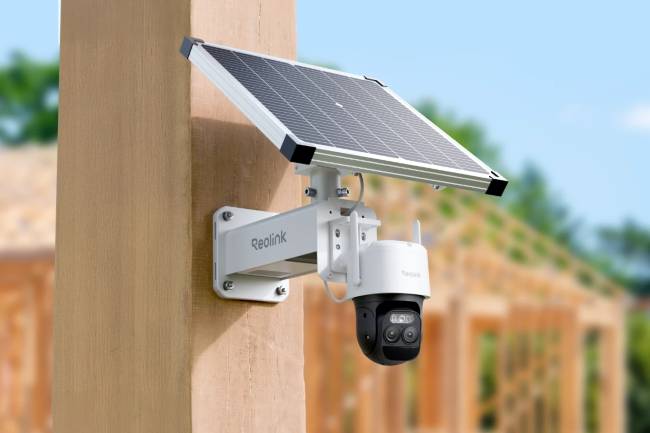
The Reolink TrackMix LTE is a 4K (8MP) dual-lens camera. Its dual view lens gives you a wide field of view while the other gives you auto-zoom tracking.
For the price, this camera is best when you need to capture plate and face detail at a distance, such as on the access road or at the treeline, though results depend on range, lighting and angle. It features infrared night vision that can reach up to 100 feet. If you are looking to place it within a more forested area, the camo TrackMix LTE-C is also available, and it swaps in 940nm no-glow infrared LEDs (Reolink announcement).
Watch the Reolink TrackMix LTE dual view in action:
Go Ranger PT – Best Cellular Camera for Weak Signal and Wildlife Areas
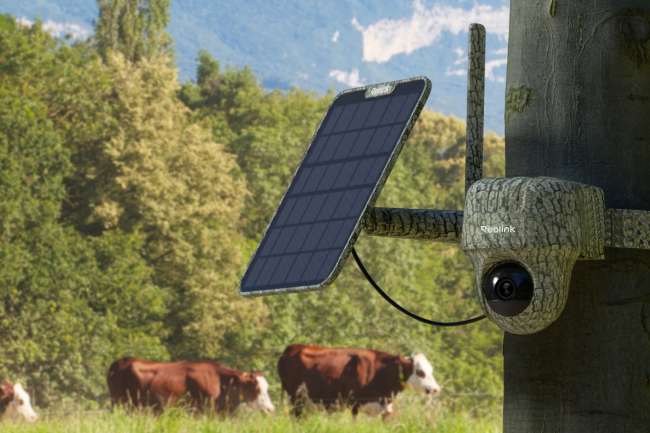
The Reolink Go Ranger PT camera shoots in 4K. It also features invisible 940nm no-glow infrared LEDs for night viewing by animals or people. This camera detects bucks, antlerless deer, and turkeys helping you avoid false alerts if you’re hanging in deer camp. The 6000mAh battery works with their 6W Solar Panel 2. IP Rating is weatherproof to IP65.
Go PT Ultra – Best Solar PT Camera for Fully Off-Grid Cabins
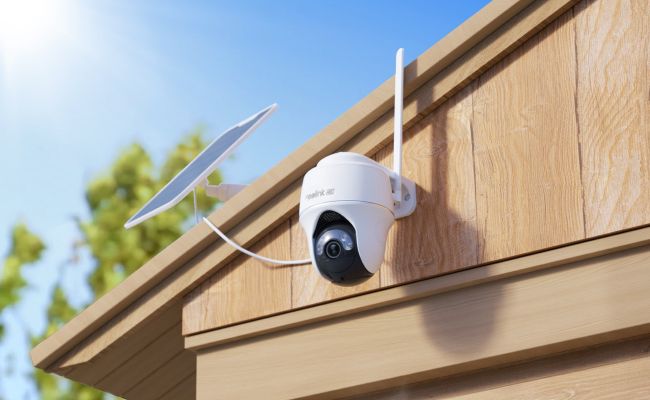
If you’ve got zero infrastructure out at your cabin, consider the Reolink Go PT Ultra. It shoots in 4K, offers spotlight to enable color night vision, and includes a siren. Reolink says the built-in battery can power the camera for up to two months even on cloudy days. However, IP64 protects against splashing water but not water jets, so for heavy rain mount it under an eave or in another sheltered spot.
Here's how the Go PT Ultra's color night vision looks:
FAQs
Does cabin camera need WiFi?
No. A cabin camera connects to the 4G LTE cellular network instead with the included SIM card. It saves video to its microSD card and sends notifications over that data connection. You’ll still need a data plan and actual service where you mount it.
What if I don’t have cell service at my cabin?
If you’ve truly got no service at your cabin, a trail camera or game camera is the better option. It saves video to its onboard SD card, and you view the footage when you visit. No cell booster can manufacture a signal that doesn’t exist.
Which security camera should I use for my cabin?
Visit frequency - If you’ve got at least some service and will be stopping by frequently then consider the TrackMix LTE or budget-friendly Go PT S Lite. Weak Service/Gap visits – If cell service is weak where you’ll mount the camera or you’ll be gone several weeks between visits then the Go Ranger PT is a better choice. Completely Off-Grid – If you have no power at the cabin, the Go PT Ultra’s solar and battery setup keeps it running, but it still needs a cellular plan.
Do security cameras affect a vacancy clause?
Cameras don't override your policy. Many insurers apply a vacancy clause after a typical 30 to 60 consecutive days, which can limit or exclude theft and vandalism coverage. Confirm how your own policy defines vacancy, and ask your agent whether camera footage helps with a claim.
Does solar work if the cabin is in the woods?
Only if there is direct sunlight on the panel. Leaves on trees limit production just as much as winter days are shorter. Also, cold temperatures decrease battery performance. Try to point the panel towards the largest gap you can find in the trees.
Choosing a Camera for your Cabin
The right cabin camera is the one that fits how your cabin actually works: how far the cell signal reaches and how long the place sits empty. Get those two answers right and the rest of the decision gets easier. Match a camera to them, set it up before your next trip, and you can leave the cabin knowing you have a way to keep an eye on it while you’re away.
Search
Subscribe for the Latest Updates
Security insights & offers right into your inbox