
Best Security Systems for Automotive Dealerships

A complete security system for an automotive dealership needs to do several things at once. It needs to cover large open lots with cameras that can identify faces and license plates, record continuously through the night without relying on Wi-Fi that can drop or be jammed, and store footage locally so evidence is available immediately when something happens.
The right setup combines PoE security cameras for perimeter and lot coverage, high-resolution cameras capable of capturing license plates at distance, and a central NVR that records 24/7 without monthly fees.
Vehicle theft in the U.S. is still significant even after recent declines. According to the National Insurance Crime Bureau's 2026 annual report, 659,880 vehicles were reported stolen across the country in 2025, meaning one vehicle disappeared every 48 seconds. Dealerships sit at the intersection of high-value inventory, open access, and thin overnight staffing, exactly the conditions that make them an attractive target.
This guide walks through what to look for, how to plan camera placement by zone, and which Reolink cameras are best suited for automotive dealership environments. It covers both smaller single-location dealers and larger multi-building facilities.
- Why Automotive Dealerships Need a Purpose-Built Security Strategy
- What to Look for in a Car Dealership Security System
- Zone-by-Zone Camera Placement Guide
- What a No-Subscription Security System Actually Means for Dealerships
- Best Reolink Security System Setup for Mid-to-Large Dealerships Automotive Dealerships
- Best Reolink Security System Setup for Smaller Dealerships
- Buyer Decision Table
- FAQs
- Conclusion
Why Automotive Dealerships Need a Purpose-Built Security Strategy

A car dealership is not a retail shop, and it should not be secured like one. Inventory is spread across open outdoor lots, often covering several acres with little physical barrier between the public and vehicles worth tens or hundreds of thousands of dollars.
A single catalytic converter theft takes under four minutes. A coordinated lot theft, where multiple vehicles are driven off using duplicate keys or relay attacks, can clear out a row before the first alert reaches anyone.
Worse, The costs can actually go beyond the stolen asset. A break-in that damages a service bay puts technicians out of work for the day. A vandalized showroom floor disrupts sales during the hours that matter most. Insurance claims following an incident take time, require documented footage, and often result in higher premiums. This is when proactive coverage with recorded evidence changes that equation.
Small dealers with one location face the same exposure as large franchise operations. A single gap in camera coverage or a recording gap overnight is all an opportunist needs. The key difference is that larger sites require more cameras and a higher-channel NVR to manage them from one screen.
What to Look for in a Car Dealership Security System
Resolution
Standard 1080p cameras capture enough detail for general monitoring, but they fall short when you need to read a license plate on a vehicle moving through a lot entrance at night. For automotive dealerships, 4K resolution (8MP and above) is the practical minimum for anything covering a gate, entrance lane, or perimeter fence. At 4K, you can zoom into recorded footage and still make out plate numbers at 30 to 40 feet. At 1080p, that same zoom produces a blur.
For interior zones like service bays or showroom floors where subjects are closer to the camera, 4K also means cleaner face recognition in footage that may need to be handed to law enforcement.
Night Vision
Standard infrared (IR) night vision produces black-and-white footage. It works in complete darkness, but it strips away the color detail that makes footage actually useful. A red sedan stolen by a thief wearing blue jacket is easier to be identified when there's color night vision footage as opposed to one recorded by IR night vision.
For vehicle rows and perimeter areas, a camera with color night vision (either a spotlight-activated system or a low-light color sensor) gives you usable, identifiable footage rather than monochrome silhouettes.
The trade-off is worth knowing. Spotlight color night vision lights up a scene when motion is detected, which can deter intruders but also signals to them that the camera has activated. Always-on color sensors record quietly without drawing attention. For gate and entrance areas where deterrence is the goal, spotlight cameras are a strong choice. For service bays where covert monitoring has value, always-on color sensors work better.
AI-Powered Detection
Basic motion detection flags every headlight passing outside, every tree branch moving in wind, and every security guard making their rounds. This can cause alert fatigue, which can cause your security team to stop checking notifications because there are just too many false alerts.
AI-powered person and vehicle detection changes this. The camera identifies that a person, not general motion, has entered a restricted zone after hours, then triggers the alert.
For dealerships with large lots, AI detection also lets you set perimeter zones that only alert after hours, so a customer browsing in the afternoon does not set off the same alarm as someone climbing a fence at 2am. H.265 compression handles the increased data from 4K AI-processed footage efficiently, roughly halving file sizes compared to H.264 at equivalent quality, which matters when you are recording 8 to 16 cameras continuously.
PoE Over Wi-Fi for Large Outdoor Coverage
PoE (Power over Ethernet) cameras run on a single network cable that carries both data and power. For an automotive dealership, this solves two real problems.
First, outdoor Wi-Fi coverage across a large lot is inconsistent, and wireless cameras drop connections or buffer in ways that create recording gaps.
Second, wireless signals can be jammed, a method some criminals use to create blind spots before acting. A wired PoE connection cannot be jammed remotely.
The installation cost is higher than a wireless setup, but the reliability is not comparable. For mission-critical outdoor locations, PoE is the right choice.
Local NVR Storage for 24/7 Recording Without Fees
Cloud storage charges a monthly fee per camera and depends on a stable internet connection. For a dealership running 8 to 16 cameras at 4K, that monthly cost adds up quickly and still leaves you without footage if the internet goes down. A Network Video Recorder (NVR) stores footage locally on-site, records continuously 24/7, and does not require an active internet connection to keep recording.
Pro tip: Reolink's guide on how cameras record without internet explains the technical detail behind local NVR recording. If something happens overnight, the footage is there when you arrive in the morning.
A 4TB NVR handles about 7 to 10 days of continuous recording from eight 4K cameras. Expanding the drive to 8TB or 16TB extends that window. The security camera systems that include an NVR with expandable storage give IT teams room to grow the setup without replacing the core hardware.
Zone-by-Zone Camera Placement Guide
No two dealerships have the same layout, but every dealership has the same category of risk zones. Use this framework as a starting point, then map it to your floor plan.
Perimeter and gate entries
This area is where you need the most resolution and the widest field of view. Cameras here should be angled to capture license plates on vehicles entering and exiting. Mount them at 8 to 10 feet which is high enough to avoid tampering yet low enough to capture plate height without severe angle distortion. A PTZ camera at the main gate can follow a vehicle or person of interest across a large entry area.
Outdoor vehicle rows
Outdoor vehicle rows need coverage that reaches 30 to 50 feet between mounts. For open lots, a PTZ camera with 16X optical zoom can cover a row from one end and follow motion without you needing to add cameras along the entire length. Fixed cameras in rows should overlap slightly so a camera block on one unit does not create a blind spot.
Showroom glass fronts
Car showrooms are more challenging to monitor in the night as high ambient light inside versus darker conditions outside can create glare and washout. In this case, cameras positioned inside angled toward the glass, or mounted externally above the entrance canopy with Wide Dynamic Range (WDR) can manage this contrast better than standard placements.
Service bays and parts storage
These are high-risk interior zones during operating hours. Theft here tends to be opportunistic and internal. Security cameras in here should cover the full bay opening and parts room entry, not just the perimeter. IK10 vandal-proof housing also matters in service bay environments where cameras may be within reach of tools or equipment.
Financing offices and back-of-house areas
These areas carry data security and liability concerns beyond physical theft. Footage of customer interactions provides documentation in disputes. These are lower-traffic fixed zones where a standard 4K dome camera with two-way audio covers the use case.
For a useful starting reference on gate and driveway camera placement, Reolink's driveway and gate security camera guide covers mounting height, angle, and field of view specifics in more detail.
What a No-Subscription Security System Actually Means for Dealerships

Most automotive dealership security solutions sold today come bundled with a professional monitoring contract. A monitoring service provides a staffed operations center watching feeds around the clock, live audio deterrence when suspicious activity is detected, and coordinated police dispatch. Annual costs for a single site typically run between $5,000 and $15,000, on top of the hardware purchase.
Reolink works differently. Cameras and NVR record continuously without a monthly service contract, and the system does not require a third party to function.
The cost difference compounds over time. Over three years, a dealership on a managed monitoring contract pays $15,000 to $45,000 in service fees on top of the initial hardware cost. A Reolink NVR system is a one-time purchase. For a single-location dealer evaluating total cost of ownership over that window, the savings are material.
Footage also stays on-site. With a cloud-based monitoring service, recorded footage lives on a third-party server and access depends on the contract remaining active. With a local NVR, footage is stored on a hard drive physically on the dealership's premises. When police request footage after an overnight incident, it is available immediately without a service ticket or third-party retrieval request.
Real-time alerts go directly to whoever runs the site. When a Reolink camera detects a person or vehicle in a restricted zone after hours, the Reolink app pushes an alert to any designated phone or tablet. The recipient opens live view, assesses the situation, and calls police directly. Response time depends on who receives the alert. That is a genuine limitation compared to a staffed monitoring center with guaranteed escalation protocols, and worth factoring into the decision.
Enterprise-grade camera systems from managed service providers often require proprietary video management software licenses to access and manage footage. Reolink's NVR operates as a standalone device with no additional software license. Footage is accessible via the NVR interface on-site or through the app remotely, with no ongoing software cost layered on top.
The trade-off is direct. Reolink delivers hardware ownership and cost control. A managed monitoring service delivers professional oversight with guaranteed response. For owner-operators and mid-size dealers who want to control their security infrastructure without committing to a long-term service contract, the hardware-first approach is the practical choice. For large franchise groups with enterprise-level monitoring requirements, a managed monitoring layer is likely still needed alongside the camera hardware.
Best Reolink Security System Setup for Mid-to-Large Dealerships Automotive Dealerships
A dealership camera setup starts with the NVR, not individual cameras. The recorder determines how many cameras you can run, how much footage you can store, and whether the system can grow without replacing core hardware. Once the NVR backbone is in place, zone-specific cameras fill the coverage gaps a standard kit may not fully address on its own.
Reolink RLK16-1200D8-A: Security Camera System Foundation for Mid-to-Large Automotive Dealerships

The Reolink RLK16-1200D8-A is a complete security camera system. Inside the kit, there are eight 12MP PoE cameras and a 16-channel NVR with a 4TB HDD pre-installed. It gives an IT team or installer everything needed to cover the primary zones from a single hardware purchase.

The 12MP resolution (4512x2512) exceeds standard 4K and captures enough detail for facial and plate identification at realistic distances across showroom floors and lot entrances. The NVR supports up to 16 PoE camera ports with room to expand storage to 16TB, so the system scales to a full 16-camera deployment without replacing the recorder. H.265 compression keeps file sizes manageable across eight simultaneous 12MP feeds.
Smart playback lets you filter recorded footage by detection type. Search for "vehicle" events between midnight and 6am across all eight cameras simultaneously rather than scrubbing through hours of footage manually. Remote access via the Reolink app gives off-site managers live view and playback without requiring a separate monitoring service.
Users running multi-camera PoE setups across commercial properties in the r/reolinkcam community consistently report that wired NVR reliability is the biggest operational difference in a commercial context. One user managing a 10-camera business installation noted zero recording gaps over 14 months compared to frequent cloud disconnects with a prior wireless setup.
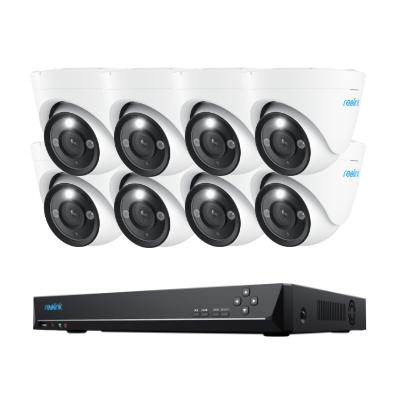
12MP PoE Security System with Color Night Vision
12MP Ultra HD, Person/Vehicle Detection, Power over Ethernet, 16-Channel NVR.
Expand this system: Add on RLC-823S2 for open lot PTZ coverage and gate entries. RLC-843A for service bays and any zone where cameras are within arm's reach of tools or equipment. Read on to find out more.
Reolink RLC-823S2: Add for Open Lot and Gate Coverage

Fixed cameras cover a lane. The Reolink RLC-823S2 covers what moves across the entire lot. Add one PTZ unit at each lot corner or at the main entry gate, where its 16X optical zoom and auto-tracking handle coverage that would otherwise require three or four fixed cameras in the same area.
At maximum zoom, the RLC-823S2 reads license plate detail on a vehicle 40 meters out. Its 360° pan and 90° tilt combined with auto-tracking means the camera follows a person or vehicle without manual input from a monitoring station. IR night vision reaches 80 meters in black-and-white mode, with color spotlight activation for motion-triggered full-color footage. The IP66 weatherproof rating covers outdoor installation without additional housing.
For smaller dealerships, two RLC-823S2 units positioned diagonally can cover a standard square lot from end to end, reducing the total fixed camera count needed for perimeter coverage.
Note: Check out more day and night car screenshots captured by user on our community Reddit thread.
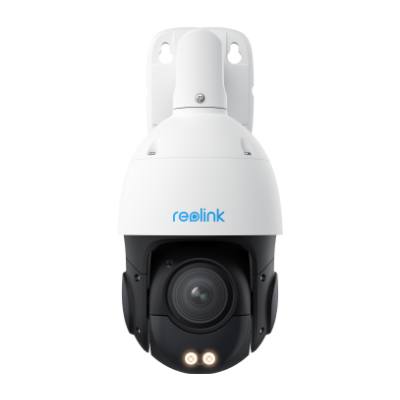
Smart 4K PTZ PoE Security Camera with 16X Optical Zoom
16X Optical Zoom, 360° Coverage in 4K UHD, Auto Tracking, Color Night Vision.
Reolink RLC-843A: Add for Service Bays and Parts Storage

Standard cameras struggle to provide adequate coverage in service bays because they are often installed within reach of tools, lifts, and equipment, where they can be easily damaged or blocked.
This is when the Reolink RLC-843A comes into the picture. Its IK10 vandal-proof housing is rated to withstand a 5-joule impact (equivalent to a 0.5kg weight dropped from 1 meter), making it the right choice for any zone where physical contact with the camera housing is a realistic risk.
Beyond the housing, it delivers 4K (8MP) at 25fps with 5X optical zoom, covering a field of view between 39° and 123°. Color night vision with dual spotlights activates on motion detection. AI-powered person and vehicle detection filters general bay activity from actual intrusion events. IP67 weatherproofing covers bay openings and wash areas where moisture is a factor.
For showroom entrances with glass exposure, the motion-activated spotlight mode draws attention without running lights all night, which is useful if you want to balance deterrence with customer experience during evening hours.
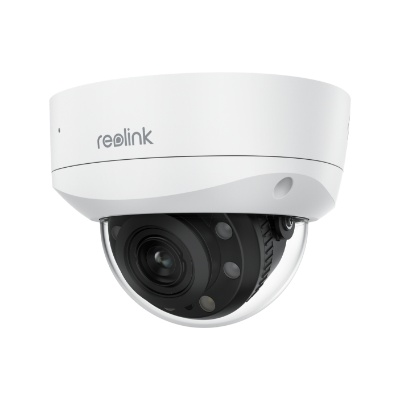
Smart 4K PoE IK10 Camera with 5X Optical Zoom
IK10 Vandal-Proof, 4K 8MP Ultra HD, 5X Optical Zoom, Color Night Vision
Best Reolink Security System Setup for Smaller Dealerships
A single-location dealer covering one or two acres needs a different starting point than a large franchise site. The priority is a complete, deployable system from a single kit purchase that covers the main risk zones without overspecifying hardware for a smaller footprint. The 8-channel NVR in a smaller kit still supports up to 12 Reolink cameras in total, so the system has room to grow if the site expands or coverage gaps emerge after installation.
Reolink RLK8-843V4: System Foundation for Single-Location Dealerships

The Reolink RLK8-843V4 is a complete security camera system featuring four 4K IK10 PoE cameras and an 8-channel NVR with 2TB HDD pre-installed. It covers a single-lot dealership's primary zones without requiring separate camera selections for different areas of the site.
The standout specification for a dealership context is the IK10 vandal-proof rating across all four cameras. Unlike a general-purpose kit where cameras are designed primarily for residential perimeter use, every camera in the RLK8-843V4 can be placed in service bays, parts rooms, or near vehicle rows without the housing becoming a liability. One kit covers the full range of zones a small dealer needs to address.
The 5X optical zoom (motorized lens, 2.7–13.5mm, adjustable field of view from 123° to 39°) compensates for the lower camera count. Where a large site deploys eight or more fixed cameras, a small dealer can position four cameras with zoom adjusted per zone: wide angle at the showroom entrance, narrowed down at the lot gate for plate capture at 20 to 30 meters. AI-powered person and vehicle detection filters alerts so after-hours lot movement that is not a person or vehicle does not trigger a notification.
The 4K (8MP) resolution at 25fps provides enough detail for face and plate identification at the shorter distances typical of a compact lot. The 8-channel NVR records 24/7 to the 2TB HDD, expandable to 16TB, and accepts up to 12 Reolink cameras total, so four additional cameras can be added as coverage needs grow without replacing the recorder.
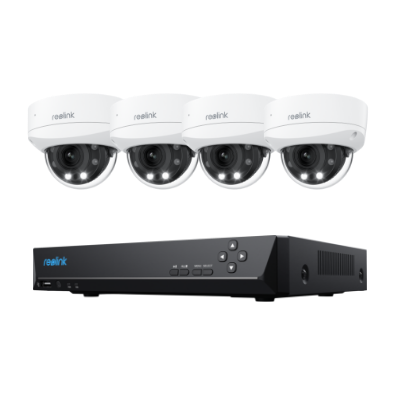
8MP IK10 PoE Dome Camera System with 5× Optical Zoom
8MP with Spotlight Night Vision; 2TB HDD 8-Channel NVR for 24/7 Recording; 5× Optical Zoom; IK10 Vandal-proof.
Expand this system: Add One RLC-823S2 PTZ at the main lot entry for long-range plate capture and auto-tracking across open vehicle rows.
Smart 4K PTZ PoE Security Camera with 16X Optical Zoom
16X Optical Zoom, 360° Coverage in 4K UHD, Auto Tracking, Color Night Vision.
Buyer Decision Table
Every dealership's security budget and complexity is different. To make the decision clearer, here's a quick framework based on site size and coverage priority.
FAQs
How many cameras does a car dealership need?
A small dealership covering one to two acres typically needs a minimum of 6 to 8 cameras to cover the perimeter, lot rows, showroom, and at least one interior zone without blind spots. Larger multi-building facilities commonly run 16 to 24 cameras to achieve full coverage. The zone-by-zone planning framework above helps map your specific layout against the number of camera positions needed before you buy.
Are PoE or wireless cameras better for automotive dealerships?
PoE cameras are the better choice for the majority of outdoor lot and perimeter positions at automotive dealerships. A hardwired PoE connection cannot be jammed, does not drop during network congestion, and provides consistent 24/7 recording without the gaps that wireless systems sometimes experience. Wireless cameras are a practical option for temporary monitoring positions or interior locations where running cable is impractical, but they should not cover primary security zones at a dealership.
Can security cameras help lower insurance premiums for dealerships?
Yes, in many cases. Insurance providers that cover commercial automotive properties frequently offer lower premiums for operations that demonstrate documented security measures, including 24/7 camera coverage with recorded footage. The key is having a system that records continuously with verifiable footage retention, not just motion-triggered clips. Talk directly to your insurer with documentation of the camera system, its recording mode, and footage retention period before renewing your policy.
What is the best type of night vision for an outdoor vehicle lot?
Color night vision with spotlights is the most useful for outdoor lots because it captures identifying detail (vehicle color, clothing color, distinguishing features) that IR black-and-white footage cannot. The trade-off is visibility: a spotlight turns on when motion is detected, which acts as a deterrent but also signals to the intruder that they have been detected. For primary lot coverage where deterrence is the goal, spotlight color night vision is the right call. For discrete coverage areas, a low-light color sensor that records in color without activating a visible light is a better option.
What happens if a vehicle is successfully driven off the lot?
Cameras document the theft and provide the footage, plate capture, and timestamps that law enforcement needs to investigate. Once a vehicle is on the road, recovery depends on a GPS tracking device installed in the vehicle, not the camera system. Dealers running floor plan financing often already have GPS units installed across their inventory as a lender requirement, which covers the recovery gap. If your operation does not use a floor plan lender or does not have GPS on inventory, a separate dealer inventory tracking system handles that piece. Cameras and GPS trackers serve different roles: cameras handle deterrence and evidence at the property level, GPS handles recovery once a vehicle has left it.
Do I need a professional installer for a dealership camera system?
For a multi-zone PoE NVR setup covering a full dealership, professional installation is the practical choice. The hardware itself is not complex, but running Ethernet cable across a large outdoor lot, through conduit, to weatherproof mounting locations at height requires low-voltage electrical work that most dealership IT teams do not handle in-house. A 4 to 8 camera installation typically takes a qualified installer one to two days. A 12 to 16 camera system runs two to four days including cabling, mounting, and NVR configuration. Unlike some enterprise camera platforms that require proprietary integrator credentials, Reolink's NVR systems do not lock you into a single installer or ongoing support vendor. Any qualified low-voltage contractor can configure and service the system.
Conclusion
The right security system for an automotive dealership is not a single camera type. It is a combination of purpose-matched cameras deployed across specific zones, backed by local NVR storage that runs regardless of what happens to your internet connection. Start with the zones that carry the most exposure: the lot perimeter, the main entry gate, and the service bays. Add a PTZ camera with optical zoom for open rows where fixed cameras fall short. Build from there as your coverage needs grow.
Reolink's PoE camera lineup is designed for exactly this kind of scalable, no-subscription commercial setup. Whether you are starting with four cameras at a single-location dealer or building out a 16-camera system across a large franchise lot, the hardware supports both and the NVR grows with the installation.
Search
Subscribe for the Latest Updates
Security insights & offers right into your inbox