
Types of Light Bulbs: A Complete Guide for Your Home Lighting

Choosing the correct lighting starts with knowing the types of light bulbs that exist today. Good light guides your tasks, flatters your rooms, and controls your monthly bill. In this guide, we look at the main light bulbs types, their bases, and the simple rules that help you buy the right lamp each time.
Different Types of Light Bulbs
It helps to first note the distinctions between the typical lamps before you approach the shelf. Most American households still have the following main types of light bulbs.
Incandescent bulbs
Many people simply call traditional lamps "light bulbs." They pass electricity across a thin tungsten wire. The wire glows until it is hot. Since this technology is over a century old, replacements are simple to get and very affordable. With a color comparable to that of candlelight, a 60-watt bulb produces soft, warm illumination.
Halogen bulbs
Though the bulb has a small quantity of halogen gas, halogen bulbs are also incandescent. The gas can run hotter, and the wire lasts longer as it sends evaporated tungsten back to the filament. The outcome is a brighter, cleaner light with somewhat better energy efficiency. Typical lamps last from 2,000 to 4,000 hours.
Fluorescent bulbs
Low-pressure mercury vapor used in garages and offices creates ultraviolet light in the long tube lamps seen here. The ultraviolet hits a covering on the glass's interior and reemits it as visible light. Four to five times more effective than conventional incandescent lamps, these tubes have a lifetime of 20,000 hours or more.
Compact fluorescent lamps (CFLs)
CFLs fit into ordinary sockets by twisting or spiraling a small, folded tube containing the same fluorescent principle. As the first true energy-saving alternative for ceiling lights and table lamps, they debuted on the market in the 1990s. A 15-watt CFL has an expected lifespan of 8,000 to 10,000 hours; it replaces a 60-watt incandescent.
Light-emitting diode (LED) bulbs
Through solid-state chips that emit light, an LED light transfers electricity. Heat reduction keeps the chips cold; there is no fragile filament or mercury. Modern LEDs achieve peak brightness the instant you switch; last 15,000 to 50,000 hours; and consume even less energy than CFLs for the same degree of light. LED lights are widely used in both homes and businesses. For instance, LED floodlight bulbs are a popular choice for outdoor security lighting and stadiums.
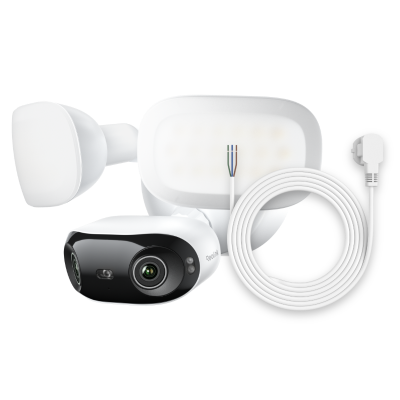
4K 180° Ultra-Wide Wired Floodlight Security Camera
3000-Lumen Dimmable Lighting, Adjustable Color Temperature, Local AI Video Search, Local Storage, Dual-Band Wi-Fi 6.
Comparison of Light Bulb Types
Check the table below to view all five lights simultaneously. Every line indicates typical values for a lamp generating about 800 lumens, which is equivalent to the brightness of an outdated 60-watt incandescent.
Types of Light Bulb Bases
The glass lamp needs to fit firmly into the socket. There are a few typical types of light bulb sockets in the United States. Almost done is matching the base code on the package to the base code on the ancient lamp.
Edison Screw (E26, E27, E12, E14)
This is the familiar screw base used in lamps, ceiling fixtures, and wall sconces. The letter tells you the base is screw-in, and the number shows its diameter in millimeters.
- E26 is the standard for 120-volt circuits in North America.
- E27 is the same lamp for 220–240-volt systems overseas.
- E12 is called the candelabra base and appears in small night-lights and chandeliers.
- E14 also serves candelabra lamps, but is more common in Europe.
Bayonet Cap (B22, B15)
A bayonet base has two side pins that you push in and twist one-quarter turn to lock. B22 is the 22-millimeter tag found on many older ceiling fixtures in the United Kingdom. B15 is the smaller size used in festoon lamps. The bayonet layout resists vibration, but you will rarely see these sockets in newer American homes.
Bi-pin (GU10, GU24, MR16, G4, G9)
A bipin light has two small metallic legs or prongs that you insert straight into the fixture. G4 measures 4 millimeters; GU10 and GU24 twist and lock; MR16 has two straight pins 5.3 millimeters apart; and G9 pins are 9 millimeters apart. Undercabinet strips and low-voltage halogen or LED spotlights employ these foundations.
Wedge Base
Wedge base lamps are common in low-voltage landscape lighting and automotive taillights. Two bare wires pierce a plastic base, and the socket holds the wires by tension. These lamps are light, cheap, and fit areas with little room for a screw or pin base.
Twist and Lock (GU10, GX53)
Though with a bayonet-like twist that clicks into place, twist-and-lock bases resemble bipin. For 120-volt track heads, GU10 is used; GX53 shows up in ultrathin undercabinet fixtures. These bases offer safe contact and remain cool enough for exposed areas.
Mogul Base (E39, E40)
Mogul is the oversized screw base used on high-wattage lamps for barns, workshops, and street lights. The base is 39 millimeters across, and the glass bulb itself is normally several inches wide. Homeowners rarely need this base unless they own an old yard light or a commercial flood light.
Intermediate Base (E17)
The intermediate screw base falls between standard and candelabra. The 17-millimeter threading shows up in appliance bulbs for microwaves, over-stove hoods, and bathroom night-lights. If you unscrew a small round bulb from a fridge and see narrow threads, you are usually holding an E17.
Comparison of Light Bulb Base Types
A clear table makes the base choice easier. Measure across the old socket with a ruler when the lamp label is missing.
How to Choose Right Types of Light Bulbs?
A good bulb raises the useful life of any room. Work through the points below, and you will move from reading labels to reliable lighting in a few minutes.
- Check the label for life hours – A label that reads “25,000 hours” does not die in one year.
- Match the base size – Measure old base diameter or bring the lamp to the store for a quick side-by-side check.
- Read lumens, not watts – Lumens measure light, watts measure power. A 450-lumen lamp is soft, 800 is medium, 1 600 is bright.
- Pick color temperature in Kelvin – 2,700 K feels warm and relaxing, 3,000 K is neutral for kitchens, and 5,000 K feels like daylight.
- Test dimmer compatibility – Only if your wall switch or lamp has a dimmer. LED packages now carry a dimmer logo when tested.
- Turn on samples in the store display – You can see color and check for flicker before you carry a box home.
- Keep receipts for LEDs – Most name-brand LEDs carry at least a 3-year warranty. Store the receipt in a drawer for a free replacement if the lamp fails early.
FAQs
What are the 4 types of bulbs?
The four most often seen bulb families in American residences and stores today are incandescent, halogen, fluorescent, and LED.
What are the five different types of light bulbs?
Add compact fluorescent lamps (CFLs) to the four major families to create five important kinds often available at most hardware stores.
What are the 6 types of light bulbs?
Some lists sort fluorescent tubes and CFLs into six categories: incandescent, halogen, fluorescent tube, CFL, LED, and HID lamps.
Which is brighter, cool white or daylight?
Daylight may feel harsher since it runs at a higher color temperature, yet the lumen count still determines actual brightness; daylight appears brighter.
Conclusion
Selecting the appropriate kinds of light bulbs for your house is easy nowadays. You are familiar with the five most popular kinds of light bulbs—incandescent, halogen, fluorescent, CFL, and LED—and you know the appropriate light bulb sockets. Compare labels for lumens, color, and life; you'll shed the appropriate light into every room. Should this guide have been useful to you, kindly share your questions or experience in the comments below.
Search
Subscribe for the Latest Updates
Security insights & offers right into your inbox