
Trail Cameras for Canada: What You Need to Know
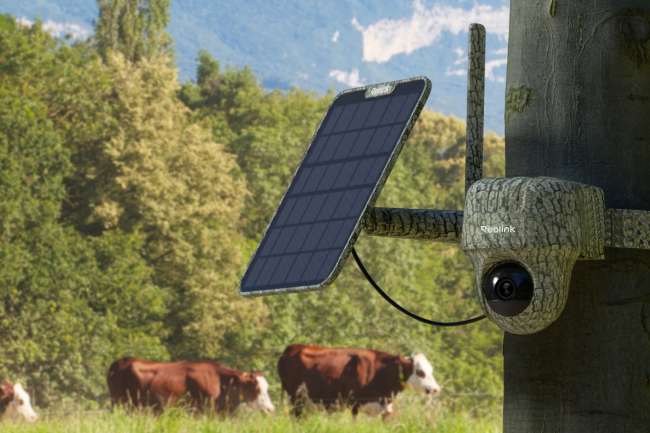
The best trail cameras for Canada has to do more than capture wildlife after dark. It needs reliable cellular connectivity in remote areas, enough battery capacity to survive long stretches between visits, and weather resistance built for changing conditions. For Canadian outdoor enthusiasts, those three requirements matter more than any single spec on the box.
That is because Canada's outdoor environments can be demanding. A camera installed near a northern woodland may face snow and prolonged cold. On a southern property, it may need to withstand rain, humidity, mud, and rapid seasonal changes. As a result, factors such as cellular connectivity, operating temperature, power options, detection features, and mounting location often matter more than choosing the highest-resolution camera.
For remote properties, these factors can determine whether a camera continues providing useful footage when regular visits are difficult. The right choice should match the location, season, and monitoring needs rather than resolution alone.
- What to Look for in a Trail Camera Suitable for Canada?
- Why Cellular Trail Cameras Make Sense for Remote Locations
- How Canadian Weather Changes Trail Camera Requirements
- Best Reolink Trail Cameras for Canada
- Trail Camera Setup Tips for Canadian Conditions
- Are Cellular Trail Cameras Worth It?
- FAQs
- Conclusion
What to Look for in a Trail Camera Suitable for Canada?
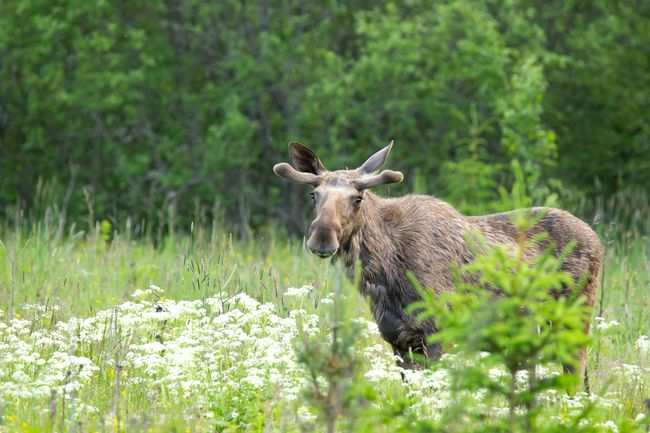
The best trail camera for Canada should match the location first, then the wildlife or property you want to monitor. A camera beside a remote forest trail has different requirements from one watching a backyard feeder or seasonal cabin.
Cellular connectivity is one of the most useful features for remote monitoring. A 4G LTE trail camera can send alerts and footage without relying on a nearby Wi Fi network, although it requires a compatible SIM card and mobile data plan. Reolink's 4G cameras are designed to operate over cellular networks rather than Wi Fi.
Battery and solar options matter just as much. If a camera is mounted several kilometres from the nearest road, frequent battery changes quickly become inconvenient. A solar compatible model can reduce the number of physical visits required, although available sunlight and winter conditions still need to be considered.
Detection features are another deciding factor. For wildlife monitoring, animal detection can help reduce unnecessary recordings, while pan and tilt functions can give you more flexibility when the camera is positioned over a large area.
Why Cellular Trail Cameras Make Sense for Remote Locations
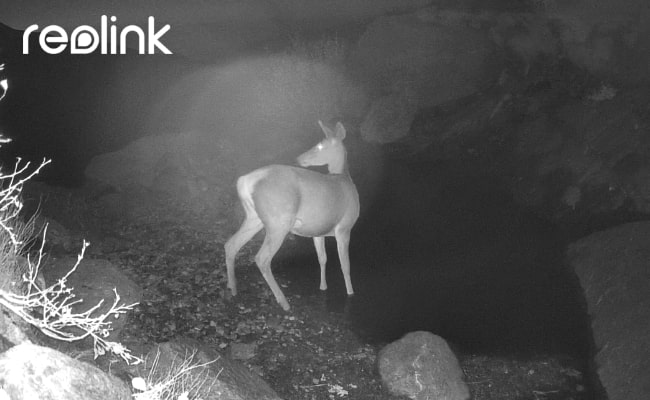
A cellular trail camera is particularly useful when there is no practical Wi-Fi connection at the location being monitored. Instead of bringing a router or extending a local network into the woods, the camera uses a supported mobile network to communicate with the user.
That makes cellular models useful for places such as remote cabins, rural properties, wildlife observation areas, farms, and forest trails. As 4G cameras require cellular service and a suitable data plan, network availability should be checked before installation.
Coverage is not automatically the same everywhere in Canada. A camera may have a clear view of a trail but still struggle to maintain a cellular connection if the location has weak service. Before mounting a camera permanently, check whether the selected carrier has usable coverage at the site.
Reolink lists Bell, Rogers, Vidéotron, Freedom Mobile, SaskTel, and Fido among the recommended Canadian carriers for models such as the Go PT Ultra and TrackMix LTE. Carrier compatibility can vary by camera version, so buyers should confirm the exact model and region before purchasing.
How Canadian Weather Changes Trail Camera Requirements
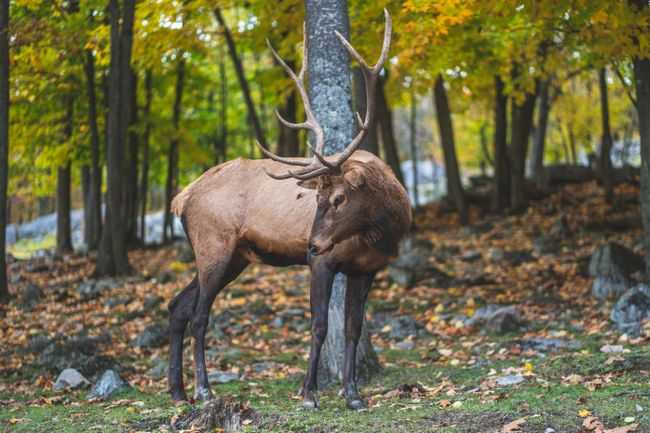
Canadian weather is not one size fits all, so there is no single climate specification that makes a camera suitable for every part of the country. Environment and Climate Change Canada's 1991 to 2020 climate normals show substantial differences in snowfall and snow depth between Canadian locations.
A bush camera in Northern Ontario or interior British Columbia can sit under deep, standing snowpack for months, while one on a Southern Ontario or coastal property may see far less accumulation and more freeze-thaw cycling instead.
Pro Tip: Checking Environment and Climate Change Canada's regional data before mounting tells you what to plan for at your specific site, not just how cold Canada gets on average nationwide.
Cold weather also affects battery performance. Lithium-ion batteries, the type used in Reolink's rechargeable camera packs, generally will not fast-charge below freezing and only accept a charge at a greatly reduced rate down to about -10°C, capping capacity at roughly 80 percent instead of a full charge. Reolink's own guidance lists -10°C to 55°C as the safe operating range for its battery-powered cameras and advises against leaving them in extreme cold for extended periods.
For Canadian buyers, that means a good trail camera should not be judged only by its advertised battery capacity. Consider the camera's operating temperature range, solar charging options, cellular signal strength, and how accessible the installation point will be during winter.
Best Reolink Trail Cameras for Canada
The right choice depends on what you need to watch/monitor. These three Reolink models cover different use cases rather than trying to solve every trail camera scenario with the same design.
Picture a remote property two hours north of Sudbury, reachable by ATV in summer and accessible by snowmobile once the trails ice over. A camera mounted there needs to send an alert the moment something crosses the frame and hold up across a full season of use. These three cameras are built for that kind of use, just with different trade-offs depending on what is being watched.
In practice, that means these models fit best on sites you can check every few weeks, such as private land, farms, or cottage properties, rather than a remote camp left completely unattended through the coldest stretch of winter. Since they run on solar-rechargeable batteries rather than swappable disposables, they suit a seasonal pattern best deployed from summer through the fall and again in spring, without needing to run untouched through the harshest weeks of January and February.
Reolink Go Ranger PT
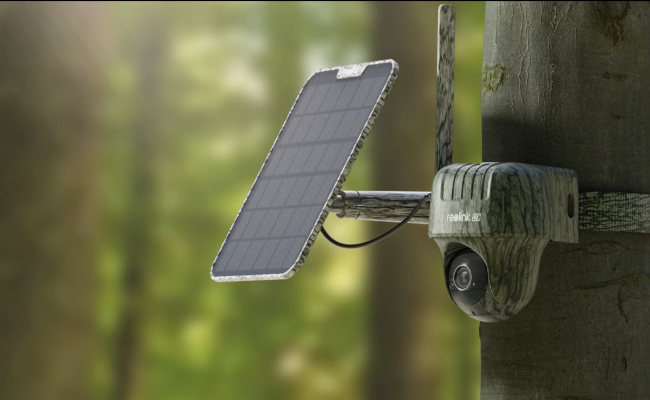
Best Security Camera for Wildlife Monitoring in Canada
The Reolink Go Ranger PT is the strongest fit for wildlife enthusiasts who want a dedicated cellular camera with pan and tilt control and animal focused detection features.
It records at up to 4K 8MP resolution and offers 355° pan and 140° tilt, allowing the camera to cover a broader area than a fixed lens design. Its detection system includes person, vehicle, and animal recognition features that can trigger alerts when wildlife like buck, antlerless deer, or turkey appears.
At night, a 940nm no-glow infrared LED and an f/1.6 aperture extend usable detail to about 10 metres without a visible flash that could spook wildlife.
The camera uses a 6,000mAh rechargeable battery and supports the Reolink Solar Panel 2. Reolink lists 10% to 90% operating humidity and an IP65 weatherproof rating for rain and dust exposure on a typical bush or trail mount.
That combination makes the Go Ranger PT a practical option for monitoring a wildlife trail where deer rarely stick to one predictable path. Picture a forest clearing where deer cut through from the tree line one day and along the opposite edge the next. Rather than missing whichever animal wanders outside a fixed frame, you can remotely turn the camera to follow the trail they're actually using and keep them in view.
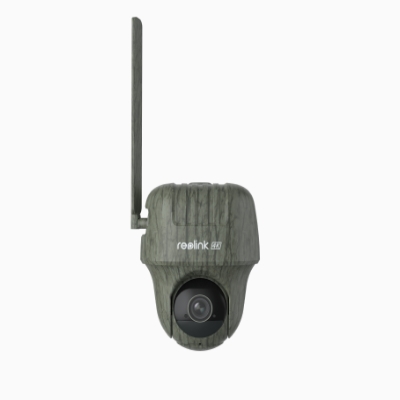
4K 4G LTE Wildlife Camera with 360° All-Around View
4G LTE Network, 4K 8MP Ultra HD, No-Glow IR LEDs, Person Detection, Animal Detection, Two-Way Audio, Battery/Solar Powered.
Reolink Go PT Ultra
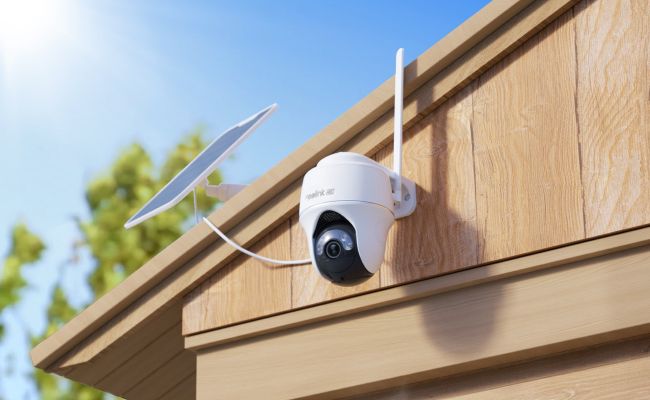
Best Security Camera for Wide Area Coverage in Canadian Climates
The Reolink Go PT Ultra is a strong option when you want 4K resolution, cellular connectivity, and broad pan and tilt coverage in a relatively compact camera.
The camera records in 4K 8MP resolution and provides 355° pan and 140° tilt. It uses a 21.6Wh rechargeable battery and supports the Reolink Solar Panel 2 for solar charging.
It carries an IP64 weather resistance rating, which protects against splashing water from any direction but not a direct, sustained jet, so it holds up best mounted under an eave, tree canopy, or angled overhang rather than fully exposed to driving rain.
The Go PT Ultra makes sense for locations where a wide viewing range is more important than having specialized wildlife recognition. A property owner monitoring a wide area such as a driveway or big yards could use the pan and tilt function to cover different areas without installing multiple fixed cameras.
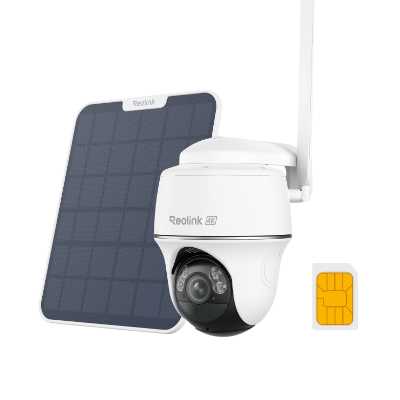
4K 8MP Wire-Free 4G LTE PT Battery Camera
4K 8MP; Smart Detection; 355° Pan & 140° Tilt; Battery/Solar Powered; Color Night Vision; Smart Real-Time Alert.
Reolink TrackMix LTE
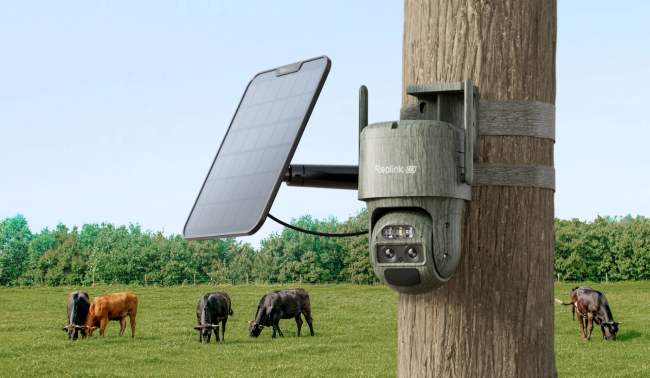
Best Security Camera for Tracking Moving Wildlife in Canada
The Reolink TrackMix LTE stands out when your priority is following movement rather than simply watching one fixed area.
Its dual-lens system provides up to 4K 8MP video, while its optical setup covers a horizontal field of view ranging from 108.4° to 38°. The camera also offers 6X hybrid zoom, pairing digital zoom on the wide lens with true optical zoom on the telephoto lens so images stay sharper than they would with digital zoom alone. Automatic tracking builds on this dual-lens setup. The wide lens keeps the whole clearing in view while the telephoto lens zooms in and follows a moving animal on its own, without needing to manually pan, tilt, or zoom to keep up.
The camera has a 5,100mAh rechargeable battery with a listed power capacity of 36.72Wh and supports the Reolink Solar Panel 2. It provides up to 30 metres of infrared night vision, person, vehicle, pet, and PIR detection, and 355° pan with up to 90° tilt. That is three times the 10-metre infrared range on the Go Ranger PT and Go PT Ultra, which matters most when animals typically appear well beyond the tree line rather than close to the mount.
Together, the camera's auto-tracking and 30-metre infrared range let it capture wildlife beyond a fixed trail camera's reach, preventing distant subjects near the tree line from appearing as dark, blurry shapes. On a large property, wildlife clearing, or trail where animals cross the frame instead of walking up to one fixed point, the TrackMix LTE keeps them in view and visible instead of losing them to the dark.
For Canadian outdoor use, its IP65 weatherproof rating provides useful protection against rain and dust exposure.
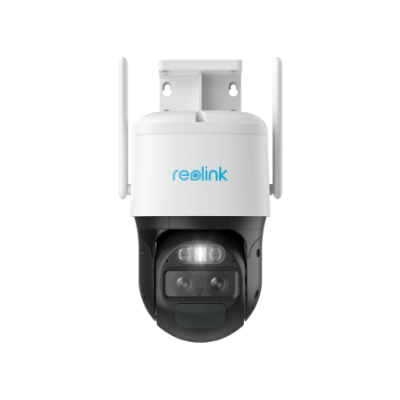
2K Dual-Lens PTZ Camera with Motion Tracking
4K 8MP UHD, Wide-Angle & Telephoto Lenses, Pan-Tilt-Zoom, Auto-Tracking, Person/Vehicle Detection, 4G LTE Network, Two-Way Audio, Time-Lapse.
Trail Camera Setup Tips for Canadian Conditions
The installation location can matter as much as the camera itself. Mount the camera high enough to reduce the risk of accidental contact, but keep the lens and detection area clear of branches that can trigger false alerts when they move in the wind.
For winter installations, avoid placing the camera where melting snow or ice can repeatedly drip directly onto the housing. If solar charging is being used, consider the seasonal position of the sun and whether snow, branches, or the mounting angle could reduce the panel's exposure.
Cellular signal deserves attention too. A camera can have excellent specifications and still perform poorly if the chosen location has weak mobile coverage. Test the connection before committing to a permanent mounting point.
If the camera is going on land you do not own, including Crown land, a provincial park, or a conservation area, check the current rules for that land before mounting anything. Regulations vary by jurisdiction and can change over time, so a camera's technical capabilities should never be treated as permission to install it in any particular location. Check directly with the relevant provincial or territorial land authority beforehand.
Are Cellular Trail Cameras Worth It?
Cellular trail cameras are worth considering when the camera will be installed somewhere without reliable Wi-Fi, and you need remote access to alerts or footage.
The trade off is that cellular models require a supported mobile network and data plan. Data usage can also vary depending on how often you use live viewing and receive motion triggered events.
For a camera beside a house with strong Wi-Fi, a conventional Wi-Fi model may be simpler. For a wildlife trail or farm, cellular connectivity can eliminate the need to build a local Wi-Fi connection at the installation site.
FAQs
Which trail camera is best without a subscription?
None of the three require a Reolink Cloud subscription to function. Each supports local microSD card storage (up to 128GB) at no extra cost, with Reolink Cloud offered only as an optional add-on for off-site backup. That said, all three are cellular-only with no WiFi support, so getting alerts and footage remotely still depends on an active SIM card and a cellular data plan from a supported carrier. Running any of them purely on local SD storage removes the ongoing subscription cost, but footage then has to be retrieved by pulling the card rather than viewed remotely.
Do trail cameras work in Canadian winters?
Some trail cameras are designed for outdoor temperature ranges that include portions of the Canadian winter, but buyers should compare the camera's specified operating temperature with local conditions. Battery performance can also change with temperature, so cold weather users should consider solar charging and installation accessibility.
Do cellular trail cameras need Wi-Fi?
No. Reolink's 4G cellular trail camera models use mobile networks rather than Wi-Fi. They require a compatible SIM card and cellular data service, and performance depends on network availability at the installation location.
Can a trail camera be used for wildlife monitoring?
Yes. Trail cameras can be useful for observing wildlife activity, identifying animals, and monitoring areas that are difficult to visit frequently. Models with animal detection and recognition can make large volumes of footage easier to manage.
Can you put trail cameras on public land?
It depends on the type of public land and the province, since there is no single federal law governing trail camera use in Canada. Crown land generally allows non-invasive uses like wildlife observation, but access rules vary by region and can change seasonally, so it is worth checking with the relevant provincial land or natural resources office before installing anything. Provincial parks and conservation areas tend to be stricter, often requiring authorization from a park officer before any equipment, including a camera, can be set up. Even where placement itself is permitted, capturing recognizable images of other people without their knowledge can raise privacy concerns, so it is best to aim the camera at genuine wildlife areas rather than trails or spots where people commonly pass through. Because the rules differ by province, land designation, and even by specific park, confirm placement with the local land manager before mounting a camera on any public land.
How do I choose a trail camera for remote Canadian property?
Start with cellular coverage, operating temperature, power options, weather resistance, detection features, and the area you need to monitor. A remote property with no Wi Fi may benefit from a 4G model, while a large clearing may benefit from pan-and-tilt or tracking capabilities.
Conclusion
Choosing a trail camera for Canada comes down to matching the camera to how and where you'll actually use it, not chasing the longest spec sheet. That's also why these three Reolink models make the most sense on land you can check every few weeks, rather than a site left untouched through the depths of winter.
Whichever one fits your situation, confirm cellular coverage at the site, weigh the operating temperature against what your local winter actually looks like, and plan how you'll power and access the camera once the snow sets in. Get that right, and it keeps working long after the leaves are gone.
Search
Subscribe for the Latest Updates
Security insights & offers right into your inbox