
Telephoto Lens: 2026 Full Guide
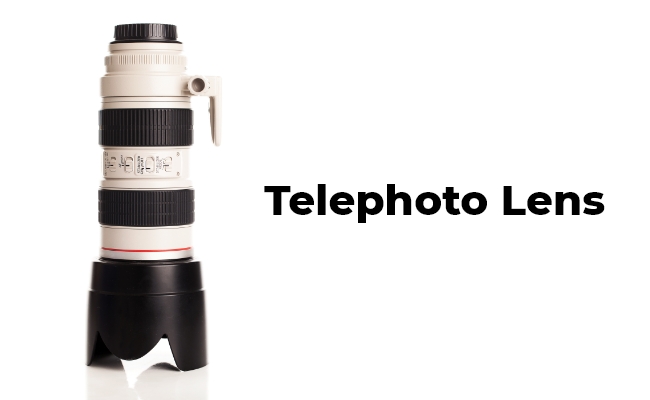
Telephoto lenses are a marvel in the world of cameras as they allow some distinct points of view and capabilities. These lenses go beyond the boundaries of ordinary camera lenses and take pictures with unbelievable sharpness from a considerable distance.
This article discusses telephoto lenses, compares them with wide-angle lenses, and contacts specialized uses such as security cameras. Comprehending these lenses helps us better understand their transformative effect on photography and surveillance.
- What Is a Telephoto Lens?
- How Do Telephoto Lenses Work?
- What Are Common Types of Telephoto Lenses?
- Pros and Cons of Telephoto Lens
- Where to Use a Telephoto Lens?
- Telephoto Lens vs. Other Types of Lenses: Quick Comparison
- How to Use Cameras with Telephoto Lenses Effectively?
- Best Telephoto Lens Applications in Security Cameras
- FAQs
- Conclusion
What Is a Telephoto Lens?
A telephoto lens is a type of camera lens that uses a long focal length (80 mm or greater) to make distant subjects appear closer and more detailed while maintaining clear image quality. It is commonly used for capturing faraway scenes, people, wildlife, sports, and security footage.
Key Features of a Telephoto Lens
- Long-distance zoom: Captures faraway objects without needing to move closer.
- Long focal length: Uses a longer focal length to magnify distant subjects.
- Compressed perspective: Makes background objects appear closer to the subject for a more cinematic look.
- Shallow depth of field: Creates a blurred background (bokeh effect) that helps the subject stand out.
- High image quality: Maintains clear details even when zooming in on distant scenes.
How Do Telephoto Lenses Work?
Telephoto lenses work by using a long focal length to magnify distant subjects and make them appear closer to the camera without reducing image quality.
Key Principles Behind Telephoto Lenses
Long Focal Length
- Telephoto lenses typically have focal lengths longer than standard lenses
- A longer focal length creates higher magnification
- This allows the camera to capture distant objects in greater detail
Narrow Field of View
- Telephoto lenses focus on a smaller area of the scene
- This makes subjects appear larger in the frame
- Helps isolate the subject from distracting surroundings
Perspective Compression
- Telephoto lenses visually compress the distance between objects
- Background elements appear closer to the subject
- Creates a more cinematic and professional-looking image
Shallow Depth of Field
- Telephoto lenses often produce a shallow depth of field
- The subject stays sharp while the background becomes blurred
- This background blur is known as the bokeh effect
What Are Common Types of Telephoto Lenses?
Different types are classified by their focal length.
Short Telephoto Lens (85mm to 135m)
- Usually between 85mm and 135m in focal length
- Popularly used for portrait photography
- Gives a flattering perspective and DOF
- Creates images with the subject emerging crisply against a softly blurred background
- Perfect for close-up work and capturing detail without distorting the subject
Medium Telephoto Lens (135mm to 300mm)
- Ranges from approximately 135mm to 300mm in focal length
- Adaptable and broadly used in sports, event, and wildlife photography
- Enables close-up shots at a moderate distance
- Helps keep enough space from the subject
- Captures significant details and creates blurred backgrounds
Super Telephoto Lens (Longer than 300mm)
- Designed for capturing subjects from a large distance
- Features focal lengths longer than 300mm
- Useful when the camera cannot get close to the object
- Often bigger and heavier than other telephoto lenses
- Usually requires support from tripods or monopods
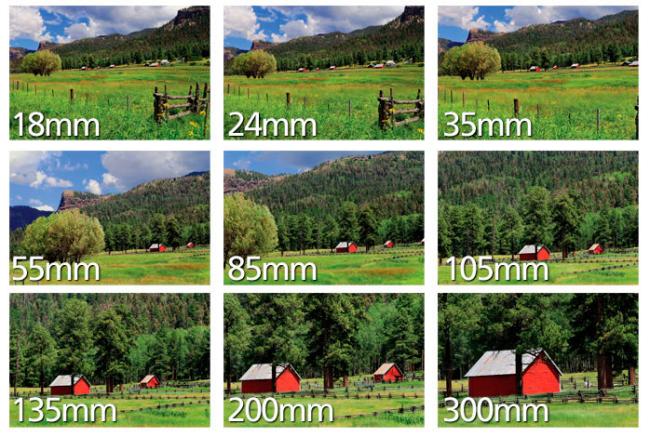
Image credit: Nikon
Pros and Cons of Telephoto Lens
Telephoto lenses are popular for capturing distant subjects and creating professional-looking images, but they also have some limitations depending on the shooting environment and setup.
Advantages
- Capture distant subjects clearly: Telephoto lenses make faraway objects appear closer while maintaining good image quality.
- Excellent subject isolation: Their shallow depth of field helps separate the subject from the background.
- Beautiful background blur: They create a strong bokeh effect for a more cinematic and professional look.
- Ideal for long-range shooting: Perfect for wildlife, sports, surveillance, and outdoor photography.
- Compressed perspective: Makes backgrounds appear closer to the subject for more visually appealing compositions.
Disadvantages
- Larger and heavier: Telephoto lenses are often bulkier than standard or wide-angle lenses.
- More camera shake: Longer focal lengths make images more sensitive to hand movement and vibration.
- Narrow field of view: They capture a smaller portion of the scene, making framing more difficult in tight spaces.
- Require more shooting distance: You may need to stand farther away from the subject.
- Higher cost: High-quality telephoto lenses can be more expensive, especially super telephoto models.
Where to Use a Telephoto Lens?
elephoto lenses are widely used in situations where subjects are far away and clear detail is important. Their long-range zoom and background blur make them useful for both professional and everyday applications.
Security and Surveillance
Telephoto lenses are commonly used in security cameras to monitor large properties, parking lots, warehouses, and entrances. They help capture clear details like faces, license plates, or suspicious activity from a long distance.
Real-world example:
A homeowner can use a telephoto security camera to clearly identify a delivery vehicle parked at the end of a long driveway without needing to place the camera close to the street.
Wildlife Photography
Wildlife photographers use telephoto lenses to photograph animals from a safe distance without disturbing them. The strong zoom helps capture detailed shots even when the animal is far away.
Real-world example:
A photographer on safari can capture close-up images of birds or wild animals without getting physically close or causing stress to the animals.
Sports Photography
Telephoto lenses are ideal for capturing fast-moving action during sports events. They allow photographers to zoom in on athletes from the sidelines or stadium seating areas.
Real-world example:
Parents recording their child’s soccer game can use a telephoto lens to capture facial expressions and action shots from across the field.
Portrait Photography
Many portrait photographers prefer telephoto lenses because they create a soft blurred background and produce a more flattering facial perspective.
Real-world example:
A portrait taken with an 85mm telephoto lens helps the subject stand out naturally while keeping the background smooth and less distracting.
Astrophotography
Telephoto lenses are also used to photograph the moon, stars, and distant celestial objects by bringing faraway details closer.
Real-world example:
A beginner photographer can use a telephoto lens to capture detailed moon photos without needing a telescope setup.
Telephoto Lens vs. Other Types of Lenses: Quick Comparison
Wide-angle lenses are best for capturing large scenes and fitting more into the frame, while telephoto lenses are designed for zooming in on distant subjects with strong background blur. Zoom lenses are flexible lenses that allow users to change focal lengths, and they can include both wide-angle and telephoto ranges in one lens.
How to Use Cameras with Telephoto Lenses Effectively?
- Use a tripod or stable mount to reduce camera shake during long-range shooting.
- Choose optical zoom instead of digital zoom for clearer image quality.
- Keep enough distance from the subject for better framing and focus.
- Use good lighting whenever possible to improve image detail and sharpness.
- Enable auto tracking on PTZ security cameras for moving subjects.
- Adjust focus settings carefully when capturing distant objects.
- Avoid obstacles like glass reflections, trees, or heavy rain that can affect image clarity.
- Use higher shutter speeds for sports, wildlife, or fast-moving subjects.
- Position security cameras at elevated locations for wider and clearer coverage.
- Combine wide-angle and telephoto views for both overview and close-up monitoring.
Best Telephoto Lens Applications in Security Cameras
Telephoto lenses are widely used in security cameras for monitoring large areas and capturing distant details that standard lenses may miss.
Long-Range Monitoring
Telephoto security cameras are ideal for monitoring large properties, farms, warehouses, and business entrances from a distance.
Recommended Example:
The Reolink TrackMix PoE combines a wide-angle lens with a telephoto lens to automatically track moving people, vehicles, and pets while keeping both overview and close-up details visible.
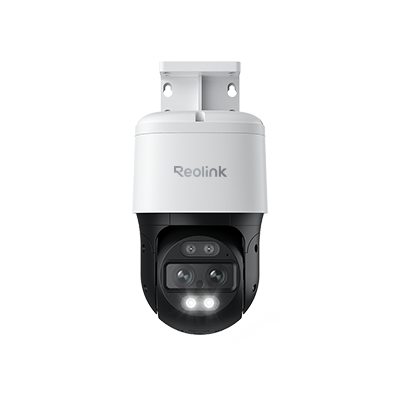
4K Dual-Lens PTZ Camera with Dual Tracking
4K 8MP Ultra HD, Wide & Telephoto Lenses, Pan & Tilt, Auto-Tracking, Person/Vehicle Detection, Power over Ethernet, Two-Way Audio.
License Plate Capture
A telephoto lens helps security cameras zoom in on vehicles and capture clearer license plate details at gates, driveways, or parking lot entrances.
Recommended Example:
The Reolink RLC-823S2 features powerful optical zoom that helps identify license plates and distant objects without losing image quality.
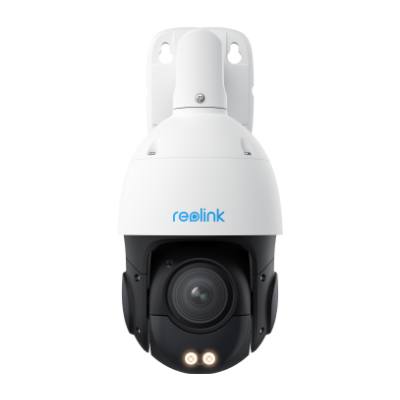
Smart 4K PTZ PoE Security Camera with 16X Optical Zoom
16X Optical Zoom, 360° Coverage in 4K UHD, Auto Tracking, Color Night Vision.
Parking Lot Surveillance
Large parking areas require cameras that can cover long distances and focus on suspicious activity or vehicle movement.
Recommended Example:
The Reolink Duo 3 PoE provides a wide 180° field of view for overall parking lot coverage, while PTZ telephoto models can monitor specific vehicles or areas in detail.
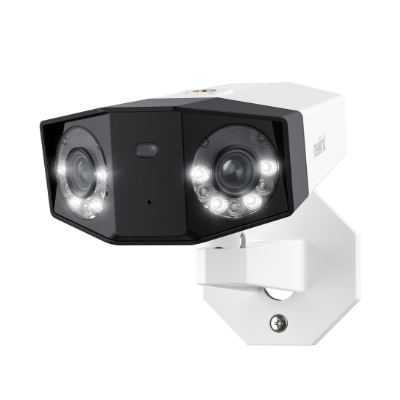
Groundbreaking 16MP Dual-Lens PoE Camera
16MP UHD, Dual-Lens, Motion Track, 180° Wide Viewing Angle, Power over Ethernet, Color Night Vision.
Perimeter Protection
Telephoto lenses are useful for monitoring fences, gates, and property boundaries where subjects may appear far from the camera.
Recommended Example:
The Reolink TrackMix LTE offers long-range monitoring with auto tracking and optical zoom, making it suitable for remote locations without WiFi access.
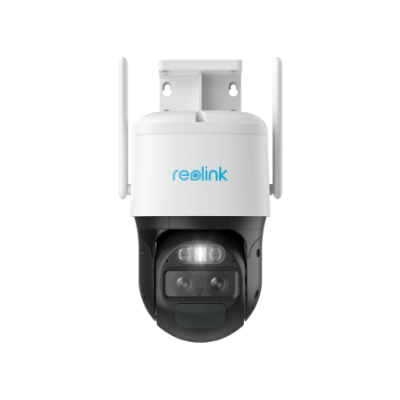
2K Dual-Lens PTZ Camera with Motion Tracking
2K 4MP Quad HD, Wide-Angle & Telephoto Lenses, Pan-Tilt-Zoom, Auto-Tracking, Person/Vehicle Detection, 4G LTE Network, Two-Way Audio, Time-Lapse.
Recommended Telephoto Security Camera Types
- Multi-Lens Security Cameras: Multi-lens cameras combine wide-angle coverage with telephoto zoom for both overview and close-up monitoring.
- PTZ Cameras with Optical Zoom: PTZ cameras can pan, tilt, and zoom to track movement and focus on distant details.
FAQs
Is a 50mm a telephoto lens?
Yes, a 50mm lens is generally considered a telephoto lens in many camera systems, especially on full-frame cameras. It offers a slightly “zoomed-in” view compared to wide-angle lenses, making it ideal for portraits and everyday photography. However, on crop-sensor cameras, a 50mm lens can behave more like a short telephoto or even a standard lens depending on the crop factor.
What is a telephoto lens in an iPhone?
iPhone telephoto camera lens helps users to zoom into subjects without having physically moved nearer. The lens also helps produce professional-looking portraits with blurred backgrounds.
Which is better: telephoto or optical zoom?
It depends on what you mean by “optical zoom.”
- Telephoto lens: Refers to a type of lens with a long focal length designed for distance shooting and subject compression.
- Optical zoom: Refers to the ability to zoom using the lens itself without losing image quality.
In most cases, optical zoom is better when it is achieved through a telephoto lens, because it preserves image quality while bringing distant subjects closer.
However, a telephoto lens with optical zoom is usually the best combination, especially for photography, wildlife, sports, and security cameras.
Conclusion
Telephoto lenses transform the way we perceive and capture our world. Be it in professional photography, smartphones, or security surveillance, their ability to make the far away closer is second to none. The practical applications of such lenses show how beneficial they are for surveillance. Overall, telephoto lenses are essential in the field of visual storytelling and security.
Search
Subscribe for the Latest Updates
Security insights & offers right into your inbox