
Safest Cities in Kansas: Guide to Family-Friendly Living
Kansas is known for its wide-open spaces, small towns, and family-oriented neighborhoods. Although safety can vary a great deal from place to place. In this article, we will go with the safest cities in Kansas for 2024, trending crime in Kansas today, and safety tips in Kansas.
Is Kansas Safe?
Yes, overall, Kansas is considered a safe state to live in and visit. Recent comprehensive safety data highlights a significant, positive shift in public safety, with actual crime experiences dropping and resident confidence on the rise.
However, safety in the Sunflower State depends heavily on where you are, as there is a stark contrast between its highly secure suburban/rural towns and its larger urban centers.
Top 10 Safest Cities in Kansas
The overall safety climate in the state has improved noticeably, with a significant drop in the percentage of residents reporting personal experiences with violent crime. In the latest rankings, check the following safest cities in Kansas.
1. Eudora
-
Violent Crime Rate: 0.2 per 1,000 residents
-
Property Crime Rate: 3.2 per 1,000 residents
After temporarily losing its crown, Eudora has made a major comeback to reclaim the #1 spot. Both its violent and property crime rates dropped year-over-year, recording an impressive zero reported rapes or motor vehicle thefts.
2. Ulysses
-
Violent Crime Rate: 0.9 per 1,000 residents
-
Property Crime Rate: 0.5 per 1,000 residents
Standing as a brand-new entry straight into the #2 spot, Ulysses is a unique outlier. It is the only city on the top 10 list that isn't located inside a major metropolitan area, and it bucks the national trend by having a property crime rate that is actually lower than its violent crime rate.
3. Mulvane
-
Violent Crime Rate: 0.7 per 1,000 residents
-
Property Crime Rate: 6.3 per 1,000 residents
Ascending two spots from previous state reports, Mulvane continues to build on its proactive community policing strategies. It managed to slash its property crime rate nearly in half compared to its numbers from a few years ago.
4. Tonganoxie
-
Violent Crime Rate: 1.8 per 1,000 residents
-
Property Crime Rate: 2.1 per 1,000 residents
Tonganoxie remains highly secure, though it slipped slightly to the #4 position. While its violent crime ticked up slightly to 1.8, its property crime rate saw a steep and impressive decline down to 2.1.
5. Bel Aire
-
Violent Crime Rate: 0.7 per 1,000 residents
-
Property Crime Rate: 7.1 per 1,000 residents
Bel Aire is one of only three top-tier cities to see simultaneous year-over-year drops in both violent and property crime. Its property crime rate plummeted from a previous 15.9 down to a much safer 7.1.
6. Lansing
-
Violent Crime Rate: 1.2 per 1,000 residents
-
Property Crime Rate: 6.0 per 1,000 residents
Lansing is a major mover on the list, jumping up 6 spots to break into the top 10. Strong neighborhood programs and a emphasis on public infrastructure have successfully suppressed property crimes.
7. Basehor
-
Violent Crime Rate: 1.5 per 1,000 residents
-
Property Crime Rate: 5.9 per 1,000 residents
Basehor held completely steady year-over-year, maintaining its firm grip on the #7 spot. Property crime rates dropped from 6.8 down to 5.9, keeping this suburb a highly attractive choice for families.
8. Prairie Village
-
Violent Crime Rate: 0.6 per 1,000 residents
-
Property Crime Rate: 11.0 per 1,000 residents
Moving up 2 spots, Prairie Village rounds out the trio of top cities that achieved dual decreases in both violent and property crime categories, cementing its status as an exceptionally safe Kansas City suburb.
9. Louisburg
-
Violent Crime Rate: 1.9 per 1,000 residents
-
Property Crime Rate: 5.7 per 1,000 residents
Louisburg makes its debut on the top 10 list this year. While it accounted for one of the very few robberies recorded across all ten of these safe havens collectively, its overall crime footprint remains incredibly small.
10. Gardner
-
Violent Crime Rate: 1.4 per 1,000 residents
-
Property Crime Rate: 8.8 per 1,000 residents
Gardner climbed up one spot to secure the final anchor position on the list. While property crimes saw a minor fluctuation upward to 8.8, violent crime numbers dropped from 1.6 to 1.4, preserving its peaceful, community-first reputation.
Data Reference: You can verify the complete methodology, full list of 63 ranked municipalities, and detailed state-wide safety trends via the comprehensive SafeWise Kansas Safest Cities Report.
Quick List of Safest Cities in Kansas
Crime Trends and Statistics in Kansas
Dramatic Drops in Crime
The latest state-level data indicates that Kansas is moving in a very safe direction:
-
Plummeting Violent Crime: According to SafeWise, only 4% of Kansas residents reported a personal experience with violent crime in the preceding 12 months—a massive drop from 17% the prior year. This gives Kansas one of the lowest percentages of violent crime experiences in the entire country.
-
Falling Major Offenses: Recent FBI data reports double-digit year-over-year decreases across several major crime categories in Kansas, including a 28% drop in murders, a 22% drop in burglaries, and a 16% drop in vehicle thefts.
-
Skyrocketing Peace of Mind: Because of these drops, the percentage of Kansans who report feeling safe in their home state jumped significantly from 42% to 58%.
The Baseline Crime Numbers
When tracking actual reported incidents per 1,000 residents, Kansas aligns very closely with national safety standards.
-
Violent Crime: At 4.27 incidents per 1,000 residents, Kansas sits slightly below the national average.
-
Property Crime: At 20.70 incidents per 1,000 residents, Kansas perfectly mirrors the baseline national average.
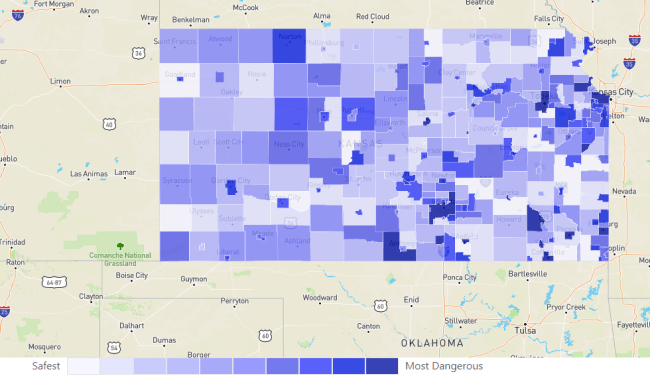
Image Credit: NeighborhoodScout
What Crime Are Kansas Residents Most Concerned About?
Overall, Kansas residents report moderate safety concerns, mainly driven by violent crime in urban areas and persistent property crime across the state.
Violent Crime
- Includes offenses such as aggravated assault, robbery, and other acts involving physical harm or threat of harm
- Concern is most noticeable in urban centers such as Wichita and Topeka, where population density contributes to higher exposure risk
- Some smaller communities, including Gardner and Basehor, also report occasional spikes above the state average
Property Crime
- Includes burglary, vehicle theft, and residential or package theft
- Kansas property crime rate is 20.7, which is in line with the national average
- More widespread than violent crime, affecting both urban and suburban neighborhoods
- Higher incidence is typically seen in larger cities and commuter communities
How to Stay Safe When Living in Kansas?
Living safely in Kansas requires a blend of standard personal security practices and an awareness of the unique geographic and environmental traits of the state. Because Kansas perfectly mirrors the national average for property crime and sits just below it for violent crime, staying safe is highly manageable.
The practical blueprint below details how to stay secure when living in the Sunflower State, focusing on its specific regional dynamics, property crime trends, and weather challenges.
1. Smart Property & Package Management
Property crime accounts for the vast majority of all offenses committed in Kansas. Because the state’s property crime rate tracks at $20.70$ incidents per 1,000 residents, home and asset security should be a top priority.
- Invest in Smart Home Security: High-quality security systems, motion-sensor lighting, and video doorbells are major deterrents. Cities like Bel Aire and Prairie Village saw massive drops in property crime primarily due to widespread residential surveillance adoption.

10MP+8MP Triple-Lens 360° Panoramic Pan-Tilt Camera
- 10MP Dual-Lens 180° View & 4K 360° Full Coverage
- PoE Connectivity & Local Storage
-
Secure Your Vehicle: While vehicle thefts dropped double-digits statewide recently, they remain common in urban driveways. Always lock your car, never leave the keys inside (especially during cold winter mornings when warming up the engine), and keep valuables completely out of sight.
-
Prevent Package Theft: If you live in an urban center, coordinate deliveries for times you are home, use secure drop boxes, or require a signature.
2. Navigate the "Urban vs. Suburban" Divide
Safety in Kansas is highly regional. Your daily safety protocols should adjust depending on where you are located.
-
In Major Cities (Wichita, Topeka, Kansas City): Practice heightened situational awareness, especially at night. Stick to well-lit public paths, park in populated areas, and avoid locking eyes with or engaging in escalating road rage incidents, which can sometimes involve firearms.
-
In Suburbs and Rural Areas: While towns like Eudora, Basehor, and Ulysses are remarkably safe (boasting violent crime rates under 1.5 per 1,000 residents), do not fall into a false sense of security. Complacency leads to crimes of opportunity; continue locking your front doors and securing outbuildings/garages.
3. Prioritize Environmental & Weather Safety
In Kansas, human-driven crime is only part of the safety equation—nature plays a massive role. Kansas sits firmly in Tornado Alley, making environmental preparedness an absolute necessity for survival.
-
Know Your Shelter Zone: Ensure your home has a designated safe area—ideally a basement or a storm cellar. If you live in an apartment or a home with a concrete slab foundation, identify an interior, windowless room (like a bathroom or closet) on the lowest floor.
-
Keep an Active Weather Alert System: Don't rely solely on outdoor air-raid sirens, which are meant to warn people who are already outside. Keep a NOAA Weather Radio in your home and ensure your smartphone's Wireless Emergency Alerts (WEA) are turned on to catch sudden tornado warnings.
-
Prep for Extreme Winters: Winter storms can isolate rural communities. Keep a winter emergency kit in your vehicle containing blankets, jumper cables, flares, non-perishable food, and a shovel.
4. Lean Into the Community
Kansans are known for tight-knit, neighborly cultures. One of the single best ways to stay safe is to actively engage with the people around you.
-
Join local Neighborhood Watch programs or community groups (such as verified Nextdoor circles).
-
Establish a relationship with your neighbors so they know what cars belong in your driveway and can spot unusual or suspicious activity when you are away from home.
FAQs
What is the safest city in Kansas to live in?
Eudora is widely considered the safest city in Kansas, with extremely low violent crime (0.2 per 1,000 residents) and low property crime (3.2 per 1,000 residents).
What part of Kansas is best to live in?
The safest and most popular areas are generally in eastern Kansas and suburban communities around Kansas City and Wichita, such as Prairie Village, Basehor, and Lansing, due to lower crime rates and better amenities.
Is moving to Kansas a good idea?
Yes, for many people. Kansas offers affordable housing, low cost of living, and generally safe small towns, though crime levels and job opportunities can vary by city, so location choice matters.
Conclusion
Safety across the state of Kansas is mixed, bustling cities and serene towns. Some areas struggle with crime, while other towns do an outstanding job of staying relatively crime-free and creating strong community members. Residents can stay informed and take proactive safety measures so that all that the Sunflower State has to offer can be enjoyed.
Search
Subscribe for the Latest Updates
Security insights & offers right into your inbox