
What Are NDAA Compliant Cameras? Everything You Need to Know
When you shop for security cameras in the United States, you will often see the term “NDAA compliant cameras.” These cameras meet the rules set by Section 889 of the National Defense Authorization Act (NDAA).
Knowing why this label matters can help you buy cameras that keep your data safe, meet federal rules, and avoid costly replacements in the future. This guide explains NDAA cameras in simple terms so you can make smart choices.
- What Is a NDAA Compliant Camera?
- Why NDAA Compliance Matters for Security Cameras?
- Who Should Consider NDAA Compliant Security Cameras?
- How to Verify Whether a Security Camera Is NDAA Compliant?
- What to Look for When Choosing an NDAA Compliant Security Camera?
- Are Reolink Cameras NDAA Compliant?
- FAQs
- Conclusion
What Is a NDAA Compliant Camera?
An NDAA-compliant security camera generally refers to a camera or surveillance solution that does not use “covered telecommunications equipment or services” prohibited under Section 889 of the FY2019 NDAA. For federal procurement, organizations should evaluate the manufacturer, equipment, services, and supply chain against the applicable Section 889 and FAR requirements.
NDAA compliance does not necessarily mean:
- The camera has passed a federal cybersecurity certification;
- Every component must be manufactured in the United States;
- The camera is automatically approved for every government contract.
NDAA Section 889 Part A vs. Part B
GSA explains that Part A took effect on August 13, 2019, while Part B took effect on August 13, 2020.
Why NDAA Compliance Matters for Security Cameras?
Before we list the benefits, let us see why the topic deserves your time. NDAA compliance is not just a box to check. It affects long‑term risk, public trust, and legal duties for many organizations.
-
Legal Risk Reduction: NDAA prohibits particular items of hardware within government projects. When you install non‑compliant cameras in these locations, you have to face procurement issues, contract eligibility problems, or equipment replacement costs.
-
Supply‑Chain Security: Compliant cameras would bypass the supplies of suppliers who are marked as a threat to data security. This helps organizations avoid equipment and services Congress has identified as presenting national-security or supply-chain concerns.
-
Public and Customer Confidence: The assurance of being compliant with NDAA as a matter of fact and confidence to many buyers reveals that a company is interested in data security. A good reputation can be achieved, and deals can be closed using authorized cameras.
-
Future‑Proof Investment: In many cases, the federal and state rules tend to converge on the same route. By picking out compliant devices today, you can be prepared when stricter laws come along, but you do not have to spend more money later to perform the upgrades.
-
Procurement Consistency: Organizations that regularly bid for federal or public-sector projects may simplify procurement by standardizing on equipment that meets applicable Section 889 requirements.
Who Should Consider NDAA Compliant Security Cameras?
Security happens everywhere, but some places face higher stakes. Before we break down each setting, remember that NDAA compliant CCTV is not only for government work. Many private groups also need it for contracts, audits, or brand trust.
Government agencies and federal contractors
Federal buildings, military bases, and research labs must follow NDAA rules. Contractors who build, manage, or secure these spaces must do the same. Even a small subcontractor can lose a project if it installs non‑compliant cameras.
Public schools, transportation, and healthcare systems
Local and state bodies often receive federal funds. To keep that money, they mirror federal rules. Airports, subway stations, public K‑12 schools, and county hospitals now ask vendors to confirm camera compliance during bids.
Large enterprises
Fortune 500 firms store trade secrets and personal data at a massive scale. They face intense audits and must follow strict vendor‑risk rules. Choosing NDAA cameras helps their security teams pass reviews and reduces the need to track many vendor lists.
Data‑sensitive environments
Banks, data centers, and cloud‑service hubs guard vast flows of user data. Regulators may not cite NDAA by name, but they do expect hardened supply chains.
How to Verify Whether a Security Camera Is NDAA Compliant?
1. Check the manufacturer's Section 889 statement
Look for a current written compliance declaration that specifically references NDAA Section 889.
2. Verify the exact product or product family
Don't assume every product sold under a brand has identical compliance status unless the manufacturer's statement explicitly covers the entire portfolio.
3. Review the equipment and services involved
Compliance assessments may need to consider more than the camera itself, including associated telecommunications or video-surveillance services.
4. Check your contract or procurement requirements
Federal contracts may contain specific FAR or agency requirements beyond a manufacturer's marketing claim.
5. Keep compliance documentation
For procurement projects, retain the manufacturer's declaration and relevant vendor documentation.
What to Look for When Choosing an NDAA Compliant Security Camera?
NDAA compliance should be the first procurement filter, but it does not tell you whether a camera is suitable for a particular installation.
Compliance documentation
Look for an official Manufacturer Section 889 Statement or Declaration of Conformity. Verifying compliance requires confirming that key components—specifically system-on-chip (SoC) processors—do not originate from restricted vendors such as HiSilicon.
Camera resolution and coverage
Match the form factor and sensor to your monitoring goals. High-resolution 4K sensors provide critical forensic detail, dual-lens setups offer wide panoramas without distortion, and Pan-Tilt-Zoom (PTZ) models enable active tracking across large open spaces.
Network connection
Determine your infrastructure requirements. Power over Ethernet (PoE) remains the standard for secure, enterprise-grade deployments due to its single-cable power and data line, whereas Wi-Fi provides flexibility where running cabling is impractical.
Local recording
Edge recording, such as microSD slots or built‑in SSDs, gives you footage even when the network drops. Local storage cameras can also lower bandwidth costs. For extra security, pick models that encrypt the card and let you lock the bay with a tamper seal.
Smart detection
Smart detection, like human and vehicle alerts, lowers false alarms and cuts review time. Make sure the AI runs on approved chipsets that still meet NDAA rules. On‑edge analytics means you do not need to send raw video to the cloud, which keeps data safe.
Scalability
Consider how easily the devices integrate into larger networks, particularly for government facilities, schools, enterprise offices, and multi-camera deployments. Look for broad ONVIF
Are Reolink Cameras NDAA Compliant?
Yes. According to Reolink's official NDAA compliance statement, Reolink products and services do not use equipment or services from entities listed under the restrictions of NDAA Section 889(a)(1)(B). Organizations conducting a Section 889 “reasonable inquiry” can reference Reolink's official compliance statement as part of their procurement review.
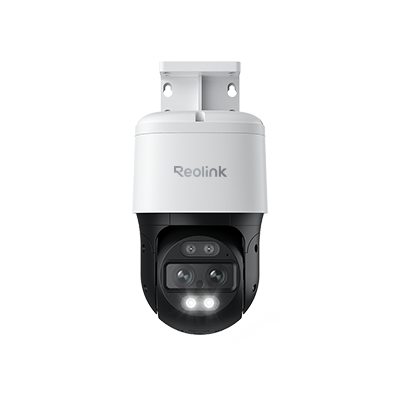
4K Dual-Lens PTZ Camera with Dual Tracking
4K 8MP Ultra HD, Wide & Telephoto Lenses, Pan & Tilt, Auto-Tracking, Person/Vehicle Detection, Power over Ethernet, Two-Way Audio.
FAQs
What is an NDAA compliant camera?
An NDAA-compliant camera is a security device built without parts or services from suppliers banned by Section 889 of the National Defense Authorization Act. The camera must avoid hardware, firmware, and support services linked to those companies. This rule protects U.S. networks from possible data theft and supply‑chain risks.
What is required to be NDAA compliant?
To be NDAA compliant, the product must not use chips or modules from the companies named in the law, rely on cloud servers or software run by those entities, or involve any services that route data through the banned suppliers. Manufacturers must track their supply chain and give written proof upon request.
Is Sony NDAA compliant?
Sony produces many imaging sensors and cameras. Many of its professional models do not rely on parts from the banned companies. Still, each model can use different boards or firmware, so buyers must check the compliance letter or chipset list for the exact unit they intend to order.
Conclusion
NDAA-compliant cameras help you meet federal rules, lower cybersecurity risks, and show customers that you take data safety seriously. In this guide, we defined NDAA cameras, explained why compliance matters, listed who needs them most, showed how to verify a model, and outlined the top features to seek. We also confirmed that Reolink’s U.S. products meet the rule.
If you plan a new install, place NDAA compliance at the top of your checklist, and you will save time, money, and stress later. Share your thoughts below and let us know how you handle camera compliance at your site.
Search
Subscribe for the Latest Updates
Security insights & offers right into your inbox