
Top 10 Most Dangerous Cities in Europe by Crime Index 2026 Ranking Table
Europe is known for its historic landmarks, cultural diversity, scenic canals, and coastal destinations. However, safety levels vary significantly from one city to another.
This guide ranks the most dangerous cities in Europe based on the latest Crime Index data. It also explains the most common safety risks, why certain cities rank higher, and what travelers can do to reduce the risk of theft, robbery, and other incidents.
Top 10 Most Dangerous Cities in Europe by Crime Index
According to Numbeo’s 2026 Crime Index, Marseille has the highest score among the European cities included in its dataset, followed by Birmingham and Coventry.
However, this ranking should not be treated as a definitive list of cities with the highest official crime rates. Numbeo’s index is based on user-contributed perceptions of crime and personal safety, including concerns about theft, robbery, assault, vehicle crime and safety when walking alone.
Official crime figures are also difficult to compare across European countries because crime definitions, reporting rates and police recording practices vary. Travelers should therefore use this ranking as a general comparison and check current government travel advisories and local guidance before visiting.
1. Marseille, France — Crime Index: 66.7
Marseille ranks first in Numbeo’s 2026 European city index. Safety concerns vary considerably across the city, with some northern districts experiencing more serious drug- and gang-related violence.
For most visitors, more immediate risks include pickpocketing, phone theft and opportunistic crime around busy transport hubs, tourist attractions and crowded public areas. Travelers should remain aware of their surroundings and research neighborhoods before booking accommodation.
2. Birmingham, United Kingdom — Crime Index: 63.8
Birmingham ranks second in the 2026 index. As a large metropolitan area, safety conditions differ significantly by neighborhood and time of day.
Visitors should take additional care around crowded shopping areas, nightlife districts and major transport stations, where theft, robbery and antisocial behavior may be more likely. Avoid displaying valuables and use well-lit routes when traveling at night.
3. Coventry, United Kingdom — Crime Index: 62.7
Coventry has the third-highest score in Numbeo’s 2026 European ranking. Concerns commonly associated with the city include violent crime, theft and nighttime safety.
Risk is not evenly distributed across Coventry. Visitors should be particularly attentive in busy city-center areas, nightlife zones and unfamiliar streets after dark.
4. Grenoble, France — Crime Index: 62.6
Grenoble ranks fourth, only slightly below Coventry. Although the city is known for its universities, technology sector and access to the French Alps, some areas have experienced concerns related to drug trafficking, street violence and property crime.
Tourists should secure their belongings around railway stations, public transportation and crowded central areas. Local advice can help identify neighborhoods that require greater caution at night.
5. Naples, Italy — Crime Index: 62.3
Naples ranks fifth in the 2026 index. The city has a long-standing association with organized crime, but this does not mean ordinary visitors are likely to encounter serious criminal organizations directly.
For tourists, pickpocketing, bag theft, scams and theft involving scooters or motorcycles are more practical concerns. Extra care is recommended around Napoli Centrale, crowded attractions, public transportation and busy streets in the historic center.
6. Montpellier, France — Crime Index: 61.0
Montpellier ranks sixth and is the final city in the top ten with a Crime Index above 60, which Numbeo classifies as high.
Its large student population, active nightlife and busy tram network can create opportunities for phone theft, bag snatching and other property crime. Visitors should keep valuables secure around transit stops, entertainment districts and crowded seasonal events.
7. Lyon, France — Crime Index: 59.3
Lyon ranks seventh in the 2026 table. Its score falls within Numbeo’s moderate crime category, although it is close to the threshold for a high rating.
As in many major European cities, theft and street crime may be more common around transport hubs, nightlife areas and crowded tourist locations. Travelers should take particular care with phones, wallets and luggage around stations and public transit.
8. Bradford, United Kingdom — Crime Index: 59.0
Bradford ranks eighth. Its 2026 score is notably lower than its 2025 score, but this should be interpreted as a change in the perception-based index rather than definitive proof of an equivalent decline in officially recorded crime.
Visitors should still take normal urban safety precautions, particularly when walking alone at night or traveling through unfamiliar areas.
9. Nantes, France — Crime Index: 58.6
Nantes ranks ninth in Numbeo’s 2026 European city index. Common urban safety concerns include theft, robbery, antisocial behavior and personal safety around certain public spaces.
Travelers should remain alert around transport hubs, nightlife districts and crowded events, especially after dark. Accommodation reviews and recent local guidance can provide more neighborhood-specific context.
10. Liège, Belgium — Crime Index: 58.3
Liège completes the top ten with a Crime Index of 58.3. Safety concerns may be more noticeable around major stations, busy nightlife areas and locations affected by drug-related activity or public disturbances.
Most visits take place without serious incidents, but travelers should secure their belongings, avoid poorly lit and isolated areas at night, and follow current local advice.
2026 Ranking Table
Data note: This table is based on Numbeo’s Europe Crime Index by City 2026. Numbeo uses user-contributed survey responses and continuously updates its current data. Its Crime Index measures perceived crime and safety rather than standardized police-recorded crime rates.
Primary data and methodology sources:
-
Numbeo Crime Index (Europe 2026): Current Crime Index by City.
-
StatBase (2026 Dataset): "Crime Index by City: Data from 2012 to 2026."
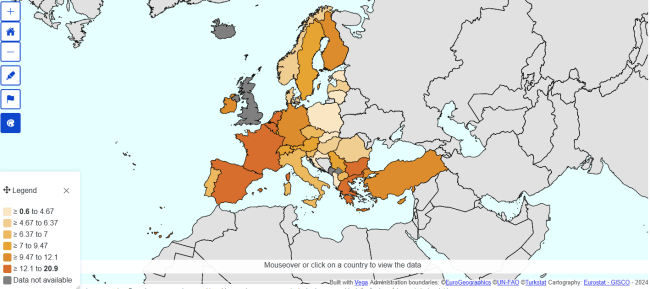
Image credit: Eurostat. Confirm that the map’s specific data, year and geographic scope match the claims made in this article before retaining this attribution.
How Reolink Determines the Most Dangerous City in Europe?
The rankings are primarily derived from the Numbeo Crime Index, which uses a combination of user-contributed data and statistical filtering to assess urban safety.
-
Crowdsourced Surveys: Residents and travelers provide feedback on their perceived safety walking alone, concerns about being mugged, and the prevalence of property crime.
-
Perception of Risk: The index measures how safe people feel, which often captures street-level issues (like drug dealing or harassment) that might not always lead to an official police report.
-
Recent Trends: The system prioritizes data from the last 12–36 months to ensure the rankings reflect current conditions in 2026.
-
The Scale: A score above 60 is considered High, while a score below 20 is Very Low. Most cities on this list fall into the "High" category relative to the European average.
What Crimes Are Common in Europe’s Highest-Ranked Cities?
The cities in this ranking face different safety challenges, and the most common risks vary by neighborhood. For most residents and travelers, the main concerns are property crime, street robbery, assault, vehicle crime, and drug-related violence.
-
Pickpocketing and phone theft: Crowded tourist attractions, public transportation, shopping streets, and nightlife districts can create opportunities for thieves. Visitors should keep phones, wallets, and bags secure, especially in busy city centers.
-
Street robbery and assault: Some cities report greater concern about robbery, knife-related incidents, and physical assault, particularly late at night or around entertainment districts and transport hubs.
-
Drug- and gang-related violence: Cities such as Marseille and Grenoble have experienced serious violence linked to drug trafficking in certain neighborhoods. However, these incidents are often concentrated in specific areas and may pose less direct risk to ordinary tourists than theft or scams.
-
Vehicle crime: Car break-ins, motorcycle theft, and theft from parked vehicles are common concerns in some urban areas. Travelers should avoid leaving luggage or valuables visible inside rental cars.
-
Burglary and property crime: Homes, vacation rentals, shops, and unattended properties may be targeted for break-ins or opportunistic theft, particularly in densely populated areas.
-
Scams and fraud: Tourists may encounter payment scams, fake petitions, distraction theft, fraudulent taxi charges, or accommodation scams. Digital fraud is also a growing concern, but it is not a primary factor in Numbeo’s city-level Crime Index.
A high Crime Index does not mean every neighborhood is unsafe or that visitors are likely to experience serious violence. Risks often depend on the specific area, time of day, and type of activity.
How to Stay Safe in Europe’s Dangerous Cities?
Most visits to European cities are trouble-free, even in places with a relatively high Crime Index. However, a few practical precautions can reduce your exposure to theft, robbery, scams, and other common urban risks.
1. Choose Your Route Before Going Out
Research your destination, transportation options, and return route in advance. At night, stay on well-lit, busy streets and avoid isolated shortcuts or unfamiliar areas.
2. Keep Valuables Secure in Crowded Places
Store your phone, wallet, passport, and bank cards in zipped inner pockets or an anti-theft bag. Be especially careful on public transportation, near major stations, and around busy tourist attractions.
3. Use Official Transportation Services
Choose licensed taxis, official public transportation, or verified ride-hailing apps. Avoid accepting rides from drivers who approach you directly, particularly at airports, stations, and nightlife venues.
4. Protect Your Phone and Payment Information
Avoid holding your phone close to the road or train doors, where it may be easier to grab. Use a screen lock, enable device tracking, and keep a backup of important travel documents in secure cloud storage.
5. Keep Money and Documents in Separate Places
Do not carry all your cash, cards, and identification in one wallet. Keep a backup card and emergency funds in a separate secure location in case your primary belongings are lost or stolen.
6. Know How to Get Help
Save the local emergency number and the address of your accommodation before leaving. In European Union countries, 112 can be used to contact emergency services.
7. Protect Your Home While You Travel
Travel safety also includes securing the property you leave behind. A video doorbell or outdoor security camera can help you check visitors, deliveries, driveways, and entry points remotely while you are away.
For homes with Wi-Fi, a Reolink battery-powered camera can provide motion alerts and remote live viewing without requiring complicated wiring.

2MP Wireless Power-Efficient Camera
Magnetic Mounting for Easy Installation, Max. 9-Month Battery Life, Dual-Band 2.4/5GHz Wi-Fi, No Monthly Fees.
For vacation homes, RVs, or remote properties without Wi-Fi, the Reolink Go PT Ultra uses 4G connectivity and supports remote monitoring through the Reolink app.

4K 8MP Wire-Free 4G LTE PT Battery Camera
4K 8MP; Smart Detection; 355° Pan & 140° Tilt; Battery/Solar Powered; Color Night Vision; Smart Real-Time Alert.
Always follow local privacy laws and avoid placing cameras where they could record neighboring properties, shared spaces, or areas where people reasonably expect privacy.
FAQs
Which European city has the highest crime?
Crime rates vary by category, but cities like Marseille (France) and Naples (Italy) are often considered among the higher-crime areas in Europe, mainly due to theft and organized crime. However, “highest crime” depends on what type of crime is being measured.
Which city in Europe is safest?
Some of the safest cities in Europe consistently include Zurich (Switzerland), Copenhagen (Denmark), and Vienna (Austria). These cities typically report low violent crime rates, strong public safety systems, and high levels of personal security for residents and travelers.
Is crime higher in the US than Europe?
In general, the United States has higher violent crime rates than most European countries, especially in categories like gun-related violence. However, crime varies widely within both regions—some US cities are very safe, and some European cities have higher petty crime levels like pickpocketing. Overall safety depends more on the specific city than the continent.
Conclusion
Europe remains one of the world’s richest playgrounds—from art-filled alleys to mountaintop vistas. Yet pockets of danger do exist. By knowing which cities record the highest rates of violence and theft, you can plan smarter, stay alert, and enjoy every moment with peace of mind. Have you ever bumped into trouble on a European trip? Tell us what happened and share your own safety tips in the comments below!
Search
Subscribe for the Latest Updates
Security insights & offers right into your inbox