
Reolink License Plate Camera Guide With a Hidden Hack
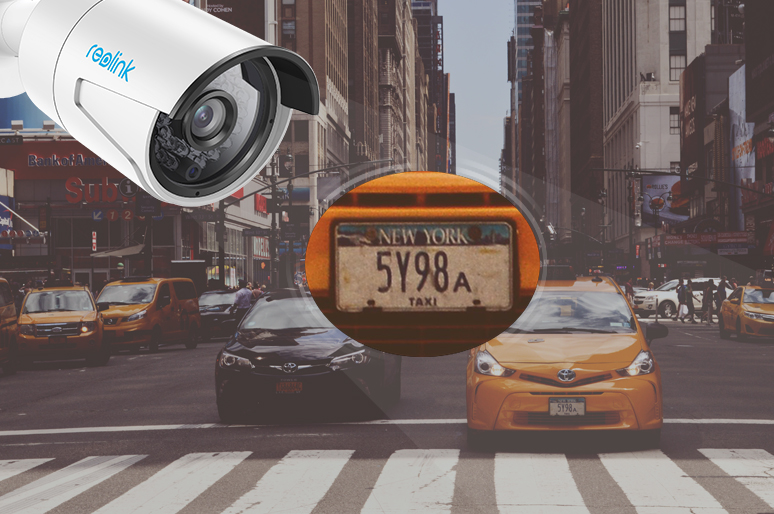
A camera that captures a clear, readable license plate is not the same thing as a true LPR (License Plate Recognition) system. One shows you a plate you can read yourself on playback. The other automatically detects and logs plates through dedicated software. Such devices are usually used for commercial parking lots, gated entrances, or vehicle fleets.
Most homeowners and small businesses searching for a license plate security camera actually need the former, and a handful of specs make the biggest difference in whether the plate ends up legible or a blur.
In this guide, we’ll explain key specs, how to choose the right camera, and where cameras end and full recognition systems begin.
🎉 Limited-Time Security Camera Prime Deals
- Explore Special Offers on Individual Cameras and Security Systems.
- Protect Your Home for Less with Bundles & Multi-Packs.
- Types of Cameras That Can Capture License Plates
- What to Consider For a License Plate Security Camera
- Already Own a Reolink Camera? Here's How to Add Plate Recognition Functions
- Which License Plate Security Camera Fits Your Situation?
- Common Mistakes When Buying a License Plate Security Camera
- Buyer Decision Table
- FAQs
- Conclusion: Buy for Your Situation, Not the Spec Sheet
Types of Cameras That Can Capture License Plates
Three types of cameras get lumped into "license plate camera" searches, and they are not interchangeable. Knowing which one you actually need prevents an expensive mismatch.
General security cameras with strong zoom and night vision

These are the standard PoE, Wi-Fi, or battery security cameras. They can capture a readable plate at typical residential distances once resolution, zoom, and night vision are matched to the distance. Think driveways, garages, or front gates.
License plate capture (LPC) cameras
Purpose-built for a specific vehicle capture zone, tuned for a set lane width and mounting height, but without automatic recognition software. A middle tier between a general camera and full LPR.
True LPR/ANPR cameras
Use optical character recognition to read the plate automatically and match it against a database in real time, then trigger an alert or access-control action. These are the types that are built for commercial parking operations, gated communities managing hundreds of vehicles, or law enforcement, with dedicated hardware.
Reolink cameras fall into the first category, general security cameras engineered for sharp detail, zoom, and night vision. They are not dedicated LPR/ANPR hardware. If your goal is real-time automatic plate matching across a large lot, the LPR/ANPR section above is what to shop for. If your goal is a camera that lets you, or the police, read a plate after something happens at your driveway or storefront, keep reading.
What to Consider For a License Plate Security Camera

We highly recommend that you check the specifications below before buying anything. Distance and lighting matter as much as any single spec on a data sheet.
How Much Resolution Do You Actually Need?
Higher resolution buys more pixels on the plate itself, which matters more as distance increases. For most driveways and short parking areas, 4MP to 5MP is the practical sweet spot while HD security cameras at 2MP can still work at closer range.
Night Vision: Why Headlights Make This Harder Than It Sounds
Infrared night vision produces black-and-white footage that can still show a legible plate. Color night vision needs more ambient light but reads more like daytime footage. Either can work for license plates as long as the range matches your distance and headlight glare doesn't wash out the frame.
License plate coatings are retroreflective. That's the same property that makes traffic signs bounce headlights back at a driver. When a camera's own infrared or white light hits the plate at night, that same reflection bounces straight back into the lens, which is why a plate can turn into a washed-out white blur even when everything else in the frame looks normal. This happens on any camera with built-in infrared or white light active during capture, and the fix is to add a separate fill light near the capture point and let the camera run in day mode rather than relying on its own IR.
An infrared security camera with a longer rated range still helps at distance, but glare is usually why a plate is unreadable up close.
Can It Capture a Moving Vehicle Clearly, or Just a Parked One?
A camera can have strong resolution and still produce an unreadable plate if the vehicle is moving and the shutter speed is too slow. Motion blur is the most common reason a moving vehicle's plate turns into a smear on playback, not megapixels.
Night settings that lengthen exposure time to brighten the image often make this worse because a longer exposure blurs anything that moved during that exposure window. This is why plate capture is far more reliable at places like stop signs, driveway aprons, or gates as compared to roads where vehicles pass at speed. That's because these are areas where a vehicle slows down or stops, which will reduce or not manifest motion blur.
A camera can have strong resolution and still produce an unreadable plate if the vehicle is moving and the shutter speed is too slow. Motion blur is the most common reason a moving vehicle's plate turns into a smear on playback, not megapixels.
Night settings that lengthen exposure time to brighten the image often make this worse because a longer exposure blurs anything that moved during that exposure window. This is why plate capture is far more reliable at places like stop signs, driveway aprons, or gates as compared to roads where vehicles pass at speed. That's because these are areas where a vehicle slows down or stops, which will reduce or not manifest motion blur.
How Close Does the Camera Need to Be?
Distance is the single biggest variable in whether a plate is readable, more than any spec on a data sheet. As a rough guide, general security cameras with strong zoom read plates reliably within roughly 15 to 50ft. Beyond that, only dedicated LPR hardware mounted at a precise height and angle stays consistent.
Does It Need to Survive Rain and Direct Sun?
Any camera capturing plates at a driveway, gate, or parking entrance is outdoors full-time, so weatherproofing isn't optional. Look for IP66-rated housings, which withstand direct water jets and dust, not just light drizzle.
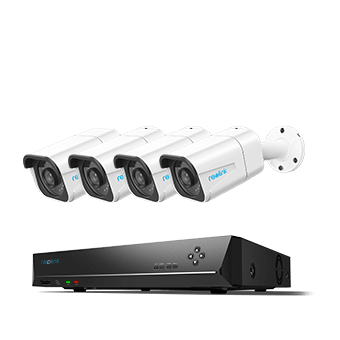
For continuous coverage, the Reolink RLK8-800B4 pairs an 8-channel PoE NVR with a built-in 2TB hard drive for 24/7 recording, so a driveway, gate, and parking entrance can all be covered without gaps or a monthly cloud plan.
Reolink RLK8-800B44K 8-Channel PoE Security System
4 pcs 4K Ultra HD Security Cameras; 2TB HDD 8-Channel NVR for 24/7 Recording; Person/Vehicle Detection; Plug & Play; 2 Network Solutions.
Does Optical Zoom Actually Help?
Optical zoom lets you get closer to the plate without losing resolution. It changes how many pixels actually land on the plate itself, which is what determines whether the characters resolve into readable text or a blur, not just how big the plate looks on screen. A fixed lens without zoom has to be mounted much closer to achieve the same result.
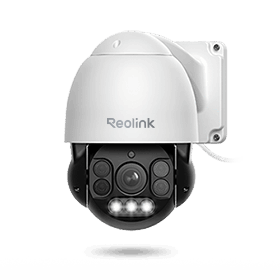
The Reolink RLC-823A with 5x optical zoom, letting you zoom in on a gate or lane without losing detail.
Reolink RLC-823ASmart PTZ PoE Camera with Spotlights
4K 8MP Ultra HD, Person/Vehicle Detection, 5X Optical Zoom, Auto Tracking, Manual Pan & Tilt, Two-Way Audio, 190ft Night Vision, Live View.
Add Vehicle Detection So You Don't Miss the Moment
AI-based vehicle detection won't read a plate, but it will flag the moment a car enters the frame, so you're not scrubbing through hours of footage to find the one clip that matters.
The Reolink CX410 includes Person/Vehicle/Animal Detection alongside its ColorX night vision, which pairs well with the resolution and zoom specs above rather than replacing them.
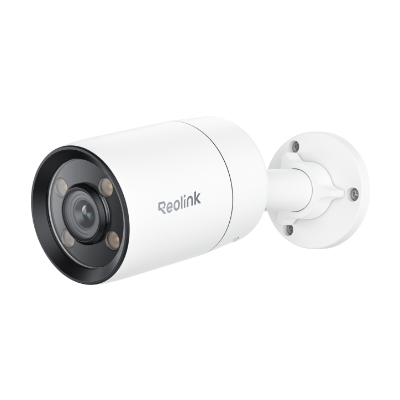 Reolink CX410
2K PoE ColorX Night Vision Camera
👍 2K 4MP video with image sensor
👍 ColorX night vision with F1.0 aperture
👍 Adjustable warm light
👍 PoE connection for reliable performance
Already Own a Reolink Camera? Here's How to Add Plate Recognition Functions
Reolink cameras and NVRs don't include built-in automatic license plate recognition. If you already own one and want plate-matching or searchable plate data rather than just a video clip, three add-on routes are commonly used by existing Reolink owners, ranging from a hosted API to fully local processing.
- A hosted plate-recognition API. Services like Plate Recognizer connect directly to a Reolink camera's video stream and run recognition in the cloud, with a limited free tier and paid plans for higher volume. No extra hardware required beyond the camera itself.
- Local AI processing through third-party NVR software. Software such as Blue Iris or the open-source Frigate can ingest a Reolink camera's stream and run object and plate detection locally, avoiding a monthly fee but requiring a reasonably capable computer or a small AI accelerator running alongside it.
- A dedicated AI accelerator. Pairing open-source software with a low-cost Tensor Processing Unit lets recognition run on inexpensive hardware rather than a full PC, at the cost of a more hands-on setup.
Note: Based on discussions among Reolink owners, these workarounds close most of the gap for parking-lot-scale monitoring, suitable for households and small businesses. But, none of these methods instantly transforms a general security camera into a purpose-built LPR system rated for high-speed roads or long distances.
Which License Plate Security Camera Fits Your Situation?
The right camera depends on distance, whether vehicles are moving or stopped, and whether you need one camera or a full system. These four situations cover most home and small business cases.
Common Mistakes When Buying a License Plate Security Camera
Assuming any 4K camera will read a plate at any distance
Resolution helps, but distance, zoom, and shutter speed matter just as much. A 4K camera mounted too far away or attempts to capture a fast-moving vehicle can still produce an unreadable plate.
Ignoring the difference between a capture camera and an LPR system
If you need automatic, real-time plate matching against a list, budget and plan for dedicated LPR/ANPR hardware, not a general security camera.
Skipping night vision testing before installation
Headlight glare at night behaves differently than daylight. Test the actual mounting spot after dark before assuming the daytime setup will translate directly.
Forgetting local storage limits
Continuous recording at 4K fills a microSD card fast. For 24/7 capture, an NVR with a hard drive can hold far more footage than a memory card.
Not considering a non-camera fix
For simple property boundary or trespassing issues, a physical deterrent, like a barrier at a problem entry point, is sometimes more effective and cheaper than any camera setup.
Buyer Decision Table
To help bring further clarity to what's best for you, here's a Buyer Decision Table to make it easier to compare choices with confidence.
Pro Tip: Want to compare full specs side by side? Use Reolink's comparison tool.
FAQs
Is a license plate security camera the same as an LPR camera?
No. A license plate security camera captures video clear enough for a person to read the plate during playback. An LPR (License Plate Recognition) camera uses OCR software to read the plate automatically and match it against a database in real time.
Can a regular security camera read license plates?
A camera with enough resolution, zoom, and the right night vision can capture a plate clearly enough for a person to read it afterward, especially at typical driveway and gate distances. However, a regular security camera can't automatically read plates the way dedicated LPR software does.
How far away can a security camera capture a readable license plate?
It depends on resolution, zoom, and whether the vehicle is moving, but general security cameras with strong zoom are typically reliable within roughly 15 to 50ft. Beyond that, only dedicated LPR hardware mounted at a precise height and angle stays consistent.
Do I need a dedicated LPR camera for my home or small business?
Only if you need automatic, real-time plate matching against a database, such as for access control across a large lot. For evidence-grade footage of vehicles at a driveway, gate, or storefront, a general security camera with the right specs is usually enough.
Can I add plate recognition to a Reolink camera I already own?
Yes, through a third-party integration. Options include a hosted API like Plate Recognizer, or local AI processing through software such as Blue Iris or Frigate. However, none of these turn a Reolink camera into a purpose-built LPR system for high-speed roads, but they can add plate-matching for parking-lot-scale use.
Conclusion: Buy for Your Situation, Not the Spec Sheet
We talk to a lot of people who land on this page because most of the time, something happened to them first. It could be that a car kept cutting across the lawn, a package went missing, or a gate camera caught nothing but a blur. Then came the shopping, and with it, the jargon. Resolution, night vision, and zoom stopped being spec-sheet noise and started being the thing standing between a usable clip and a blurry one.
Here's what we want you to walk away with. You almost certainly don't need enterprise hardware. A general security camera with the right resolution, night vision matched to your setup, and enough zoom for your distance will get you car plate footages clear enough for a police report, an insurance claim, or just knowing who's been in your driveway. However, large lots, gated entrances, or automated access control across dozens of vehicles a day are a different story, and that's when we'd honestly say dedicated LPR hardware is a better choice.
At the end of the day, the camera has to work for your situation and we want to make sure of that with this guide. If you're still unsure which camera fits your setup? Answer a few quick questions in our Solution Finder and it'll point you to the specific camera, not a whole system, that matches where you're placing it. Feel free to also drop your questions in the comments section and we'll do our best to help you out!
Search
Subscribe for the Latest Updates
Security insights & offers right into your inbox