
Active Deterrence Security Cameras: Do They Work?
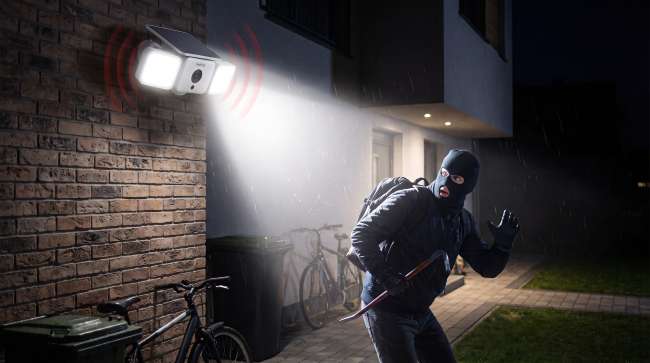
Scroll through enough camera listings and "active deterrence" starts to feel like a spec you can check off, promised on page after page as if it were a certified feature.
Truth is, it isn't one. No manufacturer association defines what has to be inside that response. The same label might mean a soft porch light on one product page and a police-style strobe with a live siren on the next. Two cameras marketed under that identical term can behave completely differently the moment someone walks up to your door.
That gap matters more than the price tag does. A higher price often has nothing to do with which camera actually works better for your property, and neither does the most aggressive feature set. Matching the response to the situation, rather than chasing the longest spec sheet, is what actually decides whether it earns its keep.
- What Is an Active Deterrence Security Camera?
- Active vs. Passive Security Cameras
- The Active Deterrence Toolkit, and How Much of It You Actually Need
- Does Active Deterrence Actually Stop Crime?
- How to Tell If Active Deterrence Is Real, Not Just a Label
- Reolink's Approach to Active Deterrence: Built for Most Homes, Not the Extremes
- Reolink Product Recommendations
- FAQs
- Conclusion
What Is an Active Deterrence Security Camera?
An active deterrence security camera responds in real time. It detects a person or vehicle, then reacts immediately with light, sound, or a live voice, rather than only recording the moment for you to review later.
A passive surveillance camera, by contrast, records and stores footage for later review. It has no way to trigger a light, sound, or voice response on its own.
In short, passive cameras detect now and react later, while active cameras detect and react in the same moment. The next section unpacks exactly what changes when a camera reacts instead of just recording.
Active vs. Passive Security Cameras
The only thing "active" changes is whether the camera produces a response the person in front of it can actually perceive in the moment. Everything underneath, the sensor, the recording, and the storage, works the same way it does in a passive camera.
Note: A push notification to your phone technically counts as a real-time response too, though it's not what most people mean by active deterrence.
The Active Deterrence Toolkit, and How Much of It You Actually Need
Active deterrence isn't one feature. It's four separate components bundled under a single label, and knowing what each one does is what separates a genuinely well-equipped camera from one that just has strong marketing copy.
- The trigger decides whether a response fires at all. It can be as basic as motion detection, as refined as infrared-assisted sensing for low light, or AI that tells a person or a vehicle apart from a passing car or a curious raccoon.
- The visual response ranges from a plain white spotlight, which doubles as color night vision as a useful side benefit, to a red-and-blue strobe built to resemble police lights. Floodlight cameras are the category built around this half of the toolkit.
- The audio response starts with an automated siren or alarm tone as the simplest version, then extends to two-way talk, which splits again into a pre-recorded warning message or a real person speaking live through the app. Cameras with two-way talk cover this half.
- Manual override gives you the ability to fire the siren, light, or a live voice warning on demand from the app, whether or not the AI actually detected anything.
Line those four up and you get a spectrum, not a checklist. On one end, a camera fires a strobe or siren automatically with nobody watching. On the other, a real person hears the alert and decides, live, what to say. Neither end is objectively better. They just serve different situations, and that's a distinction most product pages selling this category don't spell out.
The same spectrum runs from light and quiet up to loud and constant, and bigger isn't automatically better. A floodlight that trips for every moth on the lens, or a siren that fires for every passing car, turns into a nuisance fast. For most homes, the right setup is the smallest response that actually gets the job done, not the one with the longest spec sheet.
Does Active Deterrence Actually Stop Crime?
The honest answer is yes, in part, and the research has a real gap in it worth naming upfront. No study we found isolates cameras with an active light, sound, or voice response from ordinary passive security cameras. What exists instead is evidence about visible security measures more broadly, and it points the same direction.
Security.org's summary of a UNC Charlotte survey of 422 convicted burglars found that about half considered an outdoor camera an effective deterrent, and 53% said the same about visible alarm signage. Academic meta-analyses (Welsh and Farrington, 2003; Gill and Spriggs, 2005) found CCTV works best in small, enclosed spaces like parking garages, and against property crime specifically rather than violent crime. It's worth flagging plainly that the burglar-survey figures come from a secondary summary rather than the original UNC Charlotte study itself.
Here's the finding that matters most for anything with a light attached to it. A later Welsh and Farrington review of this same body of research found camera effectiveness rises specifically when a camera is paired with better lighting, more than when a camera works alone. That's about as close to a direct, evidence-backed case for pairing light with a camera as this research gets, even though it still didn't test a light-and-siren camera as its own category.
So the honest takeaway is active deterrence adds a real-time layer on top of what a visible camera already does reasonably well on its own. It's a meaningful upgrade, not proof of a completely different, superior category, and the strongest single piece of evidence here happens to back the light half of the equation specifically.
How to Tell If Active Deterrence Is Real, Not Just a Label
Since nobody standardizes "active deterrence," evaluating any product that carries the label means checking four concrete things rather than trusting the name on the box.
- Is the trigger AI-based, or just raw motion? AI that tells a person, vehicle, or animal apart from a passing car or a moth on the lens means fewer false alarms.
- Is brightness a published lumen figure, or just "bright"? A real number is something you can compare across products. A vague adjective isn't.
- Is the audio one-way or two-way? A fixed alarm tone or pre-recorded message is one-way. Two-way means an actual person can speak live through the app, which gives you far more control over how a situation plays out.
- Can it be triggered manually, or only automatically? Manual means you decide when the light or siren fires. Automatic-only means you're limited to whatever rule the camera's AI set.
Run any product through those four questions and the difference between a genuine active deterrence setup and a marketing label becomes obvious fast.
Reolink's Approach to Active Deterrence: Built for Most Homes, Not the Extremes
Reolink builds its active deterrence features around one deliberate point on that spectrum, favoring a bright light, a clear alert tone, and the option to speak up directly. It skips the 24/7 siren and the aggressive, police-style strobe that show up elsewhere in this category.
That's a design choice, not a missing feature. Most break-ins are opportunistic, not planned, so a spotlight and an alert tone that fire the moment someone's detected already change the outcome in most everyday situations. Pushing further, toward constant alarm-grade sirens or heavy strobing, adds intensity without a matching benefit for a typical home. It also brings real downsides, like false alarms from a passing raccoon or a windblown trash bin, and neighbors who stop appreciating a 2am siren fast.
The Reolink alarm siren fires automatically on motion detection or on demand from the app, and it's built to get attention, not to run continuously. For anything a light and a tone alone can't handle, two-way talk is the step up. Instead of relying on one fixed sound, you can say exactly what the situation calls for, from a polite "can I help you?" to a delivery driver, to something more direct if the situation warrants it. That flexibility does more work than a louder default alarm would.
That same restraint carries across the whole product lineup, whether you need a single wire-free camera at the front door or a full multi-camera kit for the whole property. Every Reolink option gives you a light and a response you actually control, not the loudest siren on the spec sheet.
Reolink Product Recommendations
We've shortlisted 4 models (3 security cameras, 1 NVR kit). You can dive deeper into each model or explore via the table below. Pick based on which combination of light, alert tone, and two-way talk your situation actually needs, and whether the install has to be wire-free, wired, solar, or a full multi-camera kit, not by chasing whichever model has the most boxes checked.
Reolink Lumus Pro: Best for Wire-Free, All-in-One Deterrence
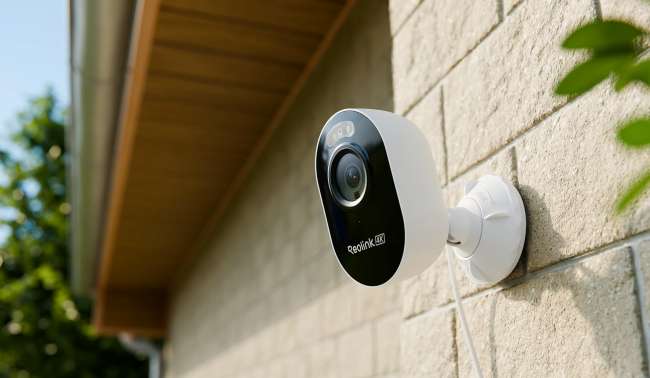
The Lumus Pro is a plug-in spotlight camera that packs the full active deterrence toolkit, a trigger, a light, and an audio response, into one wired unit. At a door or side yard, the trigger is the spec that carries the most weight.
A regular camera that fires its spotlight at every passing cat gets muted or ignored within a week due to countless false alarms. The Lumus Pro's person/vehicle/animal detection is what keeps that from happening. The spotlight covers the visual response, while the built-in siren and two-way talk cover the audio half, so a full trigger-light-sound response fits into one camera instead of three. Night vision here is standard infrared rather than color, so detail past the spotlight's reach stays black-and-white.
Because it plugs into DC power instead of requiring a hardwired AC line, it goes up wherever there's a nearby outlet, without an electrician or a separate fixture.
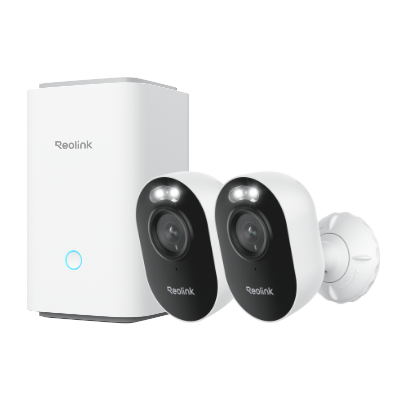
2K 4MP Wi-Fi Security System with Spotlight Night Vision
2K 4MP Color Vision Day & Night; Dual-Band Wi-Fi; Stable Plug-In Power for 24/7 Recording; All-in-One Security System.
Reolink TrackFlex Floodlight WiFi: Best for Maximum Brightness and Tracking
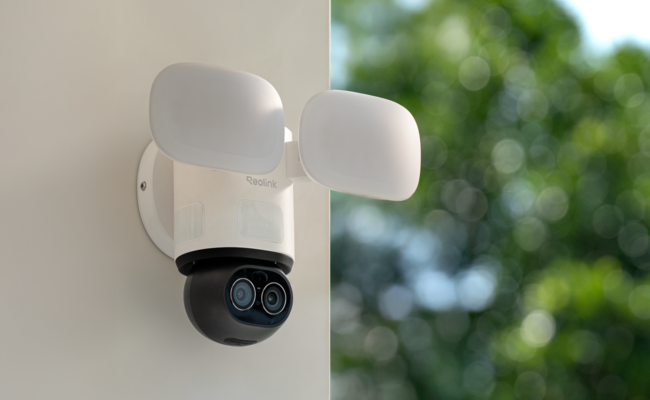
The TrackFlex Floodlight WiFi is a hardwired, dual-lens PTZ floodlight camera, and it pushes the trigger and visual response further than anything else on this list.
For a full driveway or backyard, the spec worth paying attention to isn't the lumen count. It's the 270° out-of-view detection from three staggered PIR sensors, which pick up motion before someone even enters the frame, so the light and alert fire earlier than a standard single-sensor floodlight allows.
Once triggered, the motorized 355° pan and 50° tilt, paired with 6x hybrid zoom, track the subject and pull in detail, a face, a plate, that a fixed floodlight camera would miss entirely. The 110dB siren and two-way talk carry the audio response for anyone who needs more than a light to make a point.
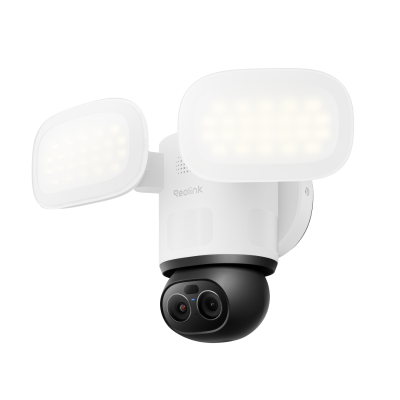
Smart 4K 360° Coverage Wi-Fi Floodlight Security Camera
Local AI Video Search, 4K 8MP Ultra HD, 360° Coverage View, 6X Hybrid Zoom, Dual-Color Floodlight.
Reolink Solar Floodlight Cam: Best for Off-Grid or Hard-to-Wire Spots
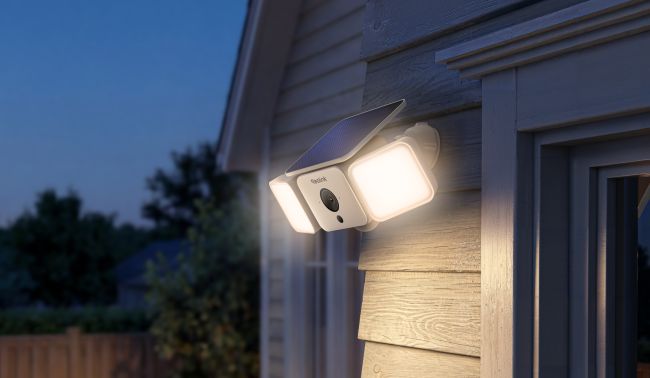
The Solar Floodlight Cam is a wireless, battery-and-solar-powered floodlight camera built for the same trigger-light-siren response as the wired models, minus the wiring.
Running on a 7,800mAh battery topped up by the included 3W solar panel, it trades some brightness, 1,000 lumens versus up to 3,000 on the wired floodlight cameras, for the ability to go anywhere you can't run a wire. It keeps the same AI trigger, siren, and two-way talk as the wired models, plus an IP66 rating for anywhere the weather actually reaches it.
For a shed, a back fence line, or a spot that would otherwise need an electrician, that trade is usually worth making.
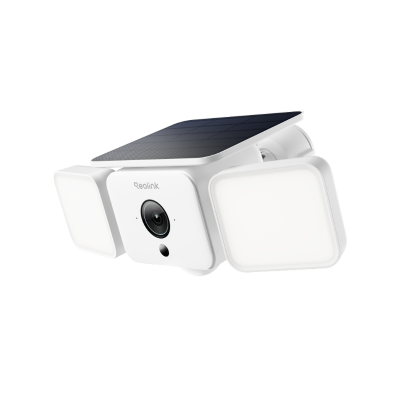
Smart 2K Solar Floodlight Security Camera
150° Ultra-Wide View, 2K 4MP HD Resolution, AI-Based Adaptive Floodlight, Endless Power with Reolink SolarEase™.
Reolink RLK8-800PT4: Best for Large Properties Needing Coverage Plus Tracking
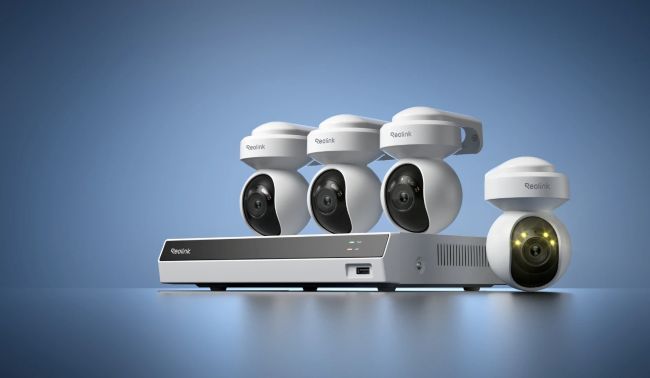
The RLK8-800PT4 is an 8-channel PoE NVR kit built around four pan-tilt cameras, and it's the only option here where the visual response moves with the subject instead of firing once and holding still.
Auto-tracking follows a detected person or vehicle across each camera's full 355° pan range instead of lighting up a spot and letting them walk out of frame. Running everything over PoE to a single NVR with 2TB already installed also means a gate, a driveway, and a back corner report to one system, not four separate app logins, and two-way talk lets you respond from wherever you're watching.
FAQs
What does "deter" mean in a security context?
To deter someone is to discourage them from acting, by making a crime look risky or difficult enough that they choose not to attempt it. Active deterrence cameras aim to do this in the moment, through light, sound, or a live voice, rather than only documenting the act afterward for a police report or insurance claim.
What is active video surveillance?
Active video surveillance is any camera system where detection triggers an immediate response, an alert, a light, a sound, or a live voice warning, rather than a system that only records footage for later review. "Active deterrence" is the more specific term for when that immediate response is meant to discourage an intruder in real time, not just notify the owner.
What does the Reolink siren sound like?
It's a clear, attention-getting alert tone that plays automatically the moment the camera detects motion, and you can also trigger it manually anytime through the app. If a fixed tone isn't enough for the situation, two-way talk lets you speak directly through the camera instead.
Do active deterrence cameras actually stop crime?
The evidence is real but mixed. No study we found isolates cameras with an active light or sound response from ordinary passive cameras specifically, so treat this as general research on visible security measures, not a controlled test of sirens or strobes. The one concrete figure worth keeping comes from a survey of 422 convicted burglars, where about half considered an outdoor camera an effective deterrent.
Do I need the most aggressive active deterrence features for my home?
Most homes and small businesses don't. A bright light, a clear alert, and two-way talk cover the large majority of situations, since most break-ins are opportunistic rather than planned. Going further, continuous alarms, aggressive strobing, mostly adds intensity without a matching real-world benefit, and can bring its own downsides, false alarms and disturbed neighbors. See Reolink's Approach above for the fuller reasoning.
Conclusion
Active deterrence is a real, useful category, built from a trigger plus a light, sound, or voice response, but it's a marketing label, not a certified standard. The right amount of it depends on your property, not the longest spec sheet.
Checking any spec sheet really comes down to the trigger, the visual response, the audio response, and whether it can be manually overridden. Match those four to your situation, then use the scenario table above, wire-free, maximum brightness, off-grid, or large-property, to find the Reolink camera built for it.
Search
Subscribe for the Latest Updates
Security insights & offers right into your inbox