
Router vs Gateway: What’s the Difference?

The network closet at many offices holds two small boxes that look almost the same, yet one is labeled “router” and the other “gateway.” Those labels are not marketing tricks; each device plays a distinct part in moving data from your laptop to the rest of the world.
This article walks through the real differences, the overlap, and the situations where you would pick one over the other. The central focus remains on gateway vs router and router and gateway, so you can plan, buy, and install with confidence.
Gateway vs Router: Understanding the Basics
A router is a traffic director that lives at layer 3, the network layer, of the OSI model. It reads the destination IP address on every packet and decides the next hop that brings the packet closer to its final stop.
A gateway is any device that acts as the “door” between two different networks, especially when those networks use unlike rules or data formats. That door can open at any layer, but home users usually meet a gateway that mixes the jobs of a router, a network address translator, a basic firewall, and sometimes a modem into one plastic case.
Router vs Gateway: Key Differences
Once you see both units side-by-side, it is tempting to treat them as the same. The next sections show why they are more like related, but not the same.
Function
A pure router focuses on one task: steering packets. It keeps tables of nearby networks, runs a routing protocol such as OSPF or BGP, and forwards packets quickly. A gateway, by contrast, changes data as it moves. It may translate an internal private address to a public one, swap one protocol for another, or even convert e-mail formats so a Unix server can talk to a Microsoft Exchange system.
In short, a router passes traffic, while a gateway also reshapes traffic when the two sides do not speak the same language. For example. PoE cameras connect to a router or network switch rather than a gateway.
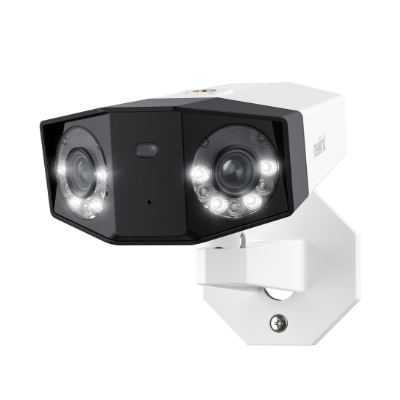
Groundbreaking 16MP Dual-Lens PoE Camera
16MP UHD, Dual-Lens, Motion Track, 180° Wide Viewing Angle, Power over Ethernet, Color Night Vision.
Application layer
Routers stop at layer 3; they never open the envelope to see what application lives inside. Gateways routinely climb to layer 7. A typical home gateway inspects web addresses, blocks peer-to-peer ports, or prioritizes Netflix packets because it can see the application header. Enterprise gateways go further, scanning attached files for viruses before the mail server ever receives them.
Network Addressing
A router understands two or more subnets, but it expects every interface to keep its own address intact. A gateway often hides those inside addresses from the outside world. The public internet sees only the gateway’s external address; every laptop behind the gateway borrows that address through network address translation (NAT). That hiding trick is optional on a router, yet it is built in and always active on almost every gateway sold today.
Protocols Supported
Routers speak IP and a handful of routing protocols. Gateways add voice over IP conversion, fax relay, e-mail encapsulation, and sometimes even IBM mainframe SNA translation. If two networks disagree on how to number packets or wrap voice samples, a gateway bridges the gap, while a router simply drops the unrecognized traffic.
Security
A router offers basic access lists: allow this subnet, block that port. A gateway brings a full toolkit, stateful packet inspection, intrusion detection, web filtering, and sometimes sandboxing of unknown executables. For that reason, small businesses often drop a standalone router and let the gateway serve as the first wall against outside attack.
Router and Gateway: Key Similarities
Before the differences feel overwhelming, notice the traits the two devices share. Both sit at the edge of a network, both move packets, and both influence speed, cost, and uptime.
Purpose
Each device exists to join two networks so users can reach printers, servers, or the internet without manual rewiring. Whether the box reads Cisco ISR or Comcast XB7, its core mission is connectivity.
Network Layers
Both units understand Ethernet frames and IP packets. Even if a gateway climbs higher, it still keeps a foot on layer 3 so it can move traffic across subnets.
Routing Protocols
Enterprise gateways include RIP, OSPF, and sometimes BGP tables. A protocol that runs on a router can also run on a gateway when the network is large enough to need dynamic updates.
Scalability
You can stack routers in a core, and you can cluster gateways behind a load balancer. Either way, the admin adds CPU or memory rather than redesigning the whole site.
Traffic Control
Quality of service, rate limiting, and policy-based routing appear on both menus. A router might use DSCP bits while a gateway uses application names, but the goal, to keep voice smooth and bulk downloads in check, remains identical.
Modem vs Router vs Gateway: Comparison Table
ISPs often rent a single plastic box and call it a “modem,” a “router,” or a “gateway,” depending on the commercial. The next table keeps the names straight.
Router vs. Gateway: Pros and Cons
Choosing between the two does not require an advanced degree, but it does require an honest look at trade-offs.
Router: pros and cons
Pros:
- Fast packet forwarding with low latency
- Supports many dynamic routing protocols
- Let's you pick your own firewall, VPN, and Wi-Fi gear
- Scales to large networks by adding modules or licenses
Cons:
- Needs extra boxes, such as a modem and an access point
- Higher up-front cost when you buy all parts
- More cables and IP plans to maintain
- Vendor support is split among several suppliers
Gateway: pros and cons
Pros:
- Single box from the ISP; plug in and go
- Built-in NAT, firewall, and often Wi-Fi and voice ports
- One support number fixes any problem
- Monthly rental spreads cost over time
Cons:
- Firmware is locked; no custom VPN or routing code
- CPU shares jobs, so heavy traffic slows down
- Upgrades require ISP approval or a new rental unit
- Vendor lock-in limits brand and model choices
Gateway vs Router vs Modem: Which One to Use?
Match the tool to the job instead of buying by brand.
- Small apartment, one ISP, no server rack: Pick the gateway the provider offers. You gain Wi-Fi, phone ports, and a technician who configures it for free.
- Growing office, ten employees, VoIP phones, cloud apps: Keep the ISP modem in bridge mode, add a business router that lets you create VLANs for voice and data, then hang a separate Wi-Fi access point on the ceiling.
- Data center or campus with three ISPs and a BGP address block: Skip the gateway; use carrier-grade routers that hold full internet tables and connect to your own firewall farm.
- Remote worker who needs corporate VPN but hates clutter: Activate the gateway’s “IP-passthrough” mode, plug your personal router behind it, and let the company router build the tunnel while the gateway keeps the ISP happy.
How to Use a Gateway as a Router?
Most ISPs disable the full router menu, yet the setting is still reachable.
- Log in to the gateway’s web page with the admin password printed on the sticker.
- Find “Gateway Mode” or “Routing Mode” under LAN settings and set it to Enabled.
- Turn off the modem-only “Bridge” choice so the gateway keeps its routing table alive.
- Create your private LAN subnet, DHCP pool, and Wi-Fi SSID; save and reboot.
- Test: plug a laptop into a LAN port; it should pull an address from the gateway and reach the internet while the gateway’s public address stays intact on the WAN side.
FAQs
Is gateway the same as router?
No. Every gateway can route, but a pure router cannot perform the address or protocol translation that defines a gateway.
Can a gateway replace a router?
Yes, in homes and small offices, the gateway already contains a router, firewall, and Wi-Fi, so a second box is unnecessary.
Is the gateway always the router?
In most consumer setups, the gateway IP listed on your computer is the same box that routes traffic, yet large networks may use a separate router while the gateway only handles protocol conversion.
Conclusion
The next time you untangle cables behind a desk, remember that router versus gateway is not a popularity contest; it is a question of fit. A router shines when speed, routing tables, and multi-vendor freedom top the list. A gateway wins when you need one plug, one support number, and built-in protection.
Knowing where the router and gateway overlap, and where they part, saves money, time, and late-night outages. Share your own experience in the comment section: which device did you keep, and why?
Search
Subscribe for the Latest Updates
Security insights & offers right into your inbox