
Is New Orleans Safe? A Comprehensive Guide for Residents and Tourists

New Orleans offers a mix of safe and unsafe neighborhoods. As a new resident or visitor, you must know crime stats and other details to ensure your safety.
In this article, we will talk about the safety of New Orleans. We will consider several key elements, including economic conditions, law enforcement, crime rates, and community engagement. We will share the crime statistics to help you understand how safe it is.
Is New Orleans Safe?
Yes, New Orleans is generally safe to visit and live in, provided you practice consistent situational awareness. The city is currently experiencing a historic turnaround in public safety, moving away from the elevated crime waves seen in the early 2020s.
According to the latest data from the New Orleans Police Department (NOPD) and independent metropolitan crime trackers, violent crime citywide has plummeted by over 20%. This massive positive trend is led by a historic 40% drop in homicides, a 26% reduction in armed robberies, and a nearly 30% decline in auto thefts and carjackings.
While this is the most significant sustained drop in crime the city has seen in decades, New Orleans' crime rates still sit above the U.S. national average. However, crime is highly localized, meaning your safety depends entirely on your specific location and habits.
Is New Orleans Safe for Tourists?
Yes. The primary tourist corridors—including the French Quarter, the Garden District, and the Central Business District (CBD)—are heavily policed, well-lit, and generally very safe. The vast majority of violent crime in the city is insular and concentrated in under-resourced residential neighborhoods well outside the standard visitor map.
The most common threats facing tourists are petty theft and opportunistic property crimes, such as pickpocketing in crowded bars on Bourbon Street or vehicle break-ins (car prowls).
Is New Orleans Safe to Live In?
Yes, depending on the neighborhood. Like any major metro area, safety varies significantly from block to block. New Orleans features several highly secure, tight-knit residential enclaves that are excellent for families, professionals, and retirees.
New Orleans Crime Rate & Trends Breakdown
The Multi-Year Decline (2022 vs. Present)
New Orleans experienced severe crime spikes in 2022, earning a temporary per-capita designation as the country's "murder capital" with 266 homicides. However, targeted local and federal multi-agency task forces, along with technology-driven policing, have driven a massive reduction in crime.
-
Homicides & Shootings: Criminal homicides plummeted dramatically down to 121 total incidents, marking a historic low. This trend has continued directly into the first quarter, tracking a 67% reduction in homicides compared to the same three-year window.
-
Armed Robberies & Carjackings: Armed street robberies dropped by 26%, while the city's notorious carjacking and vehicle theft spikes have been suppressed by 64% to 67% over the same multi-year period.
Localized Public Perception & Safety Ratings
As a direct result of these tracking metrics, public trust in law enforcement and neighborhood comfort levels have dramatically bounced back.
According to the 17th Annual Citizen Satisfaction Survey managed by the New Orleans Crime Coalition (NOCC):
-
Overall City Safety: 66% of residents now explicitly feel the city is safe, marking a rapid 12-point surge in public confidence.
-
Neighborhood Seating Safety: 87% of residents report feeling highly safe within their immediate home neighborhoods, showing that crime tracking remains confined away from quiet residential sectors.
-
Technology Adoption: Over 79% of residents actively support the police department's expanded use of public camera surveillance grids and advanced network analytics to deter property crimes.
Dangerous Areas in New Orleans To Avoid
The following five neighborhoods track crime indicators that sit well above the city's newly improved averages. The majority of these offenses stem from localized street drug operations, gang rivalries, and night-time property theft.
1. Central City
Located just inland from the Lower Garden District, Central City is an area undergoing pocketed revitalization, but it remains highly unpredictable.
- Primary Risks: Elevated rates of armed robbery, targeted street-level violence, and daytime carjackings.
Safety dynamics change drastically from block to block. While it sits geographically close to major tourist zones, walking through its interior residential corridors at night is not recommended.
2. Seventh Ward
Bordering the upper edge of the French Quarter and Marigny, the 7th Ward holds a rich cultural history but faces severe socioeconomic challenges.
- Primary Risks: High per-capita rates of aggravated assault, vehicle break-ins, and narcotics tracking.
Because it shares an immediate border with popular visitor hotspots, tourists occasionally wander into its quieter, poorly lit residential blocks after midnight by mistake. Stick to main transit thoroughfares.
3. Saint Roch
Positioned directly northeast of the French Quarter, St. Roch features historic architecture alongside persistent structural crime challenges.
- Primary Risks: Burglary, commercial property vandalism, and late-night armed disputes.
While the immediate area surrounding the St. Roch Market has seen positive commercial development, the residential streets deep within the neighborhood see minimal public lighting and frequent property property offenses.
4. Desire Area (Desire Street Corridor)
Located in the upper portion of the Ninth Ward, the Desire neighborhood is a heavily isolated residential zone.
- Primary Risks: Structural gang rivalries, high violent crime density, and residential break-ins.
This neighborhood contains zero tourist attractions or commercial centers. Due to its isolation and high crime statistics, outside traffic should avoid driving through this sector unnecessarily.
5. Saint Claude (Transitional Pockets)
St. Claude is a sprawling, diverse neighborhood that acts as a major arts and residential hub, but it features distinct high-risk corridors.
- Primary Risks: Persistent opportunistic property theft, bicycle larceny, and street-level muggings.
While highly vibrant during daylight hours due to local galleries and eateries, the unlit blocks extending away from St. Claude Avenue see elevated night-time robbery patterns.
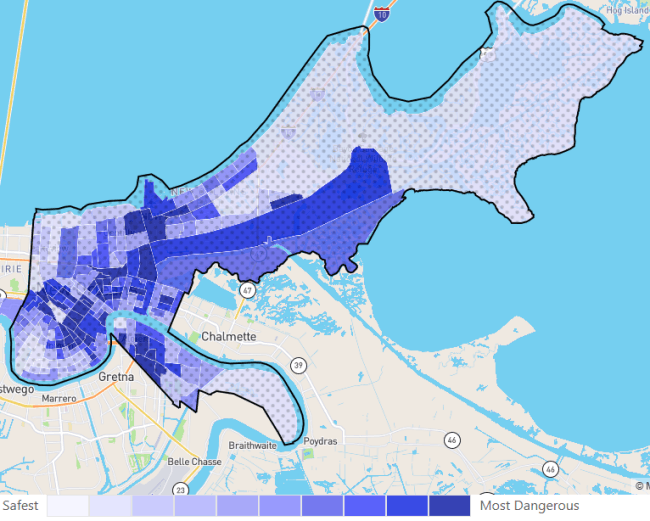
Source: NeighborhoodScout
5 Safest Neighborhoods in New Orleans
If you are looking to relocate to or travel within the Crescent City, these five neighborhoods consistently track the lowest crime rates, offer the strongest community networks, and deliver the highest overall quality of life.
1. Lakeview
Lakeview stands unchallenged as the single safest residential neighborhood within New Orleans proper, boasting a top-tier safety index score.
- Safety Profile: It is statistically safer than 93% of all neighborhoods in New Orleans. Violent crime is virtually non-existent here, with its low tracking metrics driven almost exclusively by minor, opportunistic property offenses like package theft or sidewalk vandalism.
The neighborhood is heavily backed by the Lakeview Crime Prevention District (LCPD). This specialized, resident-funded security initiative deploys dedicated, off-duty NOPD officers to run 24/7 patrols through its streets, keeping emergency response times under a few minutes.
2. West End
Located directly adjacent to Lakeview along the shores of Lake Pontchartrain, West End offers an incredibly peaceful, maritime lifestyle.
- Safety Profile: This neighborhood is rated as safer than 94% of neighborhoods in the city, outscoring nearly every other district in personal security.
It features a highly stable population of long-term residents, boaters, and families. Because the streets are primarily quiet residential cul-de-sacs and marina access points, there is very little cut-through traffic, making it highly difficult for property thieves to operate unnoticed.
3. Newcomb Boulevard (Uptown / Tulane Area)
Newcomb Boulevard is an elite, highly historic private residential street nestled inside the broader, vibrant Uptown and Tulane University ecosystem.
- Safety Profile: It carries a premium safety grade due to virtually zero reported violent crimes and an exceptionally low property crime index that sits far below national urban averages.
Because it sits directly within the university corridor, the area benefits from a dual layer of law enforcement: standard NOPD city patrols and the highly visible, continuous presence of the Tulane University Police Department (TUPD). Streets are brilliantly lit, and daytime pedestrian foot traffic remains high and self-policing.
4. Lakewood
Lakewood is an upscale, tight-knit enclave bordering City Park that features a mix of mid-century architecture and custom estates.
- Safety Profile: It holds an overall top safety grade, maintaining a near-perfect track record for personal and family safety over the last decade.
The area features highly limited street entry points and a high concentration of private, gated properties. This architectural layout naturally deters outside property crimes. Residents rely heavily on interconnected private smart-surveillance camera networks, ensuring that vehicle prowls or mailbox tampering are caught on camera instantly.
5. Gentilly Terrace
For those looking for an affordable yet highly secure alternative closer to the suburban heart of the city, Gentilly Terrace is an excellent choice.
- Safety Profile: This historic neighborhood is statistically safer than 56% of New Orleans neighborhoods, offering a highly competitive safety-to-price ratio.
Built along rolling ridges with charming historic bungalows, it features an active, highly protective neighborhood association. While it deals with minor, typical urban property crimes like nighttime car break-ins, violent crime remains remarkably rare due to high neighborhood cohesion and strong communication ties with local law enforcement.
Safety Tips for Staying Safe in New Orleans
While New Orleans has achieved historic reductions in violent crime—including a 40% drop in homicides and a 30% decline in auto thefts over the last few years—staying vigilant remains essential. Implementing smart personal safety habits and fortifying your home defense layer will ensure you navigate the city securely.
Practice Smart Travel Habits
Stay in well-lit, busy areas, especially at night. Keep your phone charged, share your location with trusted contacts when needed, and use rideshare services instead of walking alone after dark.
Protect Your Home and Vehicle
Lock doors and windows, and verify visitors before opening the door. When parking, choose secure locations and never leave valuables visible inside your vehicle.
Use Security Cameras
A security camera system can help deter crime and provide valuable evidence if an incident occurs. Place cameras at key entry points and outdoor areas for better coverage.

🎉 17th Anniversary Premium Kit: 16MP UHD IK10 Vandal-Proof 180° PoE Security System
- 16MP UHD resolution with 180° panoramic coverage
- AI detection for person, vehicle, and animal alerts
Add Smart Security Devices
Consider using smart door locks, doorbell cameras, and window sensors. These devices can send instant alerts and help you monitor your property remotely.
Stay Aware of Your Surroundings
Pay attention to local safety updates and trust your instincts. Being alert and prepared is one of the best ways to stay safe while enjoying the city.
FAQs
Why is New Orleans so dangerous?
New Orleans is often considered dangerous because it has historically had higher rates of violent crime and property crime than the national average. Factors such as poverty, economic inequality, gang activity, drug-related crime, and its large tourist population have contributed to these challenges. However, crime is not evenly distributed across the city, and many popular neighborhoods and tourist areas are generally safe when visitors take standard precautions.
Is New Orleans dangerous?
Yes, it can be dangerous, but it solely depends on the area where you live. There are some areas to avoid in which criminal activities remain at their peak.
Is the New Orleans French Quarter safe?
According to the reviews, the French Quarter is considered safe because of its low crime rate and a safe life with well-lit areas.
Is New Orleans safe at night?
The safety of New Orleans at night is low because of high violent and property crime rates. It is better to avoid wandering at night in New Orleans.
Conclusion
The reported crime rate in New Orleans is quite high, which indicates safety issues. However, some neighborhoods and areas are a bit safer compared to others. We have discussed the crime statistics for New Orleans and its neighborhoods to help you decide. Also, consider the safety tips to ensure your safety.
Search
Subscribe for the Latest Updates
Security insights & offers right into your inbox