
What Do Red Light Cameras Look Like? Everything You Need to Know

Every driver has asked the same question while waiting at an intersection: “Is that a red light camera?” Knowing what do red light traffic cameras look like can save you from an expensive ticket and help you drive with confidence.
This guide walks you through the exact shape, size, color, and placement of these devices across the United States so you can recognize them quickly and stay on the right side of the law.
- What Is a Red Light Camera?
- What Do Red Light Cameras Look Like?
- What Do Red Light Cameras Look Like in California?
- What Do Red Light Cameras Look Like in Florida?
- Where Are Red Light Cameras Commonly Installed?
- How to Spot a Red Light Camera on the Road?
- Red Light Cameras vs. Other Traffic Cameras
- FAQs
- Conclusion
What Is a Red Light Camera?
A red light camera is a machine or a mechanism that captures photographs or short videos when a vehicle is crossing an intersection when the signal turns red. There is no continuous recording of the camera. It rather relies on sensors in the pavement or radar to identify a car that has overrun the stop line once the light has changed.
After the system is triggered, it takes two pictures, one of the vehicle before crossing the intersection and the second one of the vehicle under the red light. There is also a license plate close-up to enable the registered owner to receive the citation via mail. The idea is to reduce right-angle crashes, which result in serious injuries, not to entrap the drivers.
What Do Red Light Cameras Look Like?
The most popular one is a huge white or silver box attached to a heavy piece of metal arm, going across the travel lanes. The box is generally rectangular in shape, with a size of approximately a small suitcase, and it is elevated on a higher platform than the traffic light heads so that it can view the stop line and the crosswalk.
There is usually one or two round glass lenses and a little flash unit in the front panel of about four inches in diameter and shaped like a white dinner plate. Some models have a separate infrared flash that you cannot see, so do not trust the absence of a bright burst. A short antenna or a thin black cable often runs from the box to the signal pole for power and data.
At night, the lenses may glow faintly red when headlights hit them, which is a quick giveaway. If the box is angled down toward the first row of cars and not toward oncoming traffic, it is almost always a red light camera and not a speed or surveillance camera.
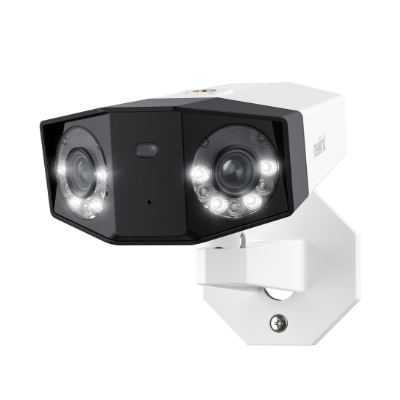
Groundbreaking 16MP Dual-Lens PoE Camera
16MP UHD, Dual-Lens, Motion Track, 180° Wide Viewing Angle, Power over Ethernet, Color Night Vision.
What Do Red Light Cameras Look Like in California?
California uses two main styles. The older setup is a big white cabinet bolted to the signal mast arm. The cabinet has “Red Flex” or “Redsafe” printed on the side in black letters, and two circular lenses face the lanes below.
The newer style is smaller and is painted in light gray; therefore, it mixes with concrete bridges. In place of that box on the arm, there is a short, tube-shaped camera just beside the signal head. At the side of the pole is a slender black cable leading into a gray control cabinet, which is locked at the level of the sidewalk.
Caltrans also puts a narrow white piece of the pavement just before the crosswalk; this is the trigger line. You should not stop short of that line; otherwise, you are not going to trigger the camera, even though the light may be red when you wait.
What Do Red Light Cameras Look Like in Florida?
Florida contracts with two vendors, so the look changes by county. In Miami-Dade and Broward, the camera is a long white wedge that hangs from a curved arm. The wedge has three small windows: two for the cameras and one for the flash.
A bright blue warning sign that reads “Photo Enforced” is posted 300 feet before the intersection, which is required by state law. In central Florida, you will see a shorter black box mounted on the signal pole itself. The box is only about ten inches tall, but a large round flash sits on top like a saucer.
Orange and yellow reflective tape is often wrapped around the pole so drivers can spot the location at night. Because Florida law bans vertical flashers, the flash is aimed across the lanes and produces a quick white burst that you can see in your rear-view mirror.
Where Are Red Light Cameras Commonly Installed?
These devices are not available at any stoplight. They are only installed in the cities at the crossroads that have a record of serious crashes or numerous red-light violations. The camera is nearly always focused on the far-right or left side of the road, and on the busiest traffic lane in the United States.
In the United Kingdom, the same equipment is painted a bright yellow and mounted on a tall pole to enable the drivers to notice it at a long distance. Canada has yellow and white housing, but the warning signs are bigger and are located 150 meters before the light.
Australia uses curved poles on top of the camera, which are made of steel, whereas Mexico employs cameras with arms used on streetlights and paints the box green like government utility counterparts. It does not matter what country it is in; the rule is the same; the camera must have a clear view of the signal head and the stop line, and thus will never be concealed behind a tree or a billboard.
How to Spot a Red Light Camera on the Road?
Use these quick checks every time you approach a busy intersection. A short glance is enough; keep your eyes on the traffic first.
- Look for a white or silver box above the signal head. If the box is larger than a shoe box and points down at the first lane, it is probably a red light camera.
- Check for extra lenses. Two round glass circles side by side mean the system can capture both the driver’s face and the license plate.
- Watch for a flash unit. A flat white plate or a small black dome on the same arm is the flash. It may fire during the day, so do not wait for darkness.
- Read the warning signs. Most states require a sign that says “PHOTO ENFORCED” or “RED LIGHT CAMERA AHEAD.” If you see that sign, assume the camera is working.
- Notice the pavement markings. A thin white or yellow line that stops short of the crosswalk is often the trigger point. Stop before that line, and you stay out of the photo zone.
- Use the cross street name. Cities publish camera locations online. If the map lists the intersection, look for the box on the approach that carries the most traffic.
Red Light Cameras vs. Other Traffic Cameras
Drivers often confuse red light cameras with speed cameras or CCTV. The table below shows the key differences at a glance.
FAQs
How do red light cameras look?
They look like a white or silver box mounted above the traffic light. Two round lenses and a small flash plate face the lanes below.
How do I know if a red light has a camera?
Look for the box on the mast arm, a white trigger line on the pavement, and a warning sign that says “Photo Enforced” before the intersection.
How do you know if your picture was taken at a red light?
You will see a bright white flash in your mirror or through the windshield, and you will receive a citation in the mail within two to four weeks.
Conclusion
Now you know exactly what red light traffic cameras look like in every common form. The big white box with twin lenses is the classic style, while smaller gray or black wedges are the newer trend.
California and Florida each have their own colors and signs, but the rule is the same: stop before the trigger line, and you will not get a ticket. Keep the spotting tips in mind, share this guide with new drivers, and let us know in the comments if your city uses a different style so everyone stays informed.
Search
Subscribe for the Latest Updates
Security insights & offers right into your inbox