
What Is PoE Voltage? Understanding Power over Ethernet Voltage
Power over Ethernet (PoE) is a transformative technology that has fundamentally changed how devices are powered and networked. By allowing Ethernet cables to deliver both power and data simultaneously, PoE+ voltage enables greater simplicity in connecting and operating devices like IP cameras, wireless access points, IP phones, access control systems, and IoT hardware.
Read on for an extensive guide exploring everything about PoE voltage across standards, influencing factors, device power optimization, and frequently asked questions. Let’s learn what voltage is PoE.
What Voltage is PoE?
PoE (Power over Ethernet) typically operates at 44–57 volts DC, with 48V being the most common voltage used by PoE switches and injectors.
PoE Standards: Voltage & Wattage Breakdown
Not all Power over Ethernet deployments are identical. The Institute of Electrical and Electronics Engineers (IEEE) regulates PoE infrastructure through three distinct active standards.
When configuring IP security cameras, matching the device's power draw to the correct switch or injector standard prevents under-powering issues like video dropouts, erratic PTZ motor behavior, or outright hardware failure.
1. PoE (IEEE 802.3af / Type 1)
Introduced in 2003, this is the baseline standard for low-voltage, low-power networking devices. It injects power over two of the four twisted pairs inside a standard network cable.
-
Voltage Range at Source (PSE): 44.0V – 57.0V DC
-
Nominal Operating Voltage: 48V DC
-
Maximum Power from Switch Port: 15.4 Watts
-
Guaranteed Power at Device (PD): 12.95 Watts (accounting for minor power dissipation over long cable runs)
-
Common Usage: Fixed IP cameras, entry-level VoIP phones, and standard interior motion sensors.
2. PoE+ (IEEE 802.3at / Type 2)
Ratified in 2009 to handle the growing power demands of advanced network endpoints, PoE+ roughly doubles the wattage allocation of Type 1 while maintaining backward compatibility with older 802.3af devices.
-
Voltage Range at Source (PSE): 50.0V – 57.0V DC
-
Nominal Operating Voltage: 54V DC
-
Maximum Power from Switch Port: 30.0 Watts
-
Guaranteed Power at Device (PD): 25.5 Watts
-
Common Usage: Smart motorized Pan-Tilt-Zoom (PTZ) cameras, dual-lens panoramic cameras, outer perimeter thermal sensors, and dual-band Wi-Fi access points.
3. PoE++ (IEEE 802.3bt / Type 3 & Type 4)
Released to future-proof dense enterprise infrastructure, the 802.3bt standard maximizes efficiency by delivering power simultaneously across all four twisted pairs within a Cat5e or Cat6 cable. It is split into two power profiles:
-
Type 3 (Mid-Power): Supplies up to 60W from the port (51W guaranteed at the device) operating at a nominal 50V to 57V.
-
Type 4 (High-Power): Supplies up to 90W–100W from the port (71.3W guaranteed at the device) operating at a nominal 52V to 57V.
-
Common Usage: Commercial-grade PTZ cameras with built-in high-output infrared illuminators, outdoor heated camera enclosures for extreme weather environments, and smart LED digital display signage boards.
Why Voltage Matters to the Installer?
Because Ethernet wires use thin copper conductors, higher standards scale up the voltage (from 44V up toward 57V) to push more power safely over the line. Increasing the voltage reduces the current flow, preventing the thin network cables from overheating inside wall conduits.
What Factors Affect PoE Voltage?
While PoE standards do define permitted voltage ranges, the actual voltage output exhibited by injectors/switches and, consequently the supply received by the powered devices can vary within the specified minimum and maximum levels due to diverse environmental conditions. Key aspects influencing PoE voltage ranges include:
PoE Standard
The predominant factor determining possible PoE voltage is the actual generation standard supported by the PoE switch, powered device, or injector being used in the infrastructure. As discussed in the previous section, 802.3af, 802.3at and 802.3bt standards define different voltage ranges like 44-57V, 52-57V, and up to 60V, respectively, according to power capacity.
Device Power Requirements
Networked devices can differ considerably in their power needs, which impacts voltage delivered accordingly. A basic IP phone may only consume 5W, while enterprise wireless access points with multiple high-gain antennas could utilize the full 15.4W capacity of older 802.3af PoE voltage switches.
Cable Length
According to Ohm’s Law (V = I x R), voltage drop is directly proportional to the electrical resistance of the circuit. Because Ethernet cables use thin copper conductors, resistance increases linearly with distance. Over a standard maximum 100-meter (328 feet) cable run, standard electrical dissipation can cause a 48V source transmission to drop down near the minimum threshold of 44V by the time it reaches the device.
Increased cable run means greater power loss during transmission through the Ethernet over distance. Resistive losses occur over longer lengths of copper cabling between the PoE source and powered device, resulting in some voltage drop accordingly.
Cable Quality
Along with cable length, the construction material consistency and resulting quality of Ethernet cables also impact sustained voltage levels. Poor quality patch cords tend to lose more power across the wire runs from source to device end even across the same distances compared to standards-grade Cat5e, Cat6, or above cabling.
Environmental EM Interference
Beyond cable quality itself, surrounding environmental conditions also impact sustained voltage. As mentioned earlier, laying cables near strong electrical sources or industrial motors can induce interference on unshielded copper Ethernet wiring.
PoE Voltage Conversion: Integrating 12V Hardware
While enterprise networks standardize on high-voltage transmission (48V to 57V) to mitigate power loss over distance, a massive ecosystem of endpoint retail hardware—including non-PoE smart cameras, entry access keypads, and POS terminals—runs exclusively on low-voltage 12V DC power.
To bridge this operational gap without running separate electrical lines, network architects deploy specialized voltage conversion components:
1. Active PoE to 12V Splitters
An active PoE splitter acts as a terminal adapter for non-PoE endpoints. It intercepts a high-voltage 48V PoE line directly from a switch and uses an internal buck converter to divide the transmission into two separate, safe paths:
-
Data Path: Outputs a standard, unpowered RJ45 Ethernet link for data transmission.
-
Power Path: Steps down the incoming 48V compliance line into a highly regulated, continuous 12V DC output via a standard physical DC barrel jack. This allows a 12V device to be mounted up to 328 feet away from an electrical outlet by drawing power directly from the central switch.
2. Low-Voltage DC-to-PoE Injectors
In off-grid setups, solar arrays, or mobile retail trucks, the primary power grid is a low-voltage 12V battery system. A common misconception is that a "12V injector" sends a weak 12V current down an Ethernet line. In reality, these are specialized DC-to-DC boost converters:
- Workflow: The device takes in an un-isolated 12V DC current from a battery bank or vehicle alternator and steps it up to an IEEE-compliant 48V or 56V PoE output, allowing standard network infrastructure to operate efficiently without requiring an inefficient AC power inverter.
3. PoE Switches with Multi-Voltage Output
In complex industrial automation and integrated retail kiosks, engineers utilize specialized multi-rail switches. Rather than running a single 48V power plane across all internal circuitry, these switches feature dual-mode internal transformers. While standard ports deliver 48V/54V compliance power, dedicated auxiliary ports can be configured via a physical hardware toggle to deliver 12V passive power over spare twisted pairs, eliminating the physical footprint of external splitters inside tight enclosures.
How to Optimize Device Power with PoE Voltage Output
While PoE standards already define working voltage ranges, further tuning output levels within specified limits provides maximum efficiency from deployed PoE infrastructure:
1. Use Thicker Ethernet Cables (Cat6 over Cat5e)
Electricity encounters natural friction—called resistance—as it travels down a wire. Thinner wires create more friction, causing the electrical "pressure" (voltage) to drop before it reaches your camera.
- Fix: Look at the wire size, which is measured in AWG (American Wire Gauge). Counterintuitively, a lower number means a thicker wire.
Avoid thin 24 AWG or 26 AWG cables for long runs. Instead, choose high-quality 23 AWG or 22 AWG solid copper cables (commonly found in standard Cat6 or Cat6A cables). Thicker copper wires allow power to flow smoothly with minimal voltage loss.
2. Choose Shielded Cables (STP) Near Power Lines
If you run a standard, unshielded network cable parallel to heavy electrical wires, air conditioning units, or large motors, it acts like an antenna. It picks up invisible electromagnetic interference (electrical noise). This noise disrupts both your data speed and the stability of the power flowing through the wire.
- Fix: In areas with lots of electrical wiring, use Shielded Twisted Pair (STP) cables instead of standard Unshielded (UTP) cables. Shielded cables feature a protective foil wrapping that blocks external electrical noise, keeping your power stream steady.
3. Keep Cable Runs as Short as Possible
The further electricity has to travel, the more voltage it loses along the way. If your power source is located at the maximum legal limit of 100 meters (328 feet) away from your camera, the voltage will drop right to the edge of what the camera needs to survive.
- Fix: Whenever possible, place your PoE switch or power injector closer to the physical location of your devices. Shorter cable runs mean less electrical resistance, higher delivery pressure, and a much more stable system.
4. Match the Power "Class" of Your Switch to Your Device
The international standards for PoE divide devices into different Power Classes based on how many Watts of electricity they consume. For example, a basic fixed camera might only need 4 Watts (Class 1), while a large, motorized outdoor camera that spins and tilts might need 30 Watts (Class 4).
- Pro Fix: Always check the spec sheet of your camera to find its power requirement, and make sure the network switch port it is plugged into can supply that exact amount of wattage. Plugging a power-heavy camera into a low-power switch port causes the camera to constantly reboot or crash when it tries to move.
5. Use Flame-Retardant "Plenum" Cables Inside Ceilings
If you are running network cables through the hidden spaces above drop-ceilings or inside air ducts (spaces known as "plenums"), standard plastic cables pose a major safety hazard because they release toxic smoke during a building fire.
- Fix: Look for cables marked CMP (Plenum-Rated). These cables are wrapped in specialized, low-smoke insulation. Beyond meeting strict fire safety codes, premium CMP cables are built with high-quality, thick 23 AWG copper wire that maintains excellent voltage stability over long structural distances.
6. Future-Proof Your Network with Modern Switches (802.3bt)
Older PoE technology was built to power simple devices like desktop office phones. Modern smart building hardware—like AI-driven facial recognition cameras, automated door locks, and digital display signs—demands significantly more electrical juice.
- Fix: If you are buying a new network switch today, look for one that supports the latest 802.3bt standard (often called PoE++). These modern switches can push up to 60W or 90W of power per port, ensuring that your system is fully compatible with next-generation smart devices for years to come.
PoE Voltage for Practical Application: Choosing the Right Reolink PoE Camera
When building a Power over Ethernet security system, you cannot buy just any camera and plug it into any switch. You must ensure the camera's feature set matches the power output of your network infrastructure.
Using Reolink’s ecosystem as a model, we can see exactly how different feature tiers require different PoE standards.
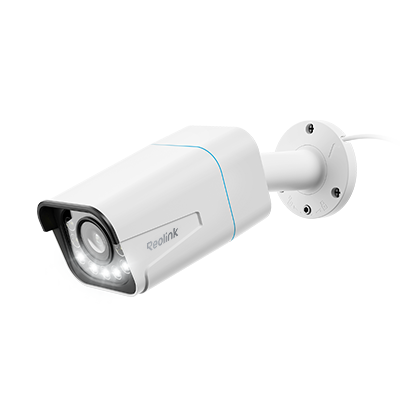
Standard Choice: Reolink RLC-811A
If you need robust, high-resolution security for standard entry points, driveways, or side yards, a classic bullet-style IP camera is the industry baseline.
Despite its powerful spotlight and zoom motor, the RLC-811A runs on the standard IEEE 802.3af (PoE) protocol. It operates at a baseline 48V and consumes a maximum of 12 Watts. This means you can easily power multiple units across a standard, budget-friendly PoE switch without overloading the system.
4K Smart PoE Camera with 5 Spotlights
4K 8MP Ultra HD Day & Night, Person/Vehicle Alerts, 5X Optical Zoom, Two-Way Audio, Built-in Siren, Color Night Vision, Live View Anywhere.
Wide-Angle Choice: Reolink Duo 3 PoE
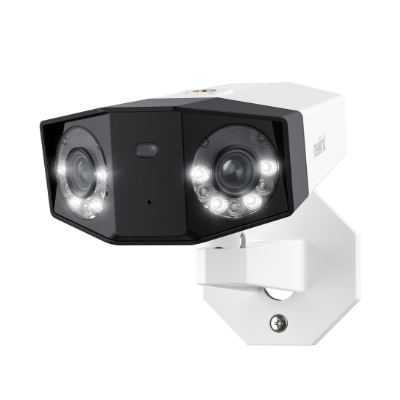
For large commercial storefronts, wide backyards, or complex corner properties, a standard narrow-angle camera leaves dangerous blind spots. A dual-lens setup resolves this limitation.
Processing two high-resolution video streams simultaneously usually demands heavy corporate power infra. However, Reolink optimized the Duo 3 to operate on the standard IEEE 802.3af (Type 1) limit. It pulls a nominal 48V and keeps its total power consumption under 12 Watts. This allows you to upgrade to a massive panoramic footprint without upgrading your existing low-voltage PoE switches.
Groundbreaking 16MP Dual-Lens PoE Camera
16MP UHD, Dual-Lens, Motion Track, 180° Wide Viewing Angle, Power over Ethernet, Color Night Vision.
FAQs
Does PoE support 12V?
While PoE standards like 802.3af, 802.at, and 802.bt specify higher ~48V levels, specialized lower voltage PoE injectors, multi-voltage switches, and splitters do provide stepped-down 12V DC output to selectively power suitable PoE endpoints.
What current and voltage is PoE?
Under the popular 802.3af PoE standard used across verticals, voltage ranges from 44V to 57V DC delivered over Ethernet cable, supporting up to 15.4 watts of power. The maximum permitted current under 802.3af is 350mA, while higher capacity 802.3at and 802.3bt standards facilitate greater power throughput.
Is PoE 12V or 48V?
Standard PoE primarily operates at 44 to 57 Volt DC levels for power capacity ranging from baseline 15.4 watts to the latest 90-watt 802.3bt switches.
Conclusion
We have now covered PoE voltages extensively across relevant standards, device needs, and cable transmission aspects. The key takeaway is that delivering power over Ethernet cabling can involve various DC voltage levels primarily around 48V, with enhanced specifications and equipment now extending up to 90 watts device support. Additional components can also interface 12V PoE endpoints when needed.
Have you ever noticed specific PoE voltage before? Please share your experiences with us in the comment section below! Let's discuss together!
Search
Subscribe for the Latest Updates
Security insights & offers right into your inbox