
Top 10 Most Dangerous Cities in Pennsylvania

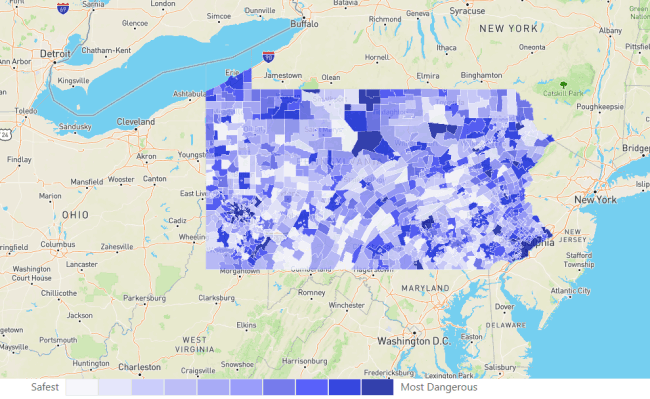
Pennsylvania incorporates both industrially established cities and rural communities, thereby creating rather considerable safety disparities. Some cities are extremely dangerous, and people need to be careful while visiting.
In this article, we will share the most dangerous cities in Pennsylvania. We will share crime stats and a safety guide.
Is Pennsylvania Dangerous?
The short answer is no, Pennsylvania as a whole is not inherently dangerous, but safety is highly dependent on where you live.
Recent data reveals a fascinating paradox in the Keystone State: while public anxiety regarding crime has spiked, actual violent crime numbers—especially homicides—have plummeted to historic lows due to aggressive state public safety investments. However, localized "crime pockets" in urban areas and a rise in property crimes like retail and package theft keep safety at the forefront of residents' minds.
Top 10 Most Dangerous Cities in Pennsylvania
1. Chester
- The Metrics: 16.4 violent crimes and 52.8 property crimes per 1,000 residents.
- The Environment: Economic challenges and drug trafficking networks near the Delaware River waterfront continue to drive an estimated 38% of violent incidents.
Law enforcement has paired a high-tech gunshot detection system (reducing emergency dispatch response times to under 90 seconds in high-risk zones) with community micro-grant programs that have funded hundreds of residential security camera installations in vulnerable neighborhoods.
2. Philadelphia
- The Metrics: 13.9 violent crimes and 48.2 property crimes per 1,000 residents.
- The Environment: While property offenses like vehicle break-ins remain highly problematic near tourist areas, Philadelphia's overall homicide rate has experienced a historic crash to its lowest numbers since the 1960s, down more than 50% from its pandemic peak.
A specialized retail theft task force has focused heavily on organized commercial crime rings, while campus safety collaborations (such as Temple University's boundary lighting and patrol expansion) have driven down hyper-local robberies.
3. McKeesport
- The Metrics: 11.7 violent crimes and 45.3 property crimes per 1,000 residents.
- The Environment: This former steel town faces persistent economic decline and narcotics trafficking along the Monongahela River corridors.
The Mon Valley Initiative has targeted structural safety via blight-removal programs, demolishing vacant, hazardous structures and successfully reducing crimes in those cleared grids by 18%. Concurrently, targeted foot patrols in the Fifth Ward have minimized neighborhood assault numbers.
4. Reading
- The Metrics: 10.4 violent crimes and 43.8 property crimes per 1,000 residents.
- The Environment: Over one-third of the city's total offenses occur along the central downtown corridor and transit hubs, frequently exacerbated by regional opioid distribution networks.
The Reading Police Department’s integration of the ShotSpotter acoustic array has improved shooting localized tracking response times by 40%. A specialized Business Improvement District has blanketed Penn Street with smart security cameras, lowering retail shoplifting.
5. Harrisburg
- The Metrics: 9.6 violent crimes and 41.2 property crimes per 1,000 residents.
- The Environment: Crime remains heavily concentrated in the Allison Hill neighborhood, alongside a multi-year 12% rise in motor vehicle thefts stretching toward the Interstate 83 commuter lines.
Community-driven violence intervention programs actively redirect high-risk individuals into state-funded social services. Meanwhile, downtown commercial revitalization efforts have brought a 15% reduction in property offenses within the Capitol District.
6. York
- The Metrics: 8.9 violent crimes and 39.7 property crimes per 1,000 residents.
- The Environment: Public safety concerns are primarily focused around historical downtown sectors and gang activity lingering along the Philadelphia Street corridor.
The deployment of high-definition security cameras across city parks has successfully curbed after-hours vandalism and trespassing by 21%. Furthermore, a specialized community outreach unit has increased anonymous resident crime tips by 28%.
7. Scranton
-
The Metrics: 8.1 violent crimes and 37.4 property crimes per 1,000 residents.
-
The Environment: Offense spikes in Scranton are highly seasonal, often concentrated near vacant properties (which account for 25% of crime scenes) and the off-campus student housing grids.
A progressive retail security partnership forged along Lackawanna Avenue has driven down retail shoplifting by 19%, while localized lighting infrastructure upgrades throughout the university district lowered nighttime assaults by 17%.
8. Allentown
-
The Metrics: 7.6 violent crimes and 35.9 property crimes per 1,000 residents.
-
The Environment: Hotspots are concentrated near major metropolitan transportation hubs, with vehicle break-ins frequently plaguing multi-level parking garages.
The Allentown Police Department's specialized gang task force has executed dozens of targeted arrests against violent repeat offenders. Additionally, the integration of public-private downtown surveillance networks has significantly accelerated felony case resolutions.
9. Wilkes-Barre
-
The Metrics: 7.0 violent crimes and 34.2 property crimes per 1,000 residents.
-
The Environment: Petty larceny and property crimes are prominent in the downtown entertainment districts, while drug-related offenses remain elevated near the Susquehanna River basin.
The city introduced an automated license plate reader (ALPR) program that successfully intercepted and recovered dozens of stolen vehicles. Targeted community policing has simultaneously improved relationships inside municipal public housing complexes.
10. Johnstown
-
The Metrics: 6.5 violent crimes and 32.8 property crimes per 1,000 residents.
-
The Environment: Long-term safety indicators are heavily impacted by macroeconomic challenges, with localized crime clusters persisting within neighborhoods like Cambria City.
A comprehensive riverfront redevelopment project has transformed former industrial footprints, reducing criminal activity in those revitalized zones by 22%. Active neighborhood watch collaborations have dropped residential burglaries by 16%.
Quick Look at Most Dangerous Cities in PA
Latest Crime Metrics & Trends in PA
1. The Urban vs. Rural Shift
Historically, major cities held the monopoly on violent crime. However, a comprehensive study published by the Center for Rural Pennsylvania revealed that since 2017, the violent offense rate in rural Pennsylvania counties has actually outpaced urban counties ($77$ per $10,000$ residents vs. $65$ per $10,000$ residents, respectively).
2. Plummeting Violent Crime Rates
Statewide gun violence and homicide prevention initiatives have yielded major successes. According to data from the Pennsylvania Commission on Crime and Delinquency (PCCD), Pennsylvania has experienced a 35% reduction in homicides statewide over a multi-year drop. In major cities like Philadelphia, homicides year-to-date dropped remarkably from their pandemic peaks.
3. The Property Crime Problem (Retail & Package Theft)
While violent crime is down, property crime has seen a dramatic uptick. According to the 2026 SafeWise State of Safety report:
-
Package Theft: $44%$ of Pennsylvanians reported experiencing a package theft in the preceding 12 months, making it the second-highest rate in the nation (trailing only New York).
-
Public Perception: Due to the visibility of retail theft rings and package piracy, the percentage of Pennsylvanians who report feeling safe in their state dropped to $40%$, with a staggering $66%$ reporting daily worry about overall security.
Source: NeighborhoodScout
How to Stay Safe in Pennsylvania?
Staying safe in higher-risk areas of Pennsylvania requires a layered security approach that combines physical protection, smart technology, and community cooperation. No single measure is enough on its own—multiple defenses working together provide the strongest protection.
Install Smart Security Cameras with Motion Detection
Security cameras are one of the most effective deterrents against property crime. Modern systems with motion detection, night vision, and real-time alerts help residents monitor activity 24/7 and respond quickly to suspicious events.
Reolink OMVI 3i PoE is a strong option for home protection. It uses a triples-lens system with pan-and-tilt tracking to cover wide outdoor areas. This makes it especially useful for driveways, front yards, and entry points where activity needs to be clearly identified.
Key benefits include:
- Real-time motion alerts
- Wide-area coverage with auto tracking
- Clear night vision for low-light conditions
- Strong deterrent effect for intruders

All-in-one Triple-Lens 180° Panoramic Pan-Tilt Security Camera
10MP Dual-Lens 180° View, 4K 360° Full Coverage, SyncTrack with auto framing & auto tracking, Local Storage (No Monthly Fees), Local AI Video Search.
Improve Outdoor Lighting and Visibility
Well-lit properties are significantly less likely to be targeted. Motion-activated lights help remove dark hiding spots around homes and increase visibility at night.
Recommended improvements:
- Install motion-sensor lights near doors and garages
- Brighten side yards and backyard corners
- Replace dim or broken exterior bulbs immediately
Strengthen Doors and Windows
Physical entry points are the most common targets in residential break-ins. Reinforcing them adds a critical layer of defense.
Effective measures include:
- Installing deadbolt locks on exterior doors
- Adding sliding door security bars
- Using window locks and shatter-resistant film
- Reinforcing door frames and strike plates
Maintain Landscaping to Reduce Hiding Areas
Overgrown shrubs and untrimmed trees can create concealment opportunities for intruders. Keeping outdoor spaces well-maintained improves visibility and reduces risk.
Best practices:
- Trim bushes near windows and entrances
- Keep trees from blocking street or neighbor views
- Avoid tall hedges near access points
Join Neighborhood Watch Programs
Community involvement remains one of the most effective crime prevention strategies. Neighborhood watch programs have been shown to reduce crime rates by 15%–20% in participating areas.
Benefits include:
- Faster reporting of suspicious activity
- Stronger communication between neighbors
- Increased sense of community safety
- Shared awareness of local threats
Build Local Communication Networks
Beyond formal programs, informal communication can also improve safety.
Helpful steps:
- Create group chats with neighbors
- Share alerts about unusual activity
- Coordinate travel or vacation watch support
- Exchange emergency contacts
FAQs
Which city in PA has the highest crime rate?
Chester's 16.4 violent crimes per 1,000 surpass even Philadelphia's worst districts. The West End's abandoned industrial sites facilitate chronic criminal activity.
What is the safest city in Pennsylvania?
Upper Dublin Township (VCR: 0.7) combines affluent demographics with Pennsylvania's most advanced community policing program.
Conclusion
The most dangerous cities in Pennsylvania pose serious but controllable safety issues. Knowing local trends is crucial for protection, from Philadelphia's urban crime hotspots to Chester's industrial decline. Residents may safely navigate these locations and take advantage of everything Pennsylvania has to offer by combining awareness, community participation, and contemporary security solutions.
Search
Subscribe for the Latest Updates
Security insights & offers right into your inbox