
Is Houston, Texas Safe? A Detailed Look at Safety and Crime Rates
Houston's safety isn't a city-wide verdict but a hyper-local reality, changing from one community to the next. However, its crime rates, both property and violent, are higher than the national average.
In this article, we will explain how safe Houston, Texas, is. We will share the recent crime data and other risks of living in the city. We will share some of the safest neighborhoods and some safety tips.
Is Houston, Texas, Safe?
According to the latest data compiled from the FBI data and NeighborhoodScout, Houston's city-wide violent crime rate sits at 11.42 incidents per 1,000 residents. This is significantly higher than both the Texas state average and the national baseline, translating to a 1 in 86 chance of a resident becoming a victim of violent crime. This metric encompasses tracked offenses including homicide, rape, robbery, and aggravated assault.
The city's property crime rate is equally pronounced, tracking at 45.82 incidents per 1,000 residents—more than double the national average (20.70). This statistic reflects a heavy volume of local thefts, burglaries, and motor vehicle thefts.
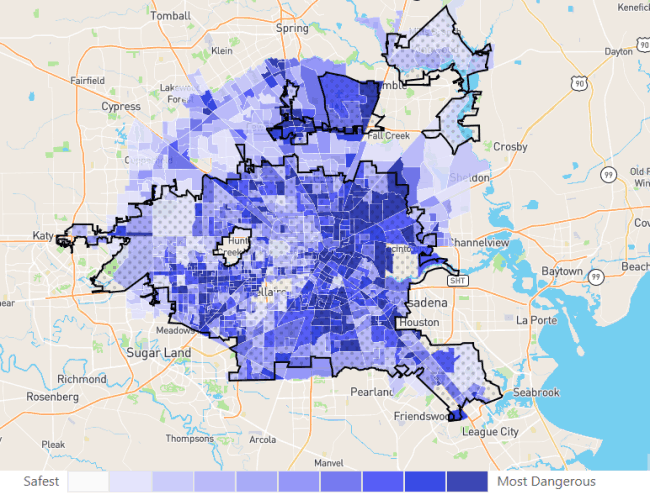
However, it is vital to note that these broad, alarming numbers are not an individualized safety forecast. Houston is a massive, sprawling metropolis, and its city-wide data is a mathematical average heavily skewed by a select few high-crime districts. While high-density hubs or transit areas require heightened situational awareness, many of Houston's premier residential neighborhoods remain exceptionally safe and secure.
How Safe Is Houston, Texas? Crime Rate Breakdown
Data reveals a massive metropolitan area making noticeable strides against violent crime, though it continues to grapple with high property-related offenses. According to the Houston Police Department’s Crime Statistics Reports, Houston violent crime rate dropped by an impressive 18.9%, driven by steep double-digit declines across major categories. Non-violent property crime also trended downward overall by 7.8%.
Despite this highly encouraging downward trajectory, the absolute volume of offenses across a population of over 2.3 million people remains heavily pronounced.
Annual Crime Volume Breakdown
Below is the latest annual breakdown of total reported offenses across the city of Houston:
Violent Crimes
-
Homicides: 268 incidents (A substantial 19% drop from the previous year)
-
Aggravated Assaults: 15,306 incidents
-
Robberies: 4,983 incidents
-
Sexual Assaults: 1,380 incidents
Property Crimes
-
Larceny-Theft: 92,525 incidents
-
Shoplifting & Auto-Theft (BMV): 31,608 incidents
-
Motor Vehicle Theft: 12,890 incidents
-
Burglaries: 11,255 incidents
While local law enforcement initiatives tracked via the Texas UCR Crime Data Portal have successfully pushed homicides, sexual assaults, and robberies to lower levels, the sheer density of property crime remains the primary everyday challenge.
5 Safest Neighborhoods in Houston, Texas
The following neighborhoods consistently report violent and property crime rates far below the distressing city averages.
1. West University Place
"West U" operates with its own police force, resulting in exceptional safety metrics. This is a family-centric community creating a tightly-knit and secure environment.
-
Violent Crime Rate (VCR): Negligible.
-
Property Crime Rate (PCR): A fraction of Houston's average.
-
Key Safety Pillars: * High property values, active neighborhood watches, and rapid police response times
2. Memorial
The Memorial area boasts a culture of resident engagement that deters criminal activity through natural surveillance and community cohesion.
-
Violent Crime Rate (VCR): Well below 2 per 1,000 residents.
-
Property Crime Rate (PCR): Remarkably low.
-
Key Safety Pillars: * Secluded, winding streets, high socioeconomic profile
3. Bellaire
Another incorporated city within Houston, Bellaire's small-town governance, excellent municipal services, and community-focused events foster a strong sense of ownership and security among its residents.
-
Violent Crime Rate (VCR): Nearly 1 per 1,000.
-
Property Crime Rate (PCR): Under 15.
-
Key Safety Pillars: Independent services
4. Tanglewood
Tanglewood's affluent, wooded setting supports active homeowner associations that enforce security standards and maintain vigilant neighborhood networks.
-
Violent Crime Rate (VCR): Virtually non-existent.
-
Property Crime Rate (PCR): Kept extremely low.
-
Key Safety Pillars: * Geographic seclusion and private security patrols
5. Clear Lake City
-
General Description: This master-planned community reports a family-oriented suburban layout that discourages transient crime.
-
Violent Crime Rate (VCR): Consistently below 3 per 1,000.
-
Property Crime Rate (PCR): Manageable and typical of a stable suburb.
-
Key Safety Pillars: * NASA-adjacent professional community and organized neighborhood watches
Source: Houston Neighborhoods & Map
What Are Other Challenges of Living in Houston, Texas?
Beyond crime statistics, Houston presents distinct environmental and infrastructural challenges that directly impact safety, property, and quality of life.
-
Severe Flooding: The city's flat topography and aging drainage systems make many neighborhoods highly prone to destructive flooding during heavy rains.
-
Hurricane & Tropical Storm Threat: The annual Gulf Coast hurricane season (June-November) brings risks of high winds, storm surge, and prolonged power outages.
-
Extreme Heat & Humidity: Summer heat indices regularly exceed 100°F (38°C), posing serious health risks like heatstroke, especially for vulnerable populations.
-
Poor Air Quality: Industrial activity and traffic contribute to ozone pollution, which can exacerbate respiratory conditions.
-
Traffic Congestion & High Crash Rates: Extensive highway networks see major congestion and a high frequency of serious automotive accidents.
-
Power Grid Vulnerability: The regional grid (ERCOT) has proven unstable during extreme weather events, resulting in unpredictable, widespread outages.
Key Safety Tips for Living in & Visiting Houston, Texas
Vehicle & Property Defense
-
Enforce a "Zero-Visibility" Car Policy: Property crime is Houston’s most common offense. Remove every single item from your vehicle's cabin and trunk every time you park—especially near major transit hubs like the METRORail Red Line, which tracks high vehicle-vandalism rates. A single visible charging cable or shopping bag is an open invitation for a break-in.
-
Upgrade Home Surveillance & Perimeter Lighting: Actively deploy motion-sensor lighting and robust deadbolts. For comprehensive home tracking, smart fixtures like the Reolink OMVI 3i PoE offer ultimate clarity, auto tracking, and wide-angle coverage to completely eliminate property blind spots.

All-in-one Triple-Lens 180° Panoramic Pan-Tilt Security Camera
10MP Dual-Lens 180° View, 4K 360° Full Coverage, SyncTrack with auto framing & auto tracking, Local Storage (No Monthly Fees), Local AI Video Search.
2026 FIFA World Cup Matchday Security
-
Leave Drones at Home (Strict No-Fly Zones): The FAA, FBI, and Texas DPS have officially designated Houston Stadium, the FIFA Fan Festival zones, and all surrounding event spaces as strict No Drone Zones. Law enforcement is utilizing specialized federal counter-UAS radio-frequency tech to intercept, confiscate unauthorized drones, and issue massive federal fines.
-
Adhere to Stadium Bag Regulations: Expect airport-style security, metal detectors, and an absolute zero-tolerance policy for aggressive behavior. Leave backpacks at home; the venue strictly enforces a clear-bag policy.
-
Vet Your Transit & Parking: If you are driving to matches, use only official, secured, and vetted stadium-perimeter parking lots. Avoid unofficial off-site lots, which are heavily targeted by local theft crews. If utilizing rideshare apps or the METRORail Red Line, arrive at least 2 hours before kickoff to smoothly clear the heavily reinforced security checkpoints.
Climate & Emergency Preparedness
-
Survive the Brutal Summer Heat Index: With World Cup matches scheduled during the peak summer months, Houston's humidity pushes the outdoor heat index between 105°F and 110°F (40°C–43°C). Schedule outdoor activities for early morning or late evening, constantly drink water (aim for 8–12 ounces every hour you are outside), and aggressively apply SPF 30+.
-
Maintain a Severe Weather Go-Bag: Keep a durable bag fully stocked with water, non-perishable food, a flashlight, batteries, backup external phone chargers, key personal documents, and vital medications. Ensure this kit is ready and accessible from June through November (the Atlantic Hurricane and tropical storm season).
Situational Awareness & Connectedness
-
Stick to Populated, Well-Lit Corridors: Plan transit routes entirely ahead of time through verified safe zones, and completely avoid unfamiliar high-crime districts. Always share your live digital location with family members or travel companions when moving through crowded fan march routes or downtown entertainment hubs.
-
Leverage Local Real-Time Alert Networks: Actively download the FIFA World Cup 2026 Tournament App for immediate event logistics, and use neighborhood platforms like Nextdoor alongside the Houston Police Department’s community portals to receive localized security alerts. If you spot unattended packages or suspicious activity at any event site, immediately report it to event staff or law enforcement.
FAQs
Why are people moving away from Houston?
People are moving away from Houston mainly due to climate risks, rising costs, and lifestyle concerns. Frequent flooding and hurricanes can lead to property damage and higher insurance premiums, especially in vulnerable areas. Traffic congestion and long commutes are also common frustrations in the city’s car-dependent layout.
In addition, the hot and humid climate increases living costs and reduces overall comfort for some residents. While Houston remains attractive for jobs and affordability, some people choose to leave in search of lower-risk environments, better walkability, or a slower pace of life.
Is it safe to walk around Houston?
Safety is precinct-specific. Walking is generally safe in active, populated districts like Downtown, Midtown, or The Heights during daylight hours. Increased caution is advised at night, and walking in isolated or poorly lit areas should be avoided.
Which is nicer, Dallas or Houston?
Recent comparative crime data indicates Dallas generally has a lower violent crime rate than Houston. Both cities, however, contend with significant and comparable property crime challenges.
Conclusion
The crime rate of Houston, Texas, is high. But the crime is mostly limited to certain areas. Many neighborhoods are safe both against crime and the climate. You can opt for a safe area for living and also practice the safety measures to keep yourself and your family out of the crime news.
Search
Subscribe for the Latest Updates
Security insights & offers right into your inbox